
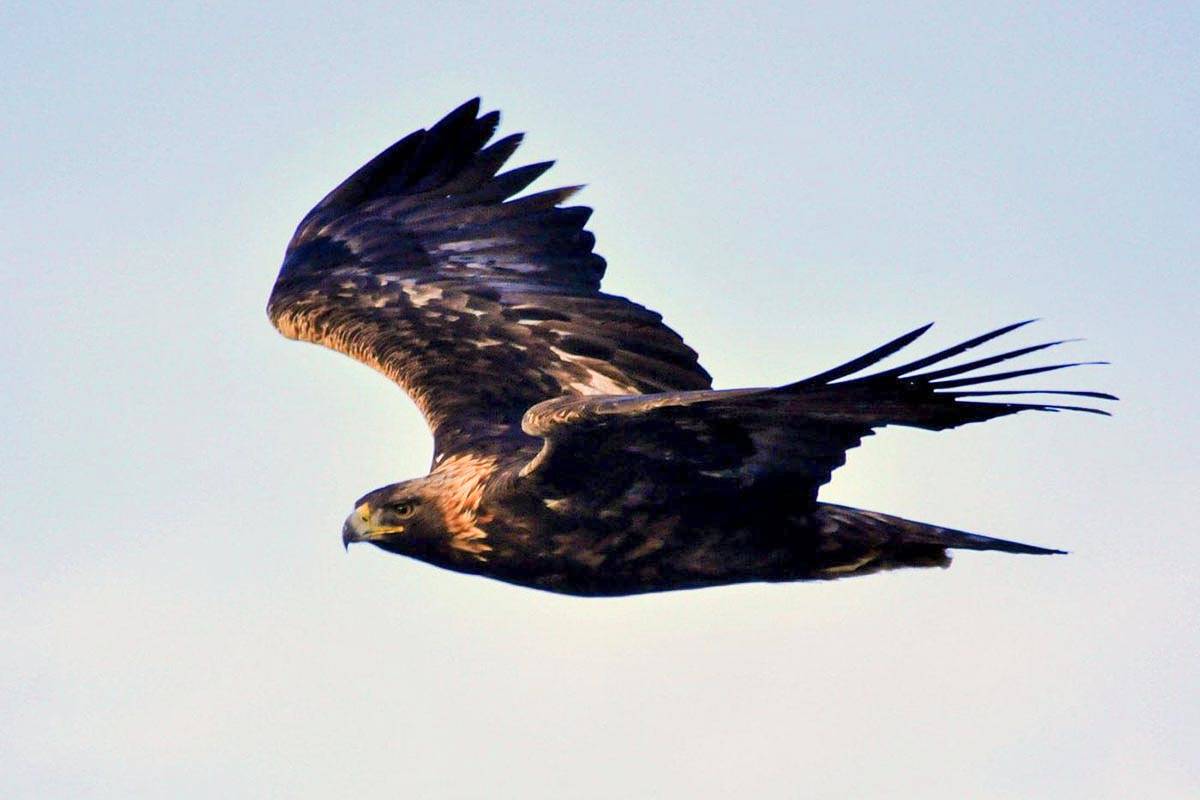
While Juneau is certainly more familiar with bald eagles, golden eagles are also widespread across Alaska, concentrated in the interior and migrating south seasonally.
But how many of them are there?
“There are golden eagles that breed here,” said Stephen Lewis, a scientist with Fish and Wildlife Service. Lewis gave a presentation on golden eagles at University of Alaska Southeast on Thursday evening. “They certainly migrate through here.”
That’s one of the questions Lewis seeks to answer, conducting observations, placing trackers, and counting birds and nests over the past decade. Some of the trackers use a satellite network, while others link to the cell network when available. Trackers help locate nests and migrations routes, Lewis said.
“This is more like a true eagle, and the only true eagle in North America and Alaska,” Lewis said.
The golden eagle, or Aquila chrysaetos, are known as true eagles, and are distinct in their classification from bald eagles. Bald eagles, Haliaeetus leucocephalus, are part of a group of birds known as sea eagles, and belong to a different genus than golden eagles.
[Rare raptor rescued from rainy roadside]
Golden eagles are distinguished from bald eagles by their brown heads and tails, but may be more easily confused as juveniles. Both juvenile bald eagles and golden eagles are largely brown as juveniles, but bald eagles typically have white streaks for the lengths of their wings, whereas golden eagles will have large white patches concentrated on their “palms” on the underside of their wings.
Golden eagles typically don’t nest in Juneau, said Kathy Benner, the manager of the Juneau Raptor Center, in a previous interview. They prefer more open spaces for their hunting than Juneau’s mountains and waterways, and as a result, there’s only a few that spend extended time here. They’re the most widespread eagle on the planet, distributed across the entire northern hemisphere.

Stephen Lewis, a researcher with U.S. Fish and Wildlife Service, gives a presentation on golden eagles in Alaska at University of Alaska Southeast, Jan. 9, 2020. (Michael S. Lockett | Juneau Empire)
The estimated numbers of golden eagles in Alaska are based on guesswork, and vary wildly based on the model one uses, Lewis said. There might be more than 5,000 or as few as barely 1,000, depending on their behavior and decline of population, according to Lewis’ presentation. Golden eagles take years to reach mating age, and may mate for life.
“We went to the Mentasta Mountains to investigate a potential count site and maybe capture some eagles in the spring,” Lewis said. “Carol saw 1,364 golden eagles fly by in nine days.”
Lewis said a number of factors are contributing to the decline of golden eagle populations across Alaska and the continent. What percentage of the global population travels through Alaska is unknown. Power lines, habitat loss and contaminants in their food are all factors. Lewis said that leftover lead from rounds used to shoot vermin is a major problem, as the eagles scavenge the meat and get sick or die from the lead content.
“Golden eagles are one of the most frequent predators of baby caribou,” Lewis said. “They’re also eating things like waterfowl.”
Eagles also eat prairie rodents like ground squirrels and the like, but are less inclined than bald eagles or other sea eagles to eat fish.
Lewis will continue to work to identify the habits and habitats of these majestic birds, but signs of decline are buoyed by some of the findings he and others have developed.
“Obviously there’s some big gaps that are probably chock full of golden eagles,” Lewis said. “There’s probably quite a lot more eagles in Alaska than we thought.”
• Contact reporter Michael S. Lockett at 757-621-1197 or mlockett@juneauempire.com.
