
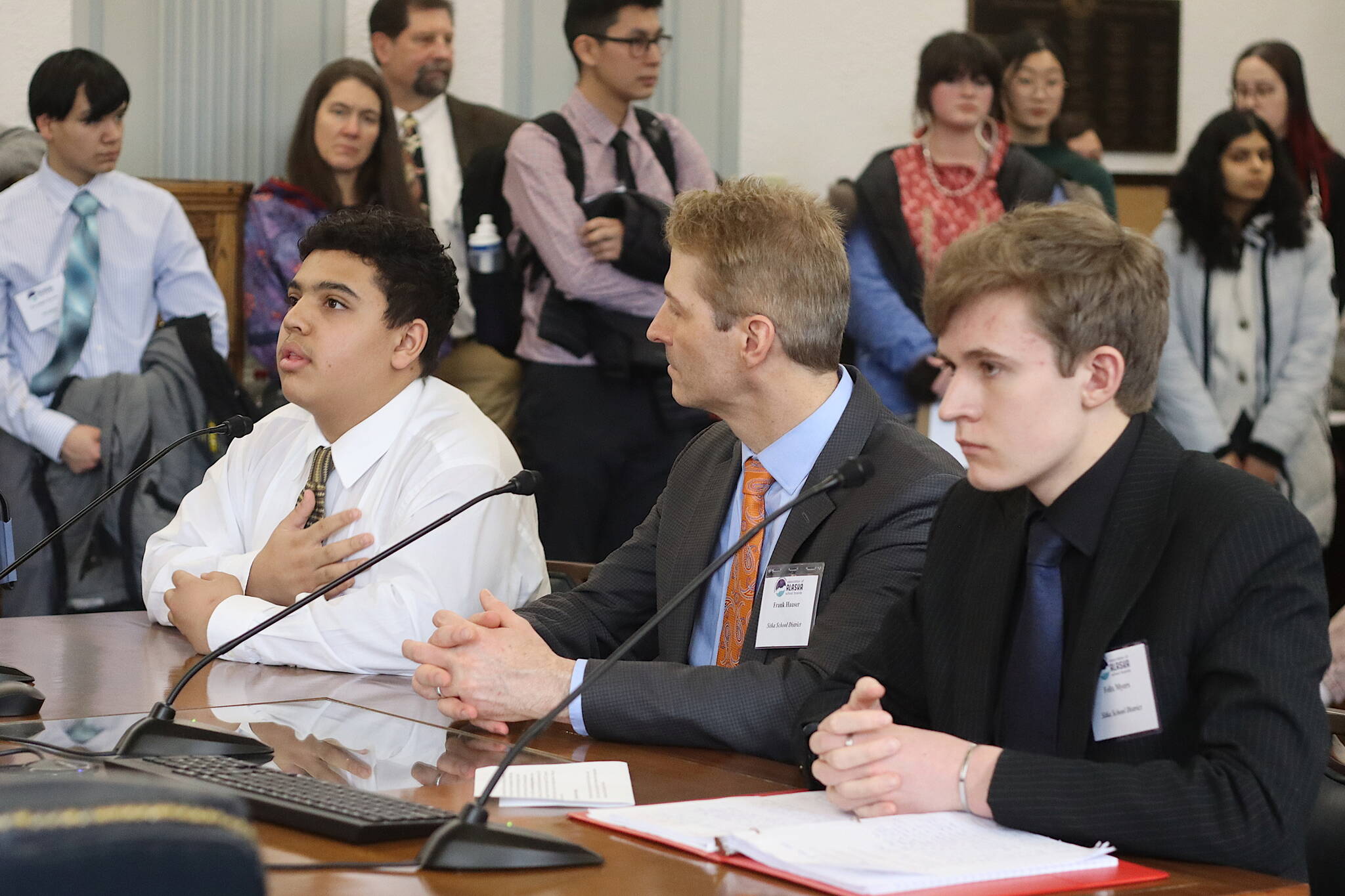
Edward Richards, left, a high school student in the Sitka School District, talks about the lack of mental health services in Alaska’s public schools as part of the testimony also offered by district Superintendent Frank Hauser, center, and student Felix Myers during a Senate Education Meeting on Monday at the Alaska State Capitol. The committee is proposing a 17% increase in the state’s school funding formula, which was remained essentially flat since 2017. (Mark Sabbatini / Juneau Empire)

Edward Richards, left, a high school student in the Sitka School District, talks about the lack of mental health services in Alaska’s public schools as part of the testimony also offered by district Superintendent Frank Hauser, center, and student Felix Myers during a Senate Education Meeting on Monday at the Alaska State Capitol. The committee is proposing a 17% increase in the state’s school funding formula, which was remained essentially flat since 2017. (Mark Sabbatini / Juneau Empire)

School’s in at the Capitol

Students and education leaders from around state make case for more classroom cash.

Students and educators from around the state heard plenty of favorable remarks from lawmakers about boosting school funding and services as they wandered throughout Alaska State Capitol on Monday, but not surprisingly are still offering a grade of incomplete since finals are far away.

A proposal boosting per-student school funding by about 17% was introduced last week by state Senate leaders, which the governor and state House have responded to by stating they will likely support an increase — but perhaps a lesser amount and with performance accountability provisions in the wake of standardized test scores that are among the nation’s lowest. The base student allocation that determines per-student funding has remained essentially unchanged since 2017, resulting in an effective loss of what schools can spend due to inflation.

More than 50 of the visiting students and staff filled the benches and stood along walls on both sides of the room during a Monday afternoon meeting of the Senate Education Committee, which introduced last week’s funding increase in Senate Bill 52. It adds $1,000 to the current $5,960 BSA (which is $30 higher this year than previous years dating back to 2017), with no other provisions such as annual adjustments for inflation or accountability measures in the initial draft leaders called the “beginning of the beginning” of discussions this session.

A Legislative Finance Division memo released last week shows an increase of about $1,200 would be needed during the next fiscal year for the BSA to be worth the same as in 2017 when adjusted for inflation. Felix Myers, one of two Sitka School District students testifying during Monday’s hearing by noting an increase of about $2,200 would be needed to match school funding levels in 2009.

“The question we are asking ourselves is not ‘Do we fully fund education?’” he said. “It’s ‘How much do we underfund education by?’”

Republican Gov. Mike Dunleavy, whose proposed budget for next year keeps the BSA at the same level, said when he released the spending plan it was a starting point and an increase negotiated with the legislature was likely. Dunleavy spokesman Jeff Turner essentially repeated that sentiment in an email to the Anchorage Daily News after the senate bill was introduced last week, the governor “acknowledges that an increase in education funding this year is appropriate” without specifying an amount the governor might support — but that he wants accountability measures included.

Opposition to the bill introduced in the Senate, which has a majority of nine Democrats and eight Republicans, is expected from the Republican-led House majority. Rep. Justin Ruffridge, a Soldotna Republican who co-chairs the House Education Committee, has previously stated he’s support a BSA increase of $250 to $750, but last week also told the Anchorage Daily News accountability provisions need to be part of the discussion.

Among the most notable opponents outside the Capitol of education funding increases is the Alaska Policy Forum, a conservative, nonprofit think tank based in Anchorage that asserts total per-pupil revenue has grown by 32% over the past two decades when all local, state and federal funding sources are included. The organization also favors “competition” measures such as vouchers, with Dunleavy a potential ally as his actions have included declaring Jan. 22-28 “School Choice Week.”

Senators speaking in favor of the formula increase bill have acknowledged it may mean reducing the Permanent Fund dividend, which is one of the early lines of attack by opponents. That’s frustrating to Peter Hoepfner, a Cordova School District Board of Education member since 2005, who said lawmakers from both parties offered encouraging words during his visits around the Capitol on Monday, but he doesn’t know if that will translate into actual support for a formula funding increase.

“It’s just painful to see education tied to the PFD,” he said.

• Contact reporter Mark Sabbatini at mark.sabbatini@juneauempire.com

More in News

A house on Telephone Hill stands on Dec. 22, 2025. (Mari Kanagy / Juneau Empire)
Court sets eviction date for Telephone Hill residents as demolition plans move forward

A lawsuit against the city seeks to reverse evictions and halt demolition is still pending.

Juneauites warm their hands and toast marshmallows around the fire at the “Light the Night" event on winter solstice, on Dec. 21, 2025. (Mari Kanagy / Juneau Empire)
A mile of lights marked Juneau’s darkest day

Two ski teams hosted a luminous winter solstice celebration at Mendenhall Loop.

A Capital City Fire/Rescue truck drives in the Mendenhall Valley in 2023. (Clarise Larson / Juneau Empire file photo)
Juneau man found dead following residential fire

The cause of the fire is still under investigation.

CBJ sign reads “Woodstove burn ban in effect.” (City and Borough of Juneau photo)
Update: CBJ cancels air quality emergency in Mendenhall Valley Sunday morning

The poor air quality was caused by an air inversion, trapping pollutants at lower elevations.

A dusting of snow covers the Ptarmigan chairlift at Eaglecrest Ski Area in December 2024. (Eaglecrest Ski Area photo)
Update: Waterline break forces closure at Eaglecrest Friday, Saturday

The break is the latest hurdle in a challenging opening for Juneau’s city-run ski area this season.

Patrick Sullivan stands by an acid seep on July 15,2023. Sullivan is part of a team of scientists who tested water quality in Kobuk Valley National Park’s Salmon River and its tributaries, where permafrost thaw has caused acid rock drainage. The process is releasing metals that have turned the waters a rusty color. A chapter in the 2025 Arctic Report Card described “rusting rivers” phenomenon. (Photo by Roman Dial/Alaska Pacific University)
Ecosystem shifts, glacial flooding and ‘rusting rivers’ among Alaska impacts in Arctic report

NOAA’s 2025 report comes despite Trump administration cuts to climate science research and projects

The U.S. Capitol in Washington, D.C., on Oct. 1, 2025. (Photo by Jennifer Shutt/States Newsroom)
Moderate US House Republicans join Dems to force vote on extension of health care subsidies

WASHINGTON — Republican leaders in the U.S. House will face a floor… Continue reading

The National Weather Service Juneau issues a high wind warning forDowntown Juneau, Southern Douglas Island and Thane due to increased confidence for Taku Winds this afternoon. (National Weather Service screenshot)
Taku winds and dangerous chills forecast for Juneau

Gusts up to 60 mph and wind chills near minus 15 expected through the weekend.

Chloe Anderson for the Juneau Empire
Fallen trees are pictured by the Mendenhall river on Aug. 15, 2025. Water levels rose by a record-breaking 16.65 feet on the morning of Aug. 13 during a glacial outburst flood.
Lake tap chosen as long-term fix for glacial outburst floods

The U.S. Army Corps of Engineers and Juneau leaders agreed on the plan.

Most Read