
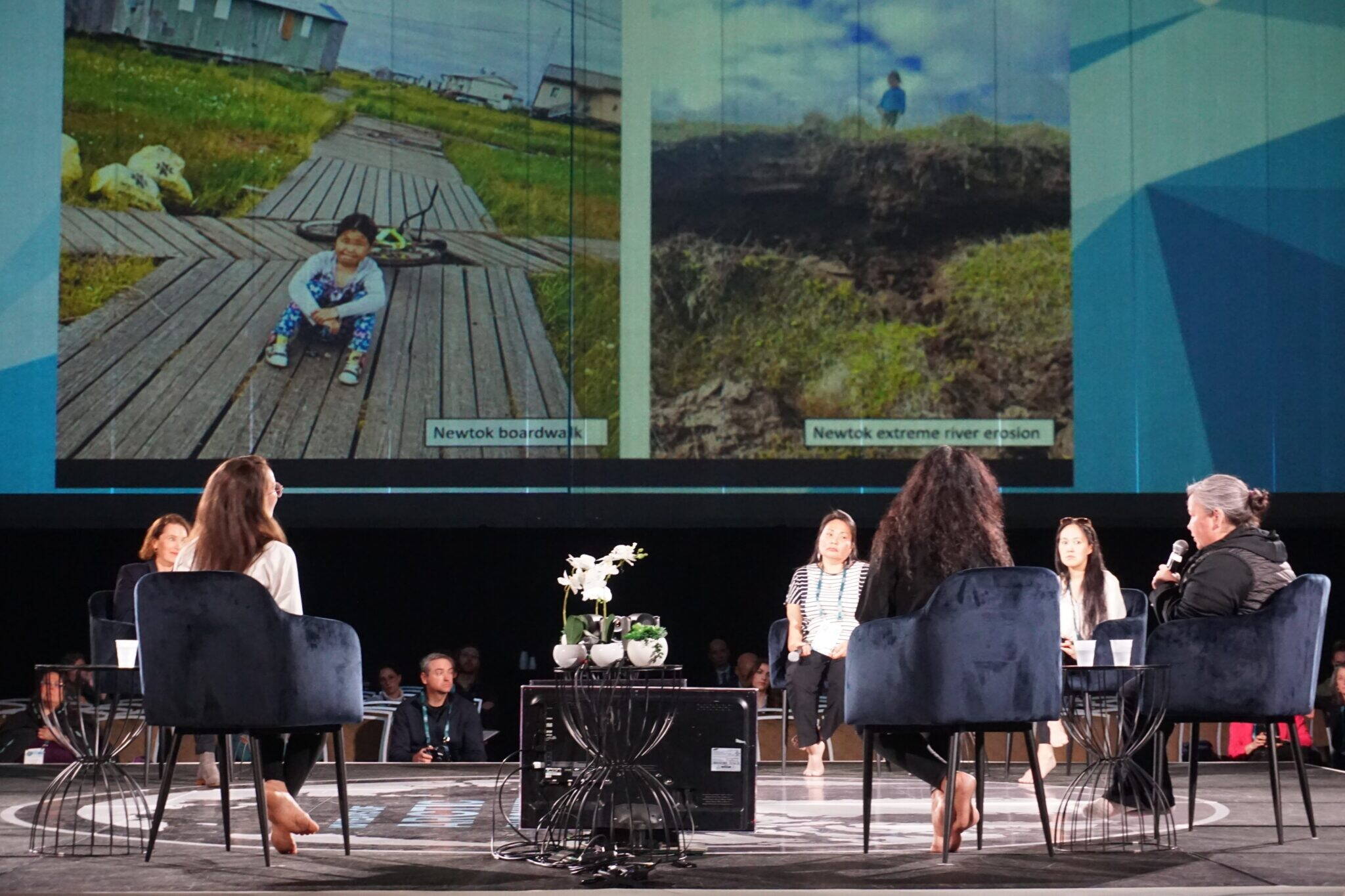
The Yup’ik village of Newtok, perched precariously on thawing permafrost at the edge of the rapidly eroding Ninglick River, is the first Alaska community to begin a full-scale relocation made necessary by climate change.
Still, the progress of moving to a new village site that is significantly outpacing relocation efforts at other vulnerable Alaska communities, remains agonizingly slow, say those who are in the throes of the transformation.
“There is no blueprint on how to do this relocation,” said Carolyn George, one of those still living in Newtok. “We’re relocating the whole community to a whole different place, and we did not know how to do it. And it’s been taking too long — over 20 years, I think.”
George, who works at the Newtok school, was one of the self-described “Newtok mothers” who made comments at a panel discussion at the recent Arctic Encounter Symposium in Anchorage. The river waters, once at least a mile away, have edged closer and closer, and the village, once sitting high on the landscape, continues to sink as that permafrost thaws, she said.
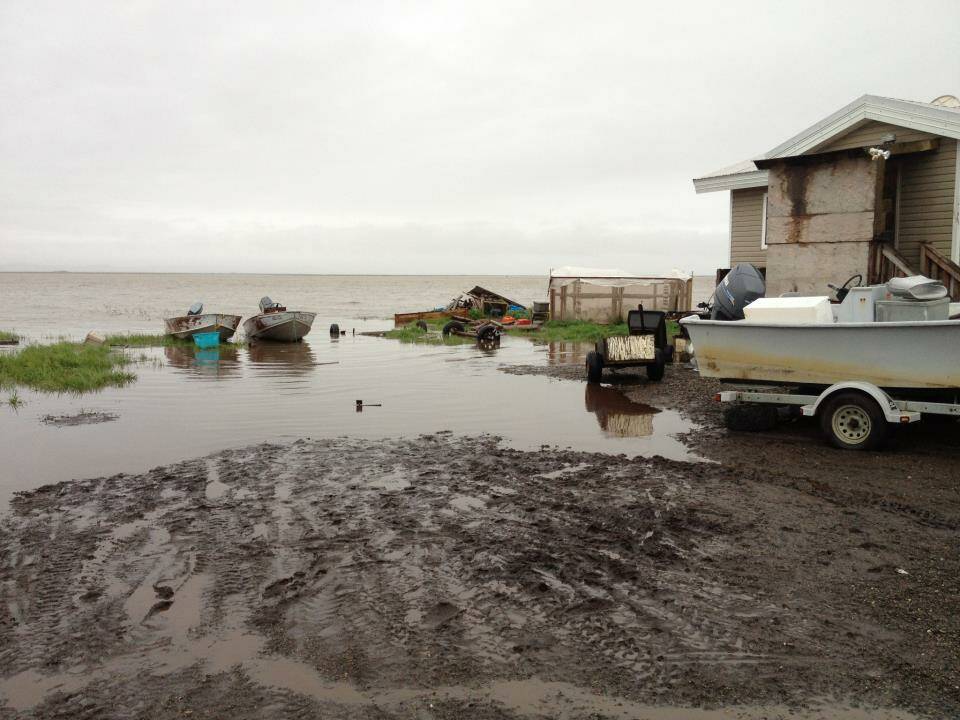
High water laps at the Kivalina shoreline in 2012. The Inupiat community on the Chukchi Sea coast is battered by erosion, storm surges and other effects of climate change. A relocation plan is in the works. (Photo provided by Alaska Division of Community and Regional Affairs)
Plans to move Newtok started to solidify in 2006 with the formation of the local-state-federal Newtok Planning Group, but that followed many years of debate and study that led to the decision to relocate. according to the Alaska Division of Community and Regional Affairs. The new site, about 9 miles away on the south side of the Ninglick River, is called Mertarvik, meaning “getting water from the spring.”
In 2019, the first Mertarvik residents settled into their new homes. As of now, more than half of the residents have moved to Mertarvik.
The latest count is 220 in Mertarvik and 129 still at Newtok, said Christina Waska, the relocation coordinator for the Newtok Village Tribal government.
The goal is to have everyone in Mertarvik by the fall, even if that means some people will be living in temporary housing, like construction work camps.
“Our ultimate goal is to not leave anyone behind,” she said.
With a single local government, a single Tribal government and unified services like mail delivery, Newtok and Mertarvik technically make up a single community. But often it does not feel that way.
George is among those coping with a sense of limbo.
Her five daughters and their father have moved to a new house in Mertarvik, but she remains in Newtok because of her job. That is a hardship, she said. “Being alone, I get anxiety, and I miss my girls, you know. Especially at night,” she said.
And the school where she works, and which is set to be demolished this summer, is in dire shape.
The four classrooms are heated by a small generator. There is no food cooked on-site for the kids. There is no plumbing – a situation that, for now, is being addressed with a “bathroom bus” that shuttles kids to their homes as needed.
Conditions are notably better at Mertarvik, said speakers at the conference.
Lisa Charles, another panel member, described the difficult conditions her family left behind in Newtok. The family was packed into a too-small, two-bedroom house with thawing permafrost below and mold growing inside. It took a toll on their physical well-being, she said.
But once the family settled in at Mertarvik, things improved, she said.
“After moving over to the new village site, we noticed all of our health improved, especially for my daughter that grew up with asthma,” Charles said. “After we moved over to our new home, she grew out of her asthma problem.”
There have been complications, like power outages affecting the school, attributed to demand that outstripped capacity.
Among the challenges is a timing mismatch. Waska and new Tribal administrator Calvin Tom started their jobs only recently, too late for them to place summer barge orders, and as a consequence, no building materials are expected to be barged in 2024 and no new houses will be built this summer in Mertarvik, Waska said.
There is still plenty of work to be done aside from construction, she said. And construction is seen as a process that will continue long after all residents are settled at Mertarvik, she added.
“It’ll never be done. If you look at every village, even Anchorage, Fairbanks, it’s always under construction,” she said.
While Newtok is the first Alaska village to relocate, others will follow.
Even two decades ago, 31 communities were identified as facing imminent threats that would make their locations potentially unlivable in the near future. Of those, nearly half were planning or considering some form of relocation.
Next after Newtok to relocate entirely may be Kivalina, an Inupiat village on the Chukchi Sea coast that is facing numerous climate stressors along with rapid erosion. The community now has a new evacuation road, completed in 2021, that can better enable movement to a new site.
But plans hit a snag after a study by the U.S. Army Corps of Engineers revealed that the originally chosen relocation site, called Kiniktuuraq, is also vulnerable to the same climate change stressors that are expected to make Kivalina uninhabitable in the relatively near future.
Napakiak, a Yup’ik village perched on a section of eroding land along the Kuskokwim River that is being quickly eaten away in large chunks, has also made progress. The community is now engaged in a partial relocation, a strategy known as “managed retreat.” Some families have already moved from vulnerable sites to safer ground upland, and there is state money available for a new school to replace the erosion-threatened building.
There is no single source of money to pay for relocation work, even for the Newtok-Mertarvik transformation, the most advanced of the projects.
The Newtok-Mertarvik move has been funded through various allocations over time. Among the recent infusions were $25 million through the Infrastructure Investment and Jobs Act and another $6.7 million from the Federal Emergency Management Agency. Napakiak received a similar $25 million grant through the infrastructure law and a $2.4 million infusion earlier this year from FEMA.
The combined costs of full and partial relocations for all the villages that need them are expected to be staggering.
Of 144 Alaska Native villages with damages from flooding, erosion, permafrost thaw or some combination of those impacts, costs for protecting infrastructure are expected to mount to $3.45 billion over the next 50 years, according to a 2020 report by the U.S. Bureau of Indian Affairs. An additional $833 million is needed to protect the hub communities of Utqiagvik, Nome, Bethel, Kotzebue, Dillingham and Unalaska, said the 2020 BIA report, which was produced in cooperation with the Denali Commission and other agencies.
The sources for the needed funding remain unclear, and bureaucratic hurdles are delaying progress toward necessary relocations, a recent report from the Alaska Native Tribal Health Consortium said.
There are fundamental obstacles in rural Alaska that make it extremely difficult for Alaska communities to work through the federal system, said Jackie Qataliña Schaeffer, ANTHC’s director for climate initiatives.
She cited an example during the Arctic Encounter Symposium forum. “Every federal agency requires you to have some type of reporting and in most of the cases you have to apply for the federal funding online. If you don’t have stable internet, how do you do that?” she said.
The ANTHC report recommends an overhaul to streamline a process that is a poor fit for remote Alaska villages.
In some ways, the Newtok-Mertarvik residents said, their split community has successfully overcome difficult challenges, making their relocation a possible example for other threatened communities in Alaska and elsewhere in the United States.
But those successes can also be bittersweet.
Relocation is absolutely necessary because the old village site is now an unhealthy place to live, Waska said. Nonetheless, she feels conflicted about abandoning the hometown she loves.
“Newtok is my home. It’s kind of sad. It kind of breaks my heart that Newtok is no longer going to be there,” she said.
• Yereth Rosen came to Alaska in 1987 to work for the Anchorage Times. She has reported for Reuters, for the Alaska Dispatch News, for Arctic Today and for other organizations. She covers environmental issues, energy, climate change, natural resources, economic and business news, health, science and Arctic concerns. This story originally appeared at alaskabeacon.com. Alaska Beacon, an affiliate of States Newsroom, is an independent, nonpartisan news organization focused on connecting Alaskans to their state government.
