
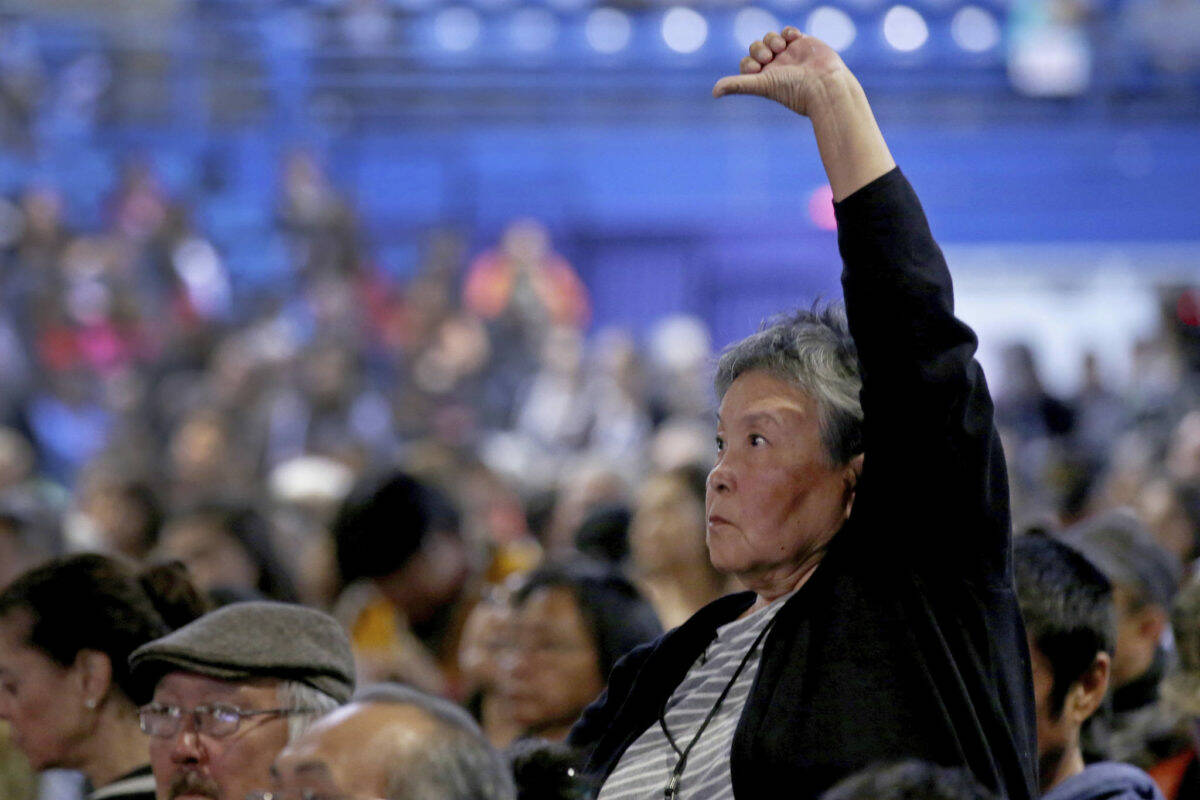
The Alaska Federation of Natives’ annual convention is Dec. 13-14, this year, and both days are packed full of high-profile speakers and panels discussing a range of issues facing the state’s indigenous peoples.
This year’s convention will look back on 50 years of the Alaska Native Claims Settlement Act, the legislation which created Alaska’s Native Corporations. According to the organization’s website, AFN began in 1966 with 17 Native organizations coming together to discuss Alaska Native aboriginal land rights and spent its early years helping to establish the corporation mandate by the act.
Since then, the organization has become a powerful unifying voice for the interests of Alaska Natives, said AFN co-chair Joe Nelson, and the convention is able to bring national attention to those issues.
“Relationships are key,” Nelson, who’s also board chair of Sealaska, Corp, said. “Administrations switch every four years, with AFN, it stays constant. I think it’s that continuity and the relationships that make the difference.”
The convention regularly features addresses from the governor and Alaska’s congressional delegation, as well as other state and national leaders. This year will feature an address from Interior Secretary Deb Haaland, the nation’s first Indigenous person to hold that office. This year’s convention will also feature a panel discussion among U.S. military officials regarding Alaska’s strategic position.
According to Nelson, issues discussed at the convention are meant to be statewide in nature, which he said helped create a sense of unity among Native groups, and a major priority was simply protecting the Alaska Native way of life.
“We’re all very focused on is just protecting our way of life, which means better management of our fish and seafood,” Nelson said. “The whole management regime needs to get better and empowering local Indigenous folks is a way to do that.”
Bringing Indigenous people into conversations was something Central Council of the Tlingit and Haida Indian Tribes of Alaska President Richard Chalyee Éesh Peterson said the annual AFN convention was good at doing.
[Health officials: Youth mental health issues, suicides worsened by pandemic]
“Tlingit and Haida, as a large regional tribe, has a lot of that ability on our own but when we’re on the same page it’s a strong voice,” Peterson said.
Alaska’s elected leaders have promoted its strategic position in the world and Peterson said the military’s presence at the convention was an opportunity to bring indigenous voices to that conversation.
“Alaska is a strategic location for the US military, it should be inclusive and the tribes and the corporations should be a part of the discussion,” Peterson said of strategic efforts in the state.
In addition to U.S. military presence, Alaska’s elected officials have touted the state’s mineral resources as a strategic asset as well. Sen. Lisa Murkowski, R-Alaska, who’ll speak to the convention Monday afternoon, has said she was able to secure funding in the recent infrastructure bill to help develop the state’s critical minerals.
Peterson said those things needed to take Alaska Native concerns into account.
”We have to have these conversations and we have to be at the table,” Peterson said. “We need to here. Maybe this resource extraction is important. but the voice of our Native people needs to be there suggesting how it can be better.”
Nelson said their presence at the convention showed U.S. military leaders recognized the value Iindigenous people have to offer and said military officials have been working on that effort for several years now.
“Some of the best ways to protect this place is to know the people that live there,” Nelson said.
Looking forward
Monday and Tuesday are filled with speeches and panels starting at 9 a.m. both days and ending in the evening. Peterson will be part of a panel to discuss a ballot initiative currently circulating advocating for state recognition of the state’s 229 already federally recognized tribes. Speaking to the Empire by phone Thursday, Peterson said AFN’s active membership made it a powerful platform to move Native issues forward and like Nelson cited the convention’s ability to draw state and federal attention.
In addition to hearing Haaland speak, Peterson said he was eager to hear discussions on better governance, voting rights and an update from a working group on missing and murdered Indigenous women.
This year’s theme is “ANCSA at 50: Empowering Our Future,” and Peterson said it was fortunate that many of the leaders who helped guide that process were still alive to give their input.
“I want to see AFN be the platform to be better relatives between our tribes and our corporations,” Peterson said.
When ANCSA was being formalized in the 1970s, there were many Alaska Natives serving in the U.S. military were left out of the settlement and have been advocating for their own payments for years. Nelson said he was eager to see an update on that issue, as well as a panel on the future of education.
“The word transformation sometimes gets overused,” Nelson said. “But with the pandemic and so many other things, our budget issues have gotten to the point where folks are ready for a transformation. A generational transformation won’t happen without education.”
The convention will be held remotely for the second year in a row, which both Peterson and Nelson noted they believed was necessary considering the ongoing COVID-19 pandemic.
“There’s a sense of anticipation and hope about doing this in person next year,” Nelson said. “We’re doing things the best we can virtually and looking forward to when we can all get together.”
How to watch
The convention can be seen live on TV on 360 North, GCI and Yukon TV Channel 1, ARCS, and listened to on Koahnic public radio. The convention webcast can be watched live at AFN’s website and on Facebook.
• Contact reporter Peter Segall at psegall@juneauempire.com. Follow him on Twitter at @SegallJnuEmpire.
