
This story has been updated with additional information about a House vote involving the bill Wednesday night.
While House leaders at the Alaska State Capitol were eager to talk Tuesday about fighting fentanyl and sex trafficking, public safety officials outside the building were demanding the lawmakers show support for such enforcement work by taking action on a stalled bill reviving pensions for state employees.
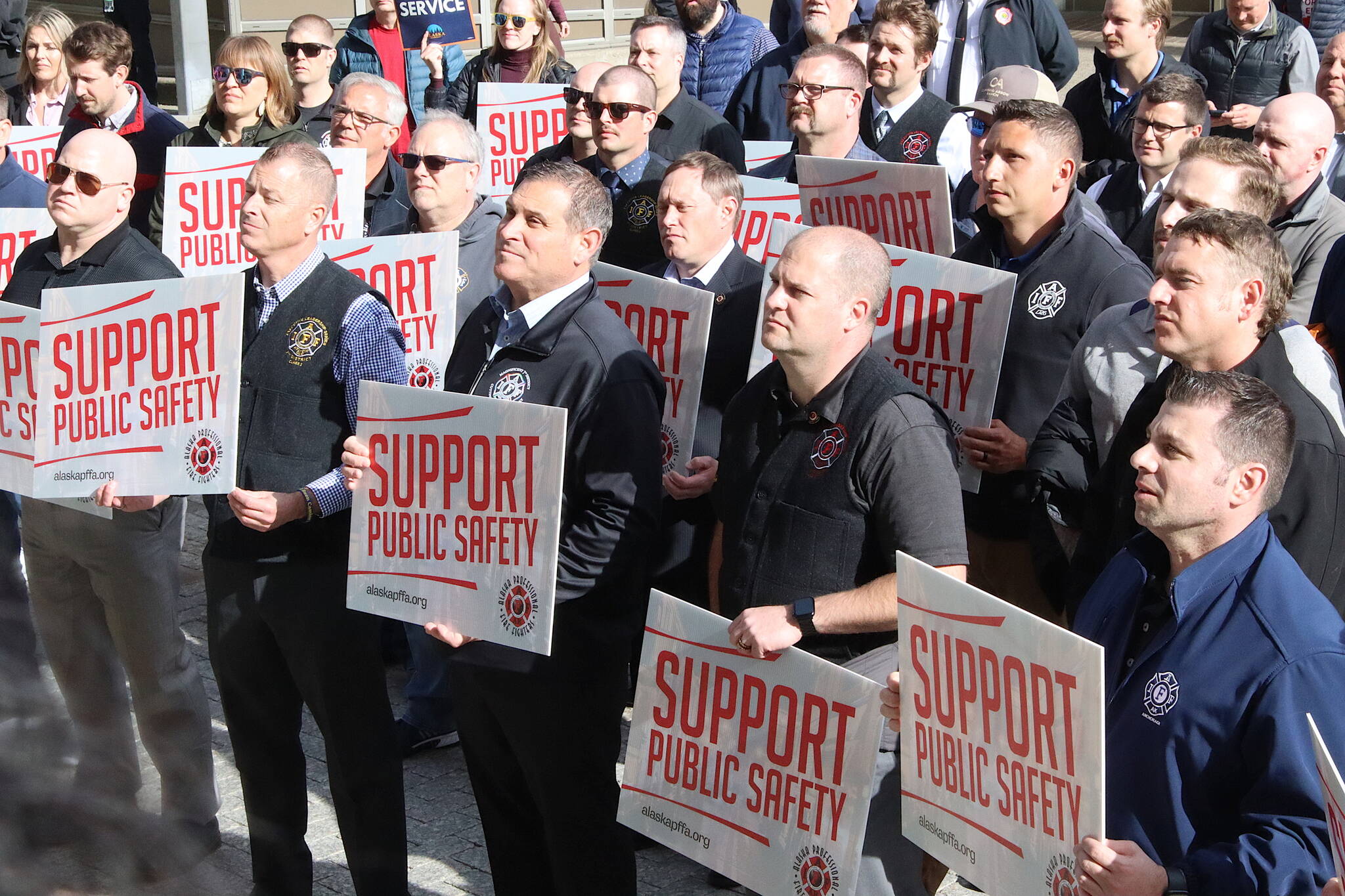
More than 50 police officers, firefighters and their supporters held signs and chanted slogans such as “hear the bill” in front of the Capitol during a protest Tuesday afternoon, as public safety leaders and some of the roughly 20 legislators standing at the entrance of the building spoke about the legislation’s merits.
Among the main points of emphasis was restoring the pension system — eliminated in 2006 in favor of a 401(k)-style system — will provide financial security necessary to resolve the state’s ongoing struggle to recruit and retain employees.
A bill restoring pensions (Senate Bill 88, introduced last year by Sen. Cathy Giessel, an Anchorage Republican) passed the Senate by a 12-5 vote at the end of January. But leaders with the Republican-led House majority spent a press conference on Tuesday emphasizing other public safety legislation largely dealing with tougher penalties for criminal activity they say are priorities with three weeks left in the legislative session.
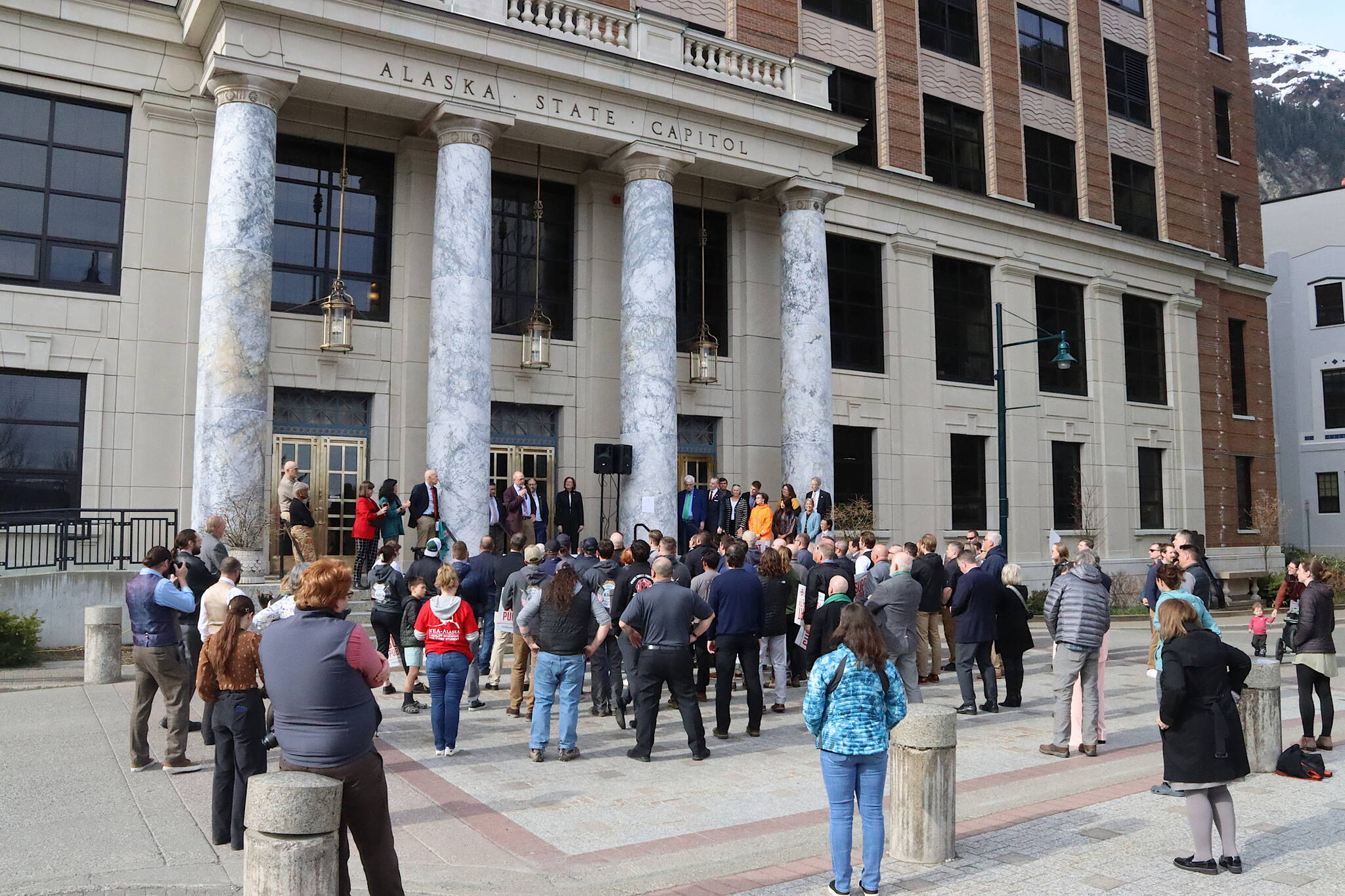
More than 50 protesters listen to public safety agency leaders and state lawmakers during a rally at the Alaska State Capitol on Tuesday afternoon. (Mark Sabbatini / Juneau Empire)
The progress of SB 88 through the legislative process since last year has been slow — it was held up in the Senate toward the end of last year’s session due to new data about the potential costs of reviving pensions, which were addressed at the beginning of this year’s session — and has not had a hearing yet in the House after being referred to three committees.
On Wednesday night a motion by House Minority Leader Calvin Schrage, an Anchorage Independent, to discharge the bill from the State Affairs Committee failed by an 18-20 vote with two members excused. Both of Juneau’s Democratic representatives, Sara Hannan and Andi Story, voted in favor of discharging the bill.
“The cost of getting nothing done in Juneau is having a significant impact on local budgets, and our recruitment and retention efforts,” Matt Fraize, vice president of the Anchorage Police Department Employees Association, told the protest crowd. “We as police officers, state troopers and firefighters have one job: that is to keep our communities safe. Unfortunately we are struggling to fulfill our duty to protect.”
The bipartisan Senate majority, comprised of 17 of the chamber’s 20 members, has declared pension reform to be one of its top three priorities of the two-year session. Sen. Jesse Kiehl, a Juneau Democrat who voted for the bill, was among the legislators claiming House leaders are stalling action on SB 88, which will die and need to be reintroduced as new legislation next year if not acted upon this session.
“I’ve seen every legislative trick in the book — I’ve played half of them,” he said. “Senate Bill 88 is stuck in a subcommittee and that’s not how this place is designed to work. This place is designed for ideas to compete, for legislators to hear bills, change what needs to be changed and move them forward if they’re going to help Alaskans, and we know a pension is going to help Alaskans.”
A personal-level challenge was offered during the rally by Chuck Kopp, a retired Kenai police chief who was elected to two state House terms, including serving as the House Rules Chair. He said he met before the rally with current Rules Chair Craig Johnson, an Anchorage Republican, and “I firmly believe the House is going to do the right thing and move on this legislation.”
“But we need to encourage them,” Kopp said. “I spoke with the current House Rules Chair today who has the power to move this bill. And he was not familiar with the economist evaluation. He was not familiar with many aspects of the bill. And he was not familiar that the Department of Public Safety employees by more than 80% support this bill. In fact, I don’t think that he has read the bill from talking with him. I encouraged him to give it a fair hearing.”
Johnson, in an interview on Wednesday, said he has indeed read the bill, but is awaiting some further financial study data requested by Senate leadership backing the legislation. He said the remaining time left in the session is sufficient to pass the bill if it has sufficient support.
“We can do magic in three weeks,” he said. However, “we want a good process. We can also take a long time.”
Giessel, on Wednesday, said the requested data is supplemental to primary studies already provided and is “not critical to the subject,” calling Johnson’s actions “a delaying process.”
SB 88, if enacted, would require new employees to enroll in the pension system (also referred to as “defined benefits”), while giving existing employees the option to switch from the 401(k)-style system (also referred to as “defined contribution”). A study presented to the Senate Finance Committee last year found a state employee hired in 2005 with a defined benefit pension would get about 30% of their salary after 15 years, while an employee hired under the defined contribution system in 2006 would get an average of about 18% and was more at risk to market volatility.
Regular employees would pay 8-12% of their salaries, and could retire at 60 years old or with 30 years of service under the terms of SB 88. Public safety employees could retire at age 50 with 25 years of service or at age 55 with 20 years.
The contribution rate would be set annually by the Alaska Retirement Management Board. The board could also adjust the state’s contribution and reduce annual inflation-adjustment payments for retirees to keep the new pension fund solvent if it earns less than is needed to pay benefits.
• Contact Mark Sabbatini at mark.sabbatini@juneauempire.com or (907) 957-2306.
