
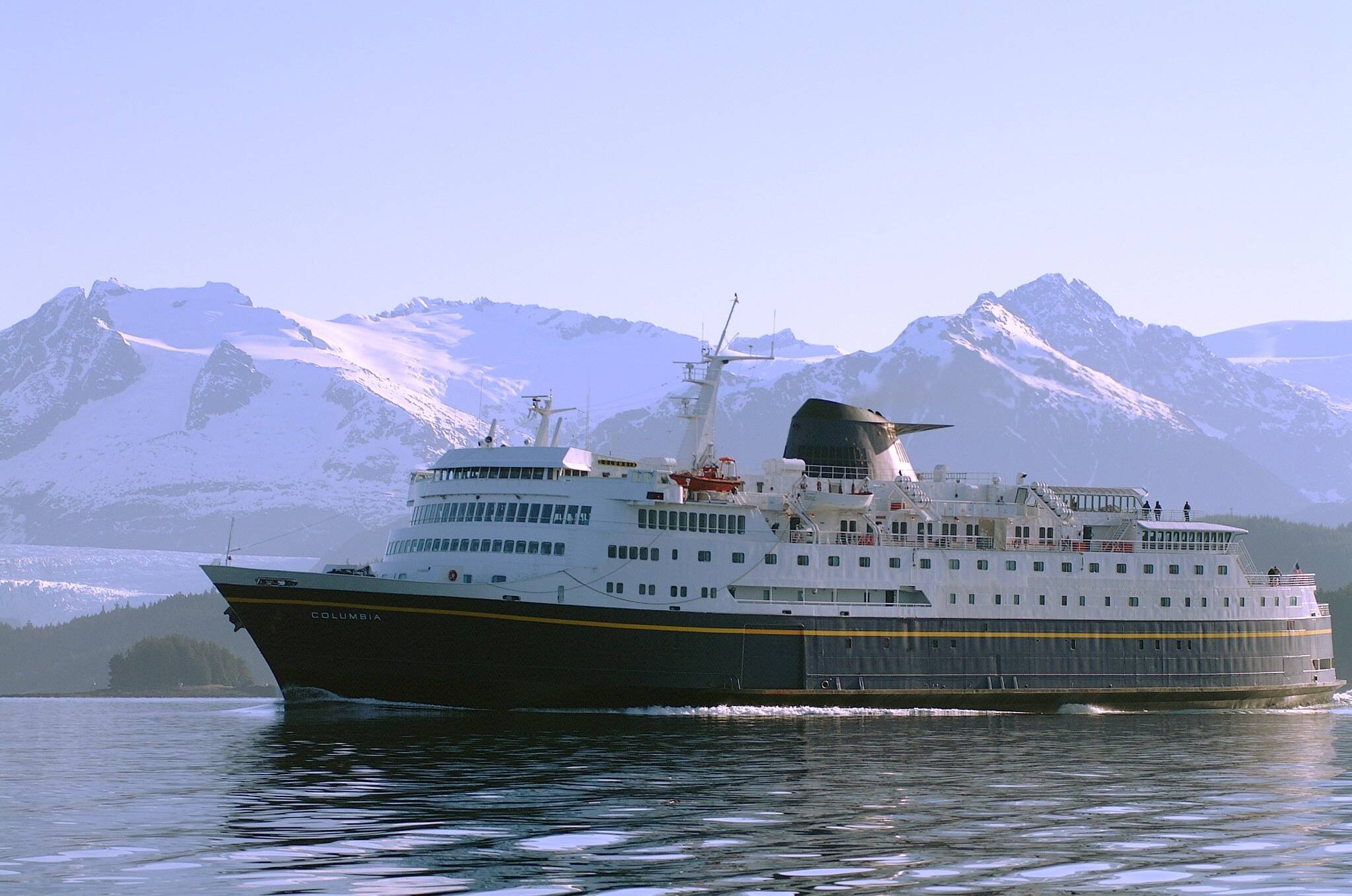
The proposed summer 2025 Alaska Marine Highway System schedule shows essentially the same level of service to Southeast Alaska as in the past several years: one ship serving the mainline route, with one stop northbound and one southbound each week.
The Columbia will stop in Juneau northbound on Mondays, on its run from Bellingham, Washington, through Southeast, then turn around in Skagway and stop on its southbound route on Tuesdays.
It’s the same schedule as the Kennicott is running this year.
The state ferry system is scheduled to pull the Kennicott out of service at the end of November, sending the 26-year-old ship to a Puget Sound shipyard for replacement of its generators to meet federal emissions standards.
While in the yard for a year, the Kennicott also will undergo steel repairs, main engine rebuilding work and a tail shaft survey, according to a staff presentation last month at the Marine Highway System’s public advisory board meeting.
The Columbia, which has been out of service for a year, will go back to sea in mid-December to take over the route. Its shop work the past year has included major steel repairs, cabin deck renovations and repairs, and new windows, according to the same fleet maintenance presentation at the advisory board meeting.
The Southeast mainline will be without any service for almost three weeks between the loss of the Kennicott in late November and the return of the Columbia mid-December.
The proposed summer ferry schedule, which covers May through September, includes one week without any mainline service in early May. “It is a one-week placeholder when the 50-year-old Columbia will dock in Bellingham,” Sam Dapcevich, Alaska Department of Transportation spokesman, said last week.
“The goal would be to take care of any maintenance items or Coast Guard requirements that pop up this winter. By keeping the Columbia in Bellingham, we can have any necessary vendors lined up to service the boat as needed,” Dapcevich said. “By taking care of the issues, hopefully the ship will run through the summer schedule without disruptions.”
With the Kennicott scheduled to be out of service until the end of 2025, the Alaska Marine Highway System will be wholly dependent on the Columbia to serve its most heavily traveled route from Bellingham through Southeast.
The ferry system is accepting public comments on the draft summer schedule through Tuesday, Nov. 12.
The public can email comments to dot.amhs.comments@alaska.gov. A virtual meeting for Southeast routes is scheduled at 10:30 a.m. Nov. 12 at https://us06web.zoom.us/j/81562507831, and at 11:30 a.m. for Southwest and Southcentral routes at https://us06web.zoom.us/j/84032925235.
The schedule will be open for reservations and fares will be posted after the ferry system adopts the summer timetable.
The Alaska Marine Highway has endured a rough decade of deteriorating ships, losing several to age, and declining ridership. Passenger traffic last year was about half of a decade ago.
The Matanuska, second in size to the Columbia, has been out of service since 2022 while the Department of Transportation considers the cost of replacing wasted steel against the value and life expectancy of the 61-year-old ferry.
While out of service, the state is using the Matanuska as a hotel for crews in Ketchikan.
The ferry system’s long-range vessel replacement plan shows it could cost $2 billion to build six new vessels over the next 20 years, with a replacement for the Columbia penciled into the schedule to arrive in 2031. The Department of Transportation has full funding for only the first of the six new vessels it says it needs.
The ferry system’s other ongoing problem is a chronic shortage of crew. As of Oct. 11, the system was down 70 workers — about 13% of full staffing — according to a management report presented to the Alaska Marine Highway Operations Board at its Oct. 23 meeting.
• This story was originally published by the Wrangell Sentinel.
