
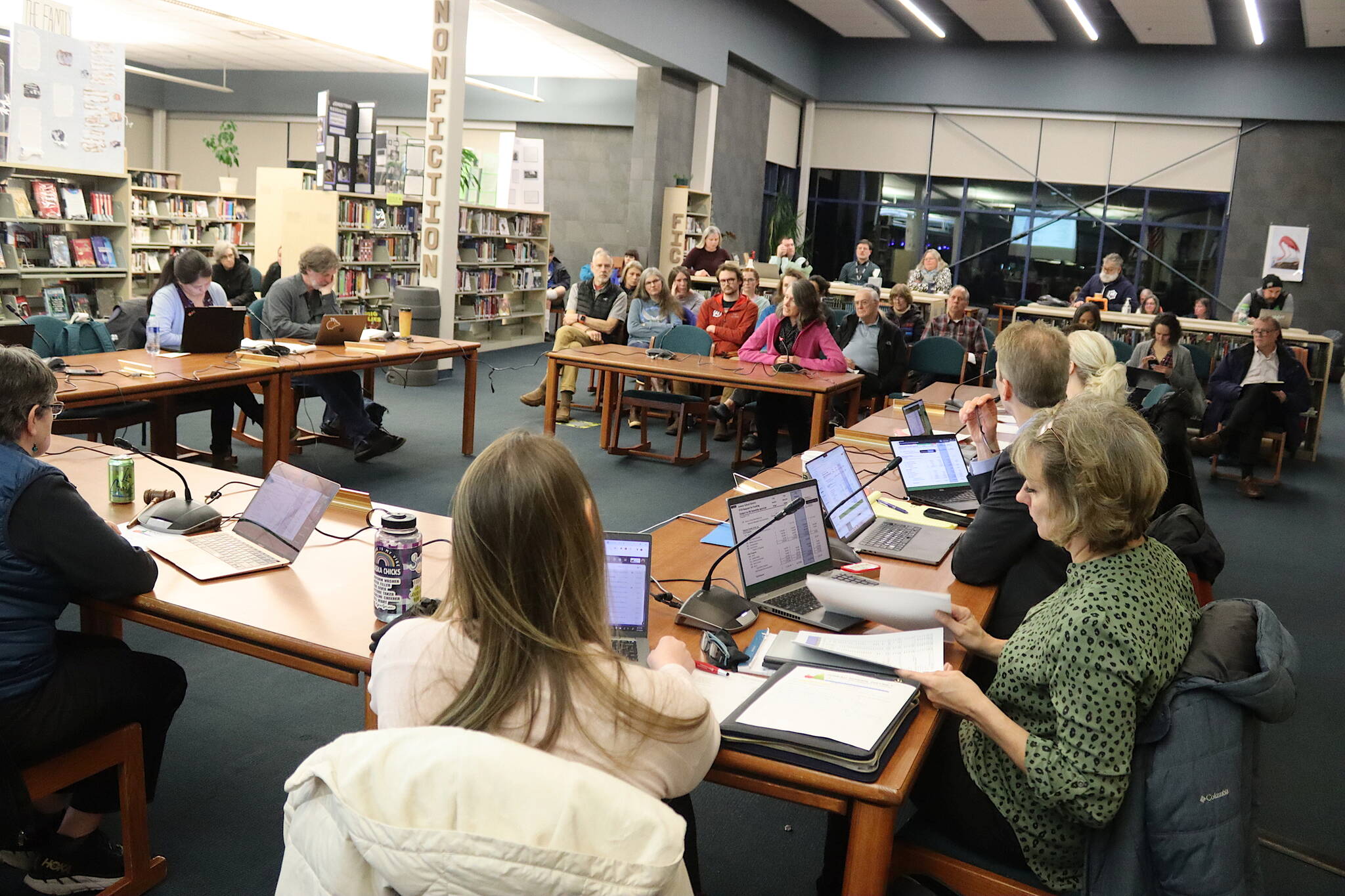
Cutting more than 70 jobs representing about 12% of employees and increasing the pupil-teacher ratio to 30 for all grades except K-3 — about four to five more kids per class — are among the measures proposed, in addition to a pending school consolidation plan, in next year’s operating budget for the Juneau School District.
The proposed budget for the fiscal year starting July 1 of about $68 million is nearly 10% lower than the current year, a necessity due to a projected $9.7 million deficit if no changes are made, District Superintendent Frank Hauser said during a special school board meeting Thursday at Thunder Mountain High School. It is also based on a consolidation plan the school board approved last month, but voted 4-3 on Thursday to reconsider.
About half of that deficit is covered by the consolidation plan and the Juneau Assembly this week approved taking over $1.65 million in operational costs, resulting in the need for significant additional reductions in a budget where staffing accounts for 90% of expenses.
“(The) district administration’s goal for 2024-25 is to provide the same — or an increased — level of services for students as existed in the prior year,” Hauser wrote in an executive summary of the proposed budget. “This includes increased access to in-person course offerings, including CTE offerings, and electives for middle and high school students. The Board of Education’s adopted district reorganization and consolidation plan will help preserve as many supports and opportunities for students as possible, despite declining revenue and increasing expenditures.”
The proposed budget assumes there will be no increase in the state’s $5,960 Base Student Allocation, although a $680 increase approved by the Alaska Legislature would provide an estimated $5.2 million to the district and thus essentially allow a balanced budget. Gov. Mike Dunleavy has stated he will veto it next week unless lawmakers also send him additional legislation covering his policy priorities — and even if he signs the bill, some officials have said they are worried he could use a line-item veto to reject education spending when he signs the budget into law in late June.
In addition to the operating budget, the proposal reviewed Thursday contains about $17.6 million in additional costs for student activities, support services and “targeted assistance programs” — with some items in the latter such as pre-kindergarten and after-school programs eliminated. However, the expectation is other entities such as the city or community organizations will be able to provide at least some of the eliminated programs.
The Juneau Board of Education is scheduled to again consider the budget and consolidation plan next Tuesday and then at a special meeting Thursday so it can meet a required deadline of sending an approved budget to the Juneau Assembly by Friday, March 15.
As with the school consolidation plan now being reconsidered that combines Juneau’s two high schools into one and does the same for the two middle schools, school board members and residents testifying Thursday expressed unease about taking drastic action quickly on a complex proposal they had little time to review in-depth.
Board member Amber Frommherz noted she and other members got the 29-page executive summary of the budget at about 12:30 p.m. Thursday, five hours before the meeting started.
“So I’m kind of struggling here to follow along,” she said. “I just want that to be known.”
Some parents and educators testifying said they had even less chance before the meeting to review the proposed budget, and efforts to get answers directly from district staff and board members since the financial crisis became public a couple of months ago can be a struggle.
“I’ve sent dozens of emails for the budget asking for clarification and answers,” Kimberly Rowan, a mother of two students at Auke Bay Elementary School, told the board. “I think as parents we’re trying to be knowledgeable and understand why these decisions are being made — not being accusatory or angry about it — but just being looped into the conversation and we’re not getting any answers.”
She said there are already more than 30 students in fourth-grade classrooms her kids attend and “it doesn’t matter how amazing a teacher is; it’s hard to teach that many students,” especially if some such as special-needed students need extra attention.
Staffing cuts in the proposed budget include 12.64% of the 317 instructional jobs such as teachers, librarians and counselors, and 11.13% of the 280 support staff that includes administrators and operations workers.
Notably among the cuts, the 70 instructional employees at Juneau’s two high schools would be reduced to 54 at a single larger high school. The 53 existing middle school employees for grades 6-8 would be reduced to 33 since the new middle school would be only for grades 7-8.
The pupil-teacher ratio for the proposed budget is set at 30 for all grade levels except K-3, where it is set at 26. The current ratios are 23.5 for K-3 students, 26 for grades 4-6, 25 for grades 7-8 and 26 for grades 9-12.
Some board members and residents asked if it is possible to sidestep the staff reductions until there is a clearer idea of whether there will be an increase in state funding that could avoid many of the layoffs. Hauser said putting the framework of a budget with the cuts — along with a reduction-in-force policy also reviewed by the board at the meeting — allows them if necessary, but the positions can be restored if funding is increased.
On the revenue side, the most drastic shift is the ratio of local vs. state funding. Local revenue would cover about 51% of the budget next year (up from 41% this year) compared to 48.5% for state revenue (down from 58%).
That’s due at the local level to the city agreeing to take over some “shared costs” of facilities used for shared non-instructional purposes such as recreation, plus an increase in how much the city is allowed to contribute for educational costs based on the increase in assessed property values during the past year. The state’s share is expected to drop in part because of the assumed flat BSA funding.
• Contact Mark Sabbatini at mark.sabbatini@juneauempire.com or (907) 957-2306.
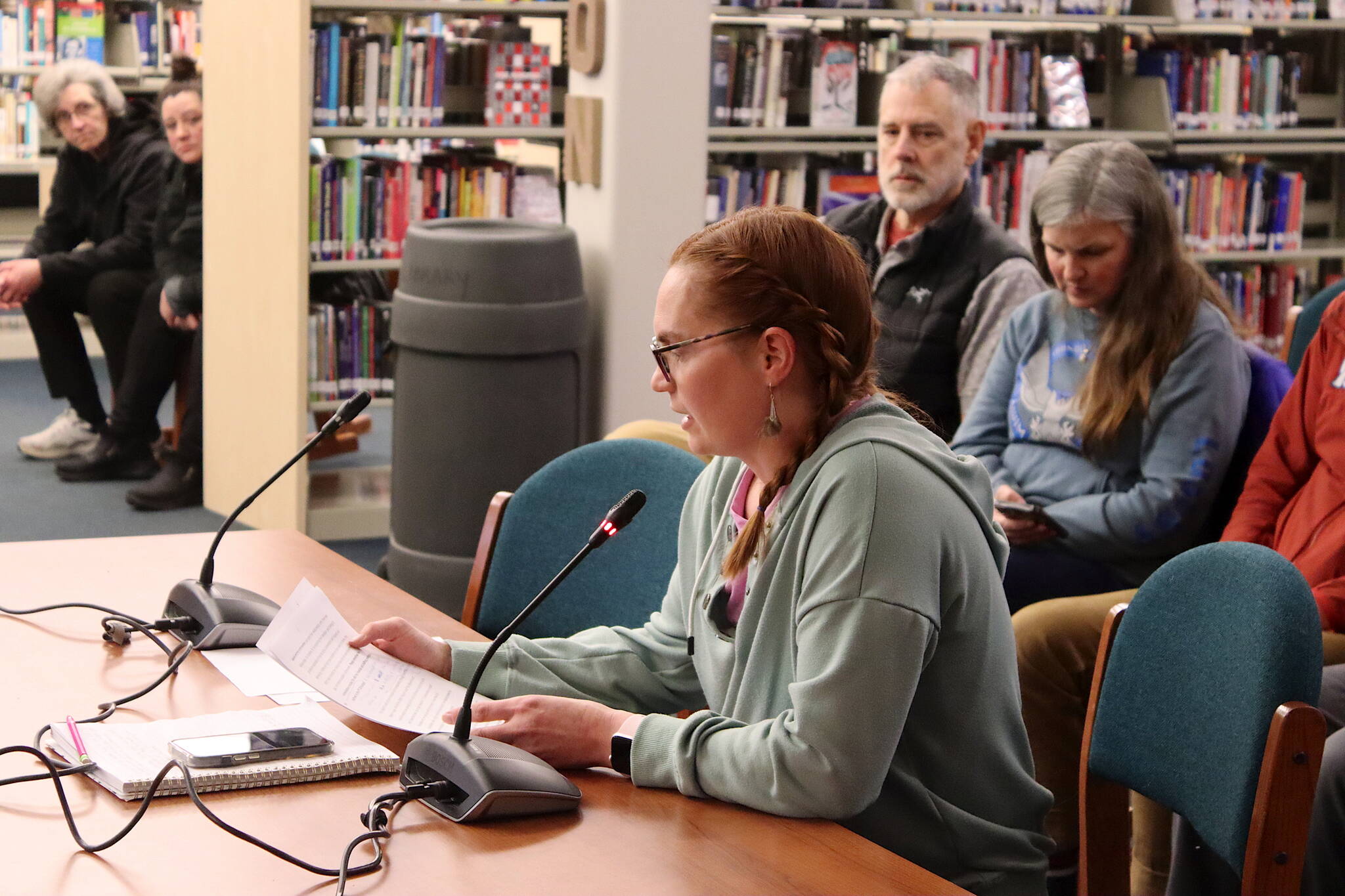
Bonnie Webster reads a portion of a document presented by several residents testifying during a special Juneau Board of Education meeting on Thursday night at Thunder Mountain High School. (Mark Sabbatini / Juneau Empire)
