
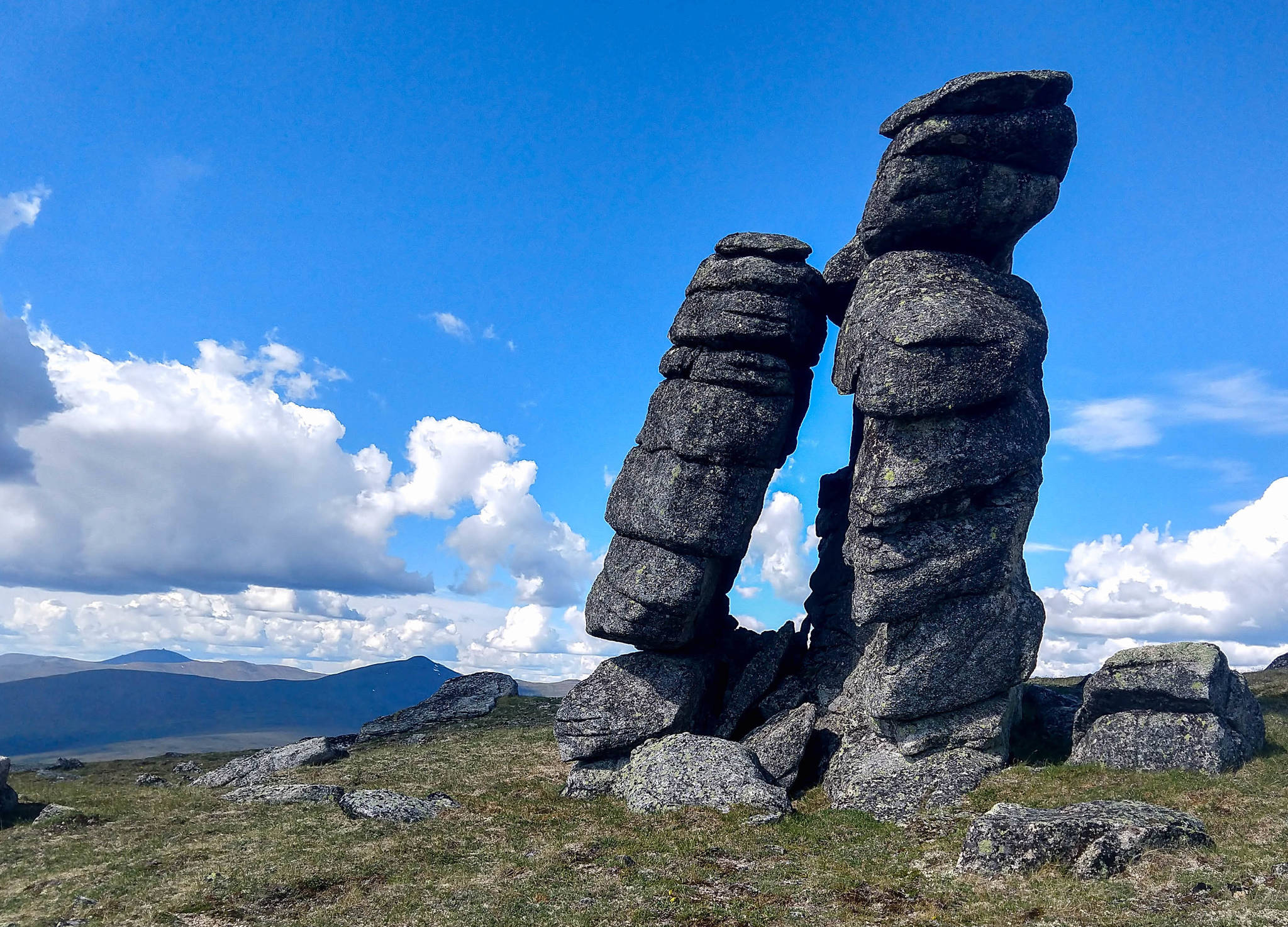
As I started hiking a ridgetop during the July 4 weekend, a friend told me to look for the mushroom rock ahead.
At first, I thought I may have heard her wrong.
But a few hours later I saw the rock she was talking about. It appeared to be a granite tor, but looked more like a mushroom than the gray fingers and fists we Alaskans recognize.
What is a granite tor? We have those blocky towers of rock here in Interior Alaska, and in other places that escaped being run over by glaciers.
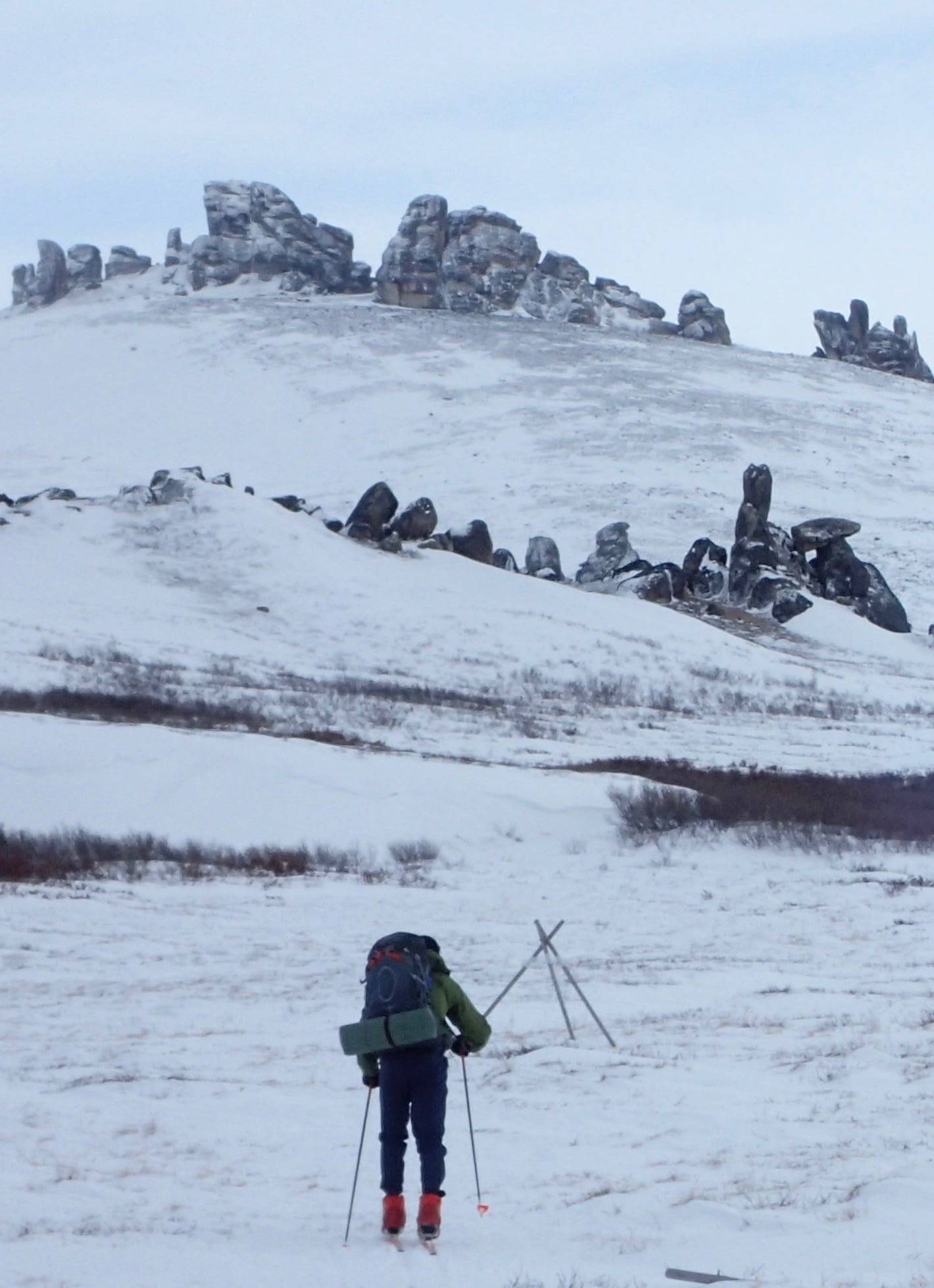
John Shook skis toward granite tors located near Serpentine Hot Springs on the Seward Peninsula. (Courtesy Photo | Ned Rozell)
Because Alaska is such a cold place, and is home to thousands of glaciers, it’s hard to believe that its cold heart was once a grassland, when Manhattan and Chicago were smothered beneath blue ice.
Twenty-thousand years ago, at the height of the last ice age, Alaska was connected to Siberia in a wide, grassy plain, the home of horses and bison. The Bering Land Bridge was free of ice, as was middle Alaska, from Nome eastward to Eagle and beyond to the Yukon Territory.
All of Alaska was not ice-free, though. During the most recent ice age, the Alaska Range and all the land south of it was beneath an ice sheet. To the north, the Brooks Range was also solid ice, as was an area of Southwest Alaska where quirky glaciers still exist in the Ahklun Mountains.
If glaciers had pressed down in Interior Alaska, they would have sheared off the rock protrusions we know as tors. Where you find tors, you can imagine a Pleistocene pathway for plants and animals.
Tors exist in areas where there is granite, a course-grained, hard rock. After many, many years of wind and water eroding softer materials away, the granite tors have endured.
“Most of the Interior’s big tors predate the Last Glacial Maximum (about 20,000 years ago) and are the product of literally millions of years of weathering in ice-free terrain,” said Dan Mann, a University of Alaska Fairbanks expert on ancient landscapes.
In Alaska, water enters the cracks in tors and, when it freezes, shoves the rocks apart. Over thousands of years, tors shed their own rocky terraces. These plateaus, often covered with low vegetation, are nearly flat, and can be pleasant places to walk.
The tors started as blobs of molten rock deep within the earth. The magma rose through denser rock, hardened into granite and eventually met the air as the ground surface weathered away.
Granite tors are scattered on hilltops all over middle Alaska, from near Serpentine Hot Springs on the Seward Peninsula to the Chena River State Recreation Area outside Fairbanks, which features a Granite Tors Trail.
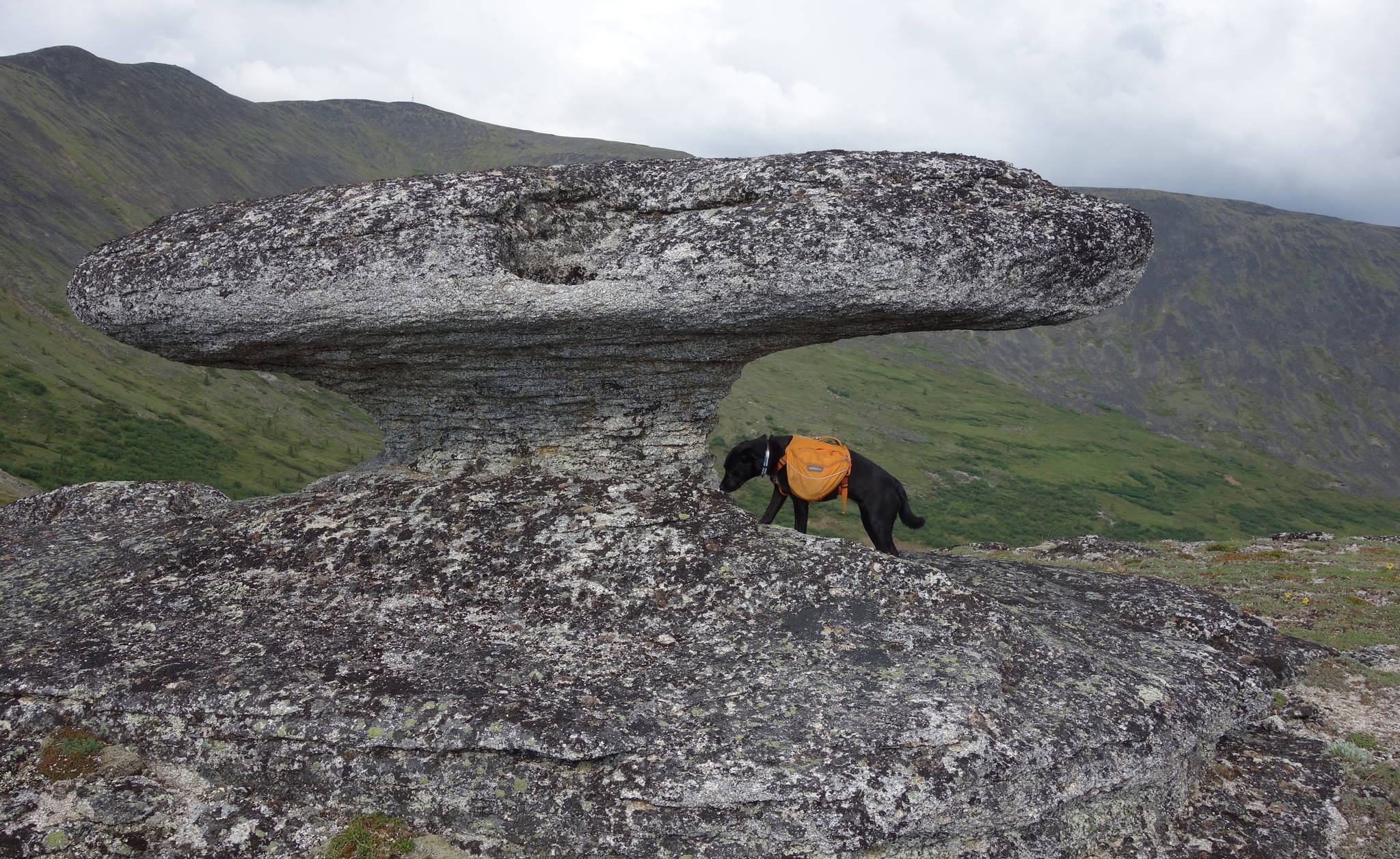
A mushroom-shaped granite tor stands about 60 miles from Fairbanks. (Courtesy Photo | Ned Rozell)
As for the mushroom-shaped tors, Mike Whalen of the Geophysical Institute said he suspects the granite there formed with some sort of layering process, and the rocky stem of the tor was softer than its cap.
“It probably could have formed from wind sand-blasting the thing,” he said.
If so, that mushroom is a yardang. A yardang is a landform created by wind, often where water is scarce and the wind usually blows from the same direction.
• Since the late 1970s, the University of Alaska Fairbanks’ Geophysical Institute has provided this column free in cooperation with the UAF research community. Ned Rozell is a science writer for the Geophysical Institute.
