
Years ago, Hans Chester watched as the late Tlingit scholar Nora Keixwnéi Dauenhauer wove a spruce-root basket.
Chester, who now works with the Sealaska Heritage Institute as a Tlingit language and culture assistant, said he couldn’t quite make out what Dauenhauer was doing because she was doing it so quickly. He knew it was a different style than he had ever seen.
Dauenhauer died in September 2017, and Chester said he hasn’t seen anyone weave like that except for on a low-quality videotape from years ago.
“It was such bad quality, I couldn’t see the technique,” Chester said. “I don’t think anyone weaves like that today, so just that one technique of Tlingit weaving is gone.”
In an effort to stop more weaving techniques from being lost, SHI is teaming up with a world travel company, Lindblad Expeditions, to make a documentary of sorts about how to create spruce-root baskets. Master Haida weaver and teacher Delores Churchill, 90, will be featured in the video.
Chester will also likely be featured, as he worked with Churchill as her apprentice last year and is working with her again this year. Churchill constantly challenges her pupils, Chester said, trying to hold them to a high standard.
Spruce roots can be used to create baskets, hats or other items that were vital for the early residents of Southeast Alaska. Though he currently practices weaving as an art form, Chester said he knows how vital this process was to those who came before him.
“This is one of the remnants of our ancestors that’s still at our fingertips, so we need to take it seriously and be just as focused as (Churchill) is so that we can learn as much as we can,” Chester said. “What we call an art form today allowed our ancestors to haul water and clams and protect their heads from getting rained on when they’re canoeing.”
The video project will document a class that runs from Aug. 20-31, Chester said. Though Lindblad is helping out with the project, SHI will own the copyright to the documentary, according to a news release. This is, in part, to ensure the footage is used responsibly and that the instruction doesn’t go to what the release calls “unscrupulous pirates of intellectual property who will mass produce pieces and pawn them off as ‘Native’ art.”
Lindblad Expeditions works with National Geographic to organize ship-based voyages around the world to inspire people to care more about the planet. Part of this partnership is also to introduce people to the cultures and traditions of communities throughout the world.
Stacy Rivett, the director of artisan development at Lindblad Expeditions, said in the release that the resources come from what they call the LEX-NG Artisan Fund, which aims to give money to artisans in the places where the expeditions visit.
Amy Fletcher, the SHI media and publications director, said via email that it’s still unknown how exactly the footage will be released. She said it will likely be posted on the organization’s Vimeo page in the coming months.
On Saturday, Chester led a small group of people on a spruce root expedition at the Eagle Valley Center near Amalga Harbor. They brought shears, hooks, gloves, water and other tools out to the trees, searching for spruce trees with trunks about a foot in diameter, Chester said. Those ones have the most suitable roots.
When they found the right-sized trees, they uncovered the long, spindly roots and followed them to the end. They pulled them out of the ground lightly, making sure not to break the root. Chester said this harvesting process won’t severely harm the tree, as they take small roots and don’t take too many of them.
Once they had a few roots, they started a fire, roasting the roots in the flames. This, Chester said, removes the sap and makes the bark easier to take off the roots. They then ripped the bark off the roots and rinsed them in water.
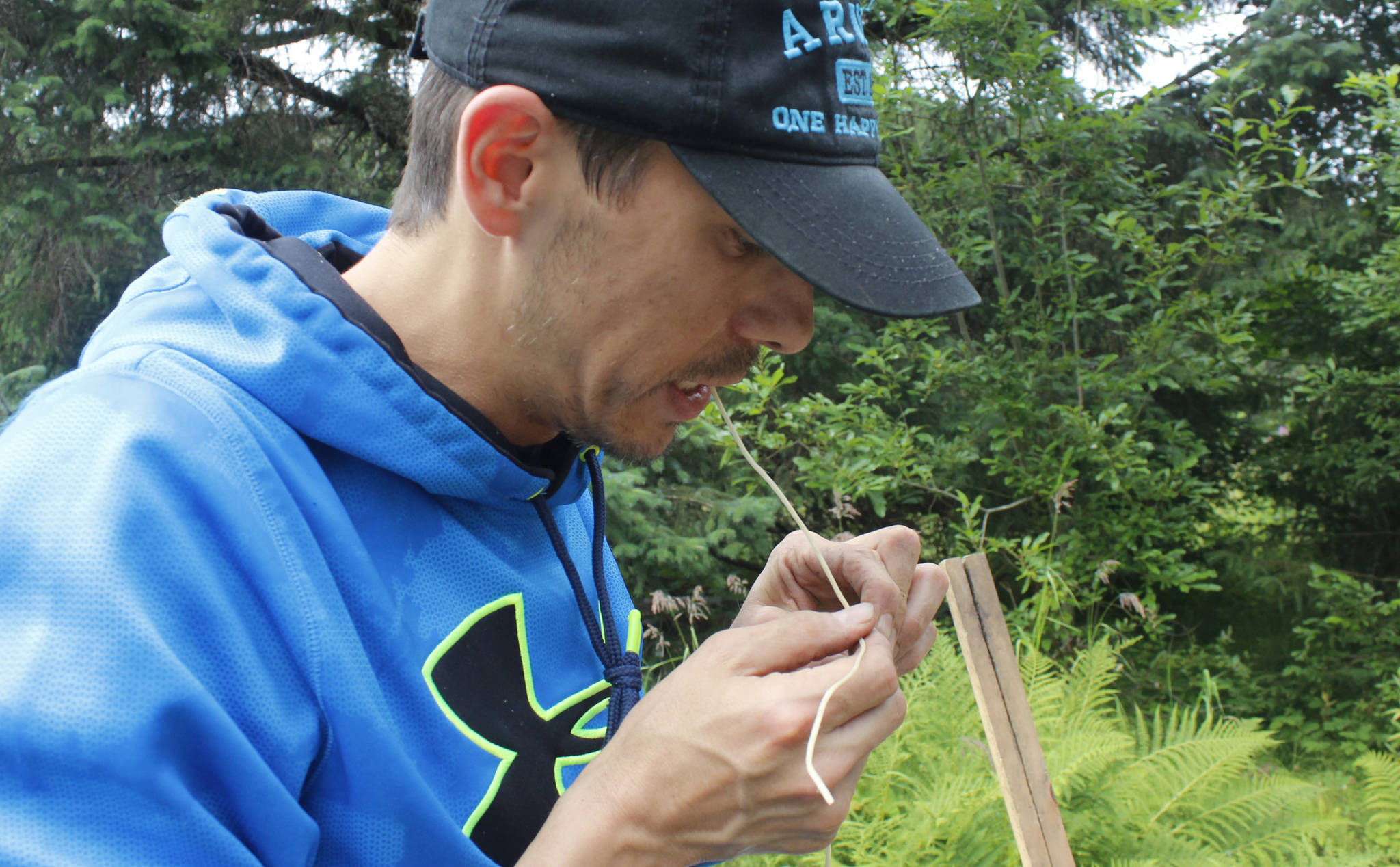
Chester demonstrated the next part for the group as multiple others pulled out their phones to record. He cut a small slit a few inches into one of the roots, in order to start splitting it into two halves. He put one half of the root in his mouth and began to pull on the other half, making it look like he was peeling a long, thin piece of string cheese.
These two halves might get split again, Chester said, if they’re not thin enough to weave with. Chester said he held one end in his mouth simply because that’s how he was taught, and for no other important reason.
Chester said the process is just second nature to him now that he’s been doing it for more than 15 years. He can sit and watch TV while he splits a root. He hopes others can become that comfortable and adept doing it, and this documentary could help preserve the process.
Trevan Skan, who was with Chester on Saturday, has a spruce tree tattooed on his arm. Below the tree is a system of roots that spell out “Sproot root gang,” a moniker for him, his teacher and others who harvest and weave spruce roots.
“It’s a dying art form,” Skan said, “and I want it to keep going on.”
• Contact reporter Alex McCarthy at 523-2271 or amccarthy@juneauempire.com. Follow him on Twitter at @akmccarthy.
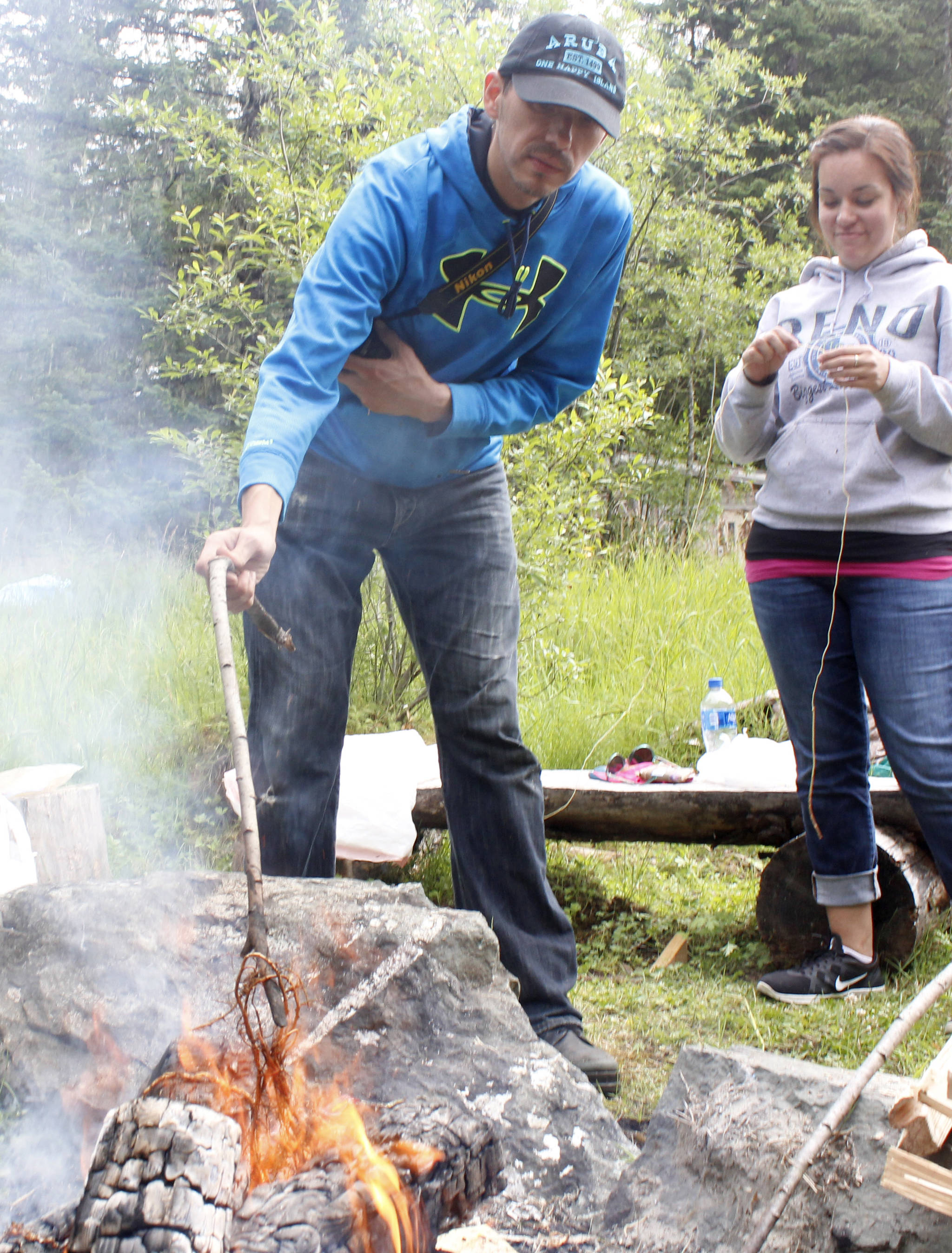
Hans Chester of the Sealaska Heritage Institute roasts a spruce root at the Eagle Valley Center on Saturday, July 28, 2018. SHI is collaborating with a travel company to make a video about spruce root weaving techniques. (Alex McCarthy | Juneau Empire)
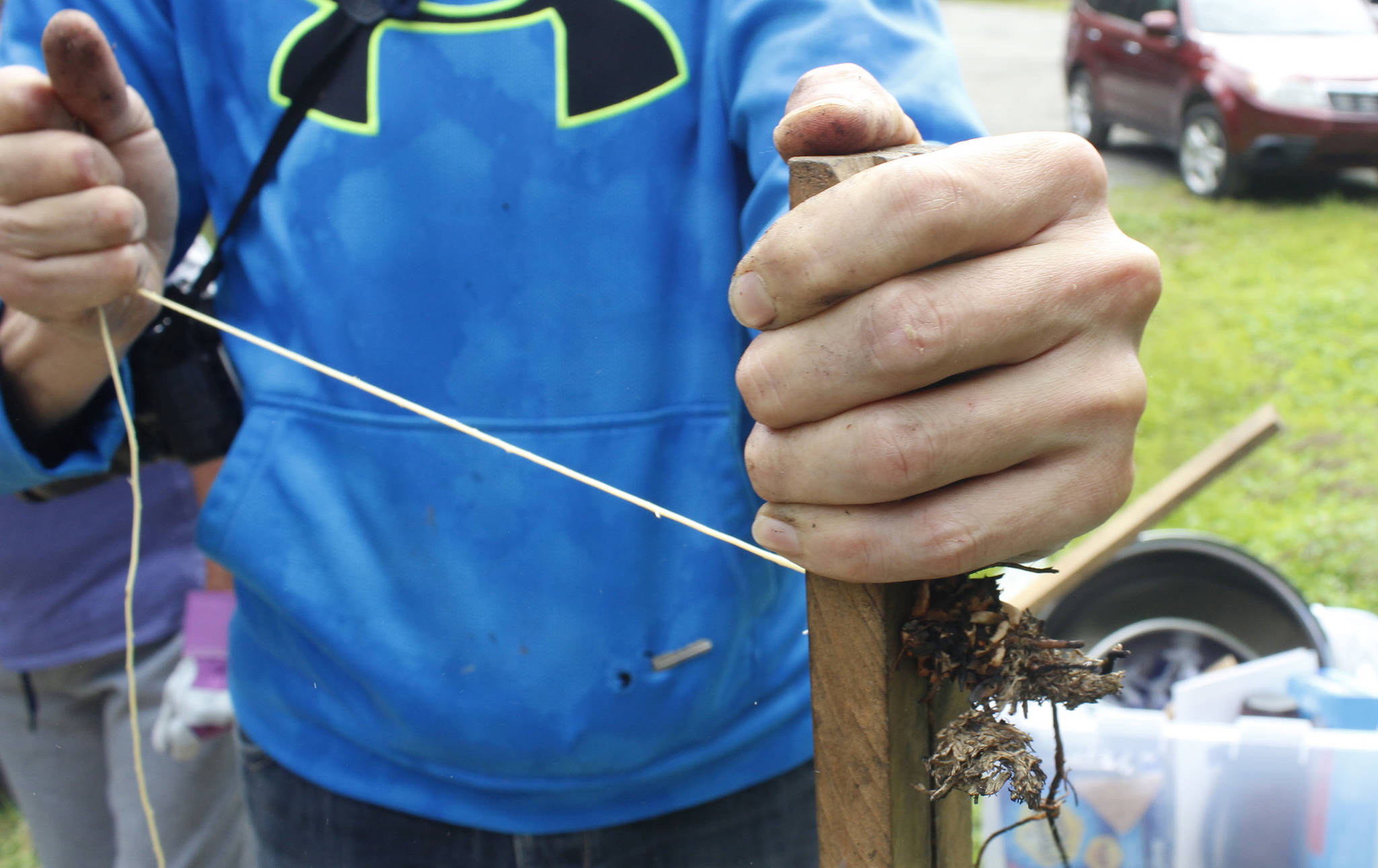
Hans Chester of the Sealaska Heritage Institute rips the bark off a spruce root at the Eagle Valley Center on Saturday, July 28, 2018. SHI is collaborating with a travel company to make a video about spruce root weaving techniques. (Alex McCarthy | Juneau Empire)
