
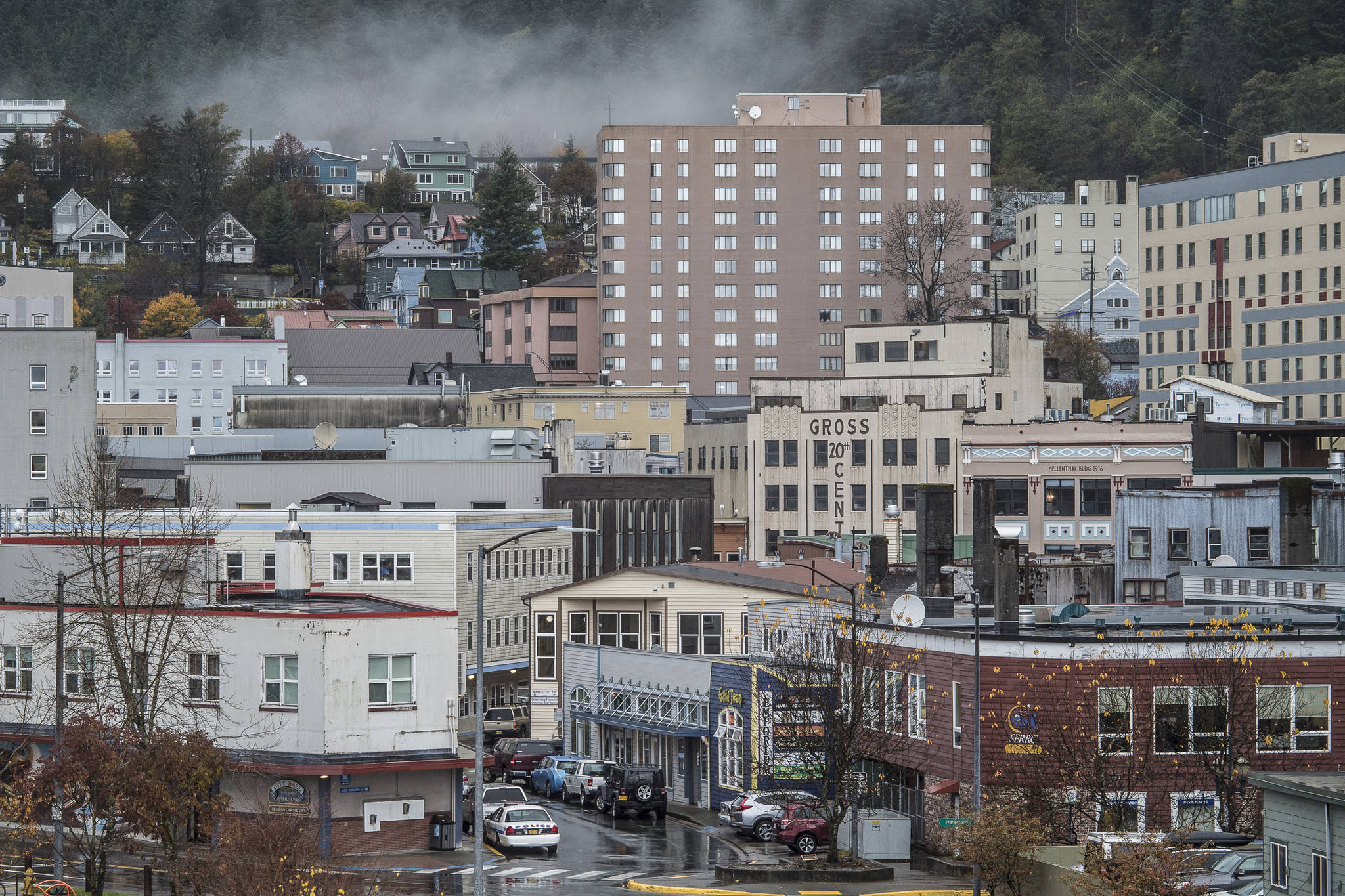
Southeast Alaska and the state as a whole continued to lose residents last year.
From 2018 to 2019 Southeast’s population declined by 284 residents, according to estimates from the Alaska Department of Labor and Workforce Development. That .39% decline is nearly identical to the statewide decline of .4% — 3,048 fewer people — shown in the department’s population estimates. Juneau’s population declined by 191 people last year, which is a .6% decrease.
This is the third year in a row the state’s population has declined. Juneau’s population has been in decline since 2016, according to the department of labor, and the Southeast losing streak dates back to July 2015.
“Our big difference at the statewide level is we’re not seeing as many people as we normally have coming into the state,” said state demographer David Howell. “A lot of that is in Anchorage and Fairbanks.”
That decrease in new-to-the-state residents has not been matched by an increase in people moving away from the state, Howell said.
“Our out-migration is actually down from our average,” he said.
Alaska’s population peaked at 739,649 people in July 2016, according to the department of labor’s estimates, and it had dwindled to 731,007 as of July 2019. Juneau’s population peaked July 2015 at 33,128 and sat at 31,986 in July 2019, according to the department of labor’s figures.
Some of the statewide population decline can be attributed to a decrease in the number of births in Alaska.
“We’ve seen very noticeable declines the last three years,” he said. “We’ve been seeing birth decline by about 500 per year.”
Births are on the decline throughout the country, according to the Centers for Disease Control and Prevention.
However, Howell said that hasn’t consistently been the case in Southeast.
“It looks like Southeast is pretty steady,” he said. “It has declined, but not consistently, it’s kind of up-down, up-down, but the overall pattern is down.”
Another population trend quirk of Southeast Alaska is the age of its population.
“Southeast as a whole is quite a bit older than the rest of the state,” Howell said.
Older populations tend to lead to less natural growth.
Natural growth is a statistic that subtracts the number of deaths in an area from the number of births in an area. Coupled with migration, it’s what changes an area’s population.
Petersburg and Skagway each saw more deaths than births from 2018-2019, according to state figures. Petersburg’s natural growth was -1 and Skagway’s was -3. Juneau’s natural growth was 145.
Despite consecutive years of declining populations, the state as a whole, Southeast Alaska and Juneau actually gained residents over the entirety of the past decade.
The state gained 20,776 residents, Southeast gained 709 residents and Juneau gained 711 residents. Some Southeast communities, including Sitka, which lost 349 residents from 2010-2019, and Ketchikan, which lost 96 residents, had declining populations in that time frame.
While that’s not a massive in flux of new people to the capital city, Dan Robinson, research chief for the Alaska Department of Labor and Workforce Development, said it’s enough to be considered real growth.
The reason for the overall growth is because of population gains in the early part of the decade, which offset the years of decline. Those gains were largely driven by in-migration, according to department of labor data.
“It wasn’t that long ago we were seeing big gains in net migration,” Howell said.
He said typically, Alaska’s net migration is right around zero, which means an equal number of in-migrations and out-migrations.
Robinson said net migration in Alaska is largely dependent on how job growth in the state compares to job growth in the U.S.
Alaska’s not seasonally adjusted unemployment rate was at 6% in November 2019, according to department of labor data. The U.S. unemployment rate of 3.3% was at about half of that.
“Since 2013, the Alaska job growth has been significantly lower than the U.S.,” Robinson said.
• Contact reporter Ben Hohenstatt at (907)523-2243 or bhohenstatt@juneauempire.com. Follow him on Twitter at @BenHohenstatt
