
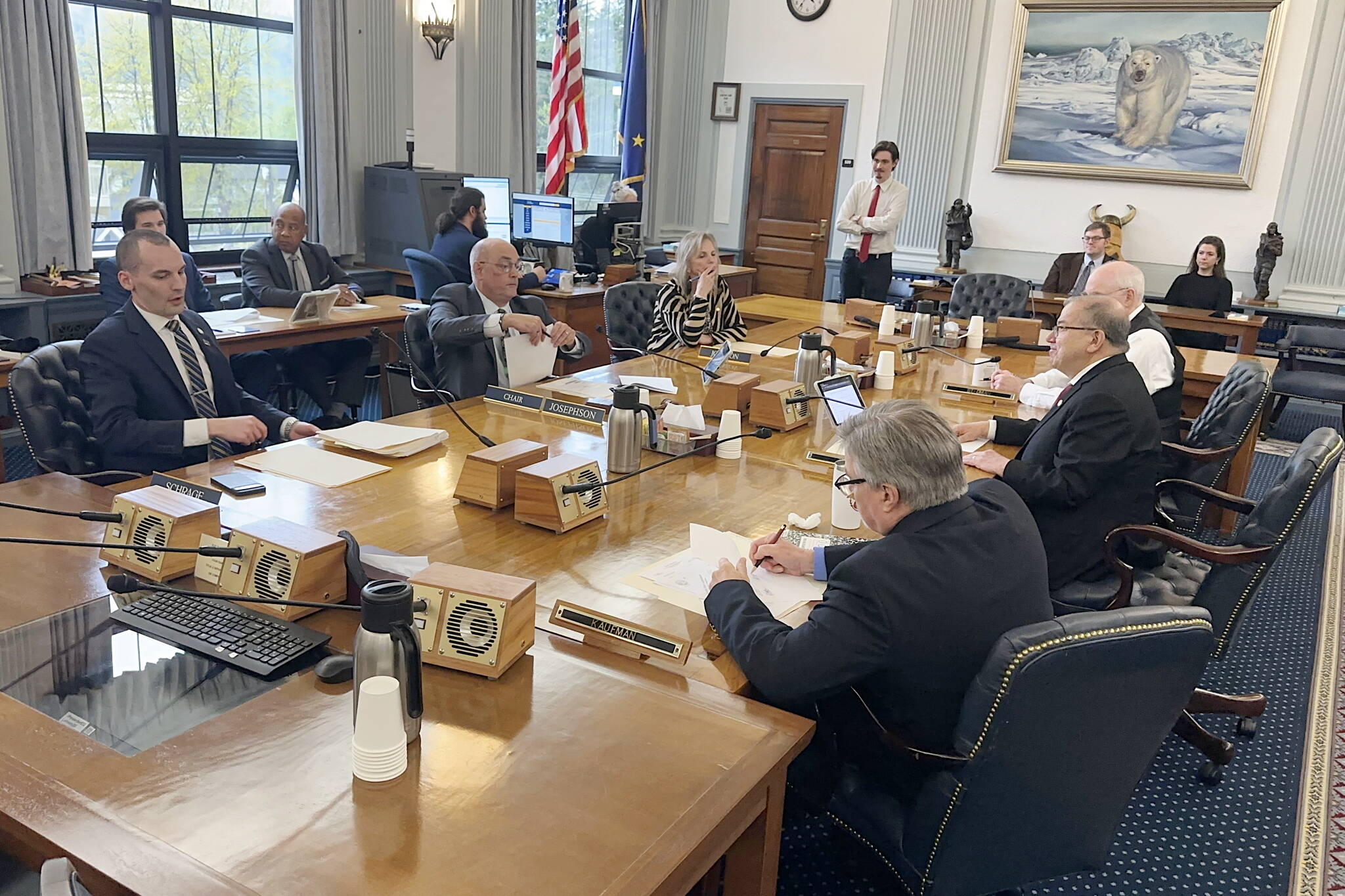
A panel of six House and Senate members began trying to resolve about 400 differences in the state budgets passed by their respective chambers by forming a conference committee Tuesday to craft a compromise spending plan for the full Legislature to pass by next Wednesday’s scheduled adjournment.
They’ll decide money matters such as whether the Permanent Fund dividend will be the roughly $1,400 in the House’s budget or $1,000 in the Senate’s version — or potentially some other number. But they’ll also have to resolve numerous differences in policy and intent language, such as bans on Medicaid funds for abortion (Senate version) and gender dysphoria (House version).
“You’ll see it evolve as we go through the conference committee meetings,” Sen Bert. Stedman (R-Sitka), co-chair of the Senate Finance Committee, said during a press availability Tuesday. “The first couple won’t be too exciting because the first one will be organization. The second one will be where we agree on everything. The third one would most likely be where we disagree, but there’s not much to squabble about so there will be rapid conclusions and then it’ll boil down to some of the bigger issues.”
The committee’s first meeting Tuesday afternoon lasted less than seven minutes, during which members were officially appointed and they voted to approve all of the identical items in both budgets. The committee consists of three members each from the House and Senate, with two majority and one minority member from each chamber.
The Senate’s roughly $12 billion budget for the fiscal year starting July 1 is effectively about $430 million lower than the House’s, according to the Legislative Finance Division. In addition to the lower PFD, some of the most notable cuts by the Senate are $25 million to the Department of Corrections, $14 million for childcare grants and subsidies, and $12 million to the Department of Public Safety.
The House’s budget essentially had a $330 million deficit, including a $79 million unspecified cut the governor is supposed to make at his discretion, which legislative attorneys call legally questionable. That provision was removed from the compromise budget during a conference committee meeting on Wednesday.
The Senate’s budget has a surplus for now, but leaders in that chamber said that figure — and the House’s — will both end up further toward the red due to costs not yet factored in such as new contracts for state employees that recently were tentatively agreed upon.
Lawmakers also have to cope with a roughly $200 million carryover deficit for the current fiscal year due to factors such as getting less revenue than expected due to low oil prices.
Leaders in the Senate bipartisan majority are vowing to pass a final budget for next year that doesn’t require lawmakers to tap the $2.8 billion Constitutional Budget Reserve. In addition to requiring a three-fourths vote of both chambers to access the fund — which would make negotiations more difficult — many policymakers are saying they expect Alaska’s fiscal situation to be even worse a year from now due to continuing low oil prices, so preserving the reserve fund is essential.
The policy and intent language items still to be resolved won’t necessarily affect the state’s finances, but may well provoke strong reactions among lawmakers debating them at the Capitol and/or while facing constituents in the future.
One such item in the Senate budget prohibits the state from spending money on abortions unless they are deemed a “mandatory service” under Medicaid. That provision isn’t in the House budget, but that chamber did pass a similar measure referencing gender dysphoria.
That means Sen. Jesse Kiehl (D-Juneau), a member of the Senate Finance Committee who is pro-choice, voted to advance the bill with the abortion provision out of the committee and in favor of the budget bill on the Senate floor. When asked at Tuesday’s press availability why the language was in the bill — and passed by a Senate majority with nine Democrats and five Republicans — he said it’s a compromise in the process that in practicality is meaningless under the Alaska Constitution.
“That language is a difficult one and it’s been problematic for different members,” he said. “It was included in part because it’s long been in the budget — and I don’t care for it. Alaska’s courts have ruled that it is not effective and cannot actually change the substance of law of the land. You can’t do that in a budget bill. And so one of the compromises that got made was to include that language that does not in the end harm people’s access to health care. And so we moved that forward. It’s been in there for a long time. That’s the simple explanation.”
A more subtle and typical difference in intent language is correctional facility closures in both budgets. The House is seeking the possible closure of one facility that will have the most cost savings, while the Senate proposes more specific intent language including permanently closing a housing unit at Spring Creek Correctional Facility and no longer covering “the full cost of unsentenced federal inmates housed in state facilities.”
The list of differences is also sprinkled with plenty of items that fall decidedly in the category of miscellaneous, such as a Senate provision referring to artificial intelligence.
“It is the intent of the legislature that the Office of Information Technology shall present a prioritized plan to the Co-chairs of the Finance committees and to the Legislative Finance Division by December 20, 2025 for the uses, costs, and expected benefits of projects using artificial intelligence,” the budget item states.
• Contact Mark Sabbatini at mark.sabbatini@juneauempire.com or (907) 957-2306.
