
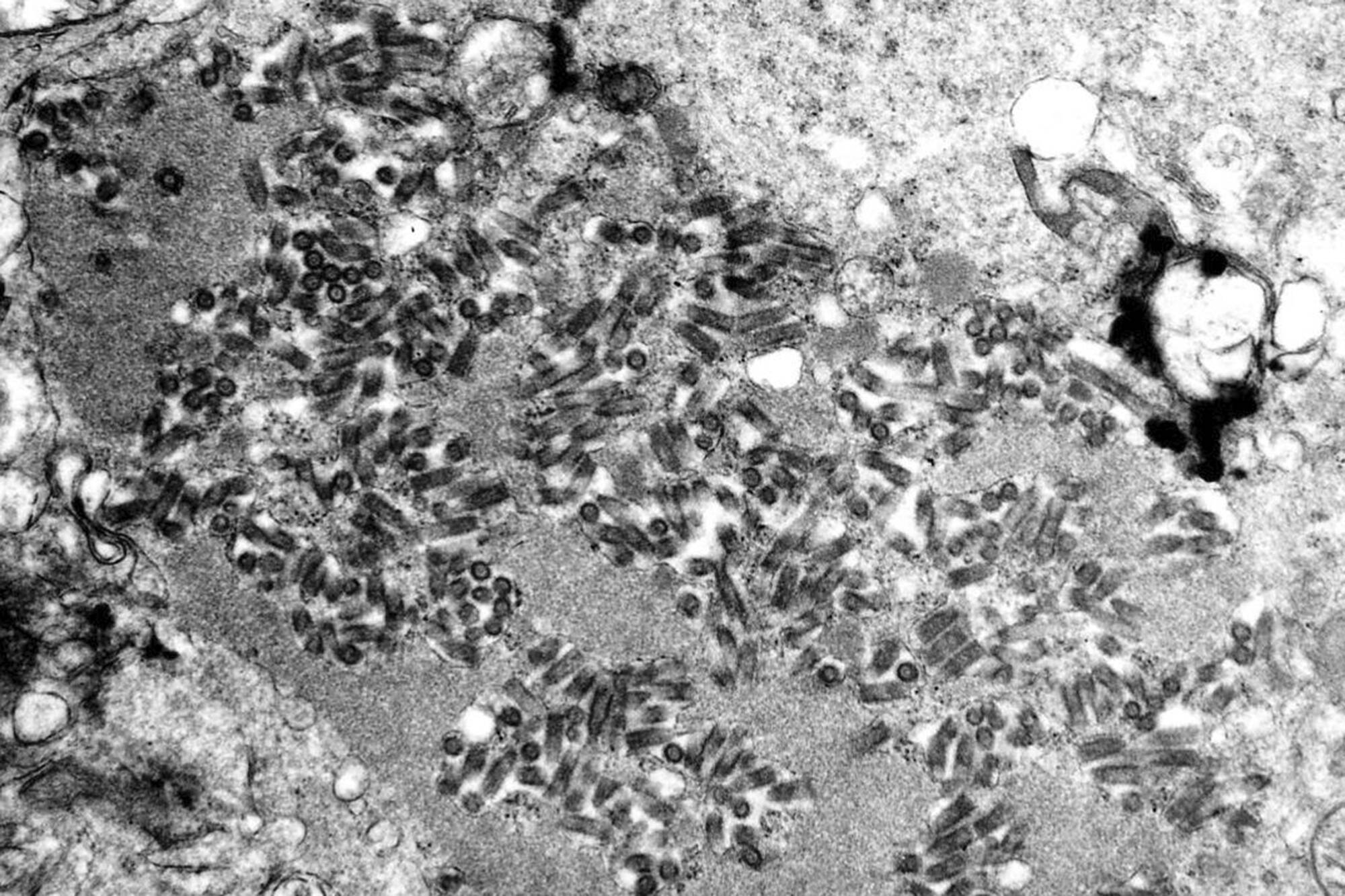
This undated electron microscope image made available by the Centers for Disease Control and Prevention shows rabies virions, dark and bullet-shaped, within an infected tissue sample. (F. A. Murphy/CDC via AP)

This undated electron microscope image made available by the Centers for Disease Control and Prevention shows rabies virions, dark and bullet-shaped, within an infected tissue sample. (F. A. Murphy/CDC via AP)

Overall rabies risk in Southeast minimal, says wildlife biologist

Bats are the main carriers in the Southeast, and as ever there the odds are extremely low.

Southeast Alaska’s unique geography and species present make the likelihood of increased rabies risk low, said an Alaska Department of Fish and Game wildlife biologist.

The discovery of a bat carrying the disease last week wasn’t unheard of, but is nevertheless a very rare event.

“Unlike many other mammals, bats don’t associate with other mammals,” said area wildlife biologist Roy Churchwell in a phone interview. “That’s probably why it doesn’t travel out of the population.”

[Play brings rarely-seen side of Klondike Gold Rush to fore]

Rabies is a virus which attacks the central nervous system, according to the federal Centers for Disease Control and Prevention. It often spreads to people and pets if they’re bitten or scratched by rabid animals, according to the CDC. Bats are the primary carriers of rabies— insofar as the term primary carriers signifies for six documented positive cases over 45 years— in the region due to the animals present, Churchwell said.

“There’s potential, but it’s pretty unlikely that we’ll pick one up. It’s not going to be common enough that we’ll be able to detect,” Churchwell said. “Further up north, foxes get it. We don’t have much of a fox population here.”

Interacting with house pets is one of the most likely vectors in Southeast Alaska as well, Churchwell said; a cat or dog, for example, might see a bat on the ground and interact with it, becoming infected. Rabies travels through saliva, such as through a bite or an open wound, according to the CDC.

“That’s how it’s most likely to infect a pet,” Churchwell said. “People need to make sure their pets are vaccinated.”

A vaccine also exists for humans, Churchwell said, though it’s not commonly administered preventatively.

“There’s a human vaccine,” Churchwell said. “Most humans don’t get it unless they work with wildlife.”

For humans that are exposed, a two-week course of vaccination has to take place immediately, according to the CDC, administered in the arm like regular vaccinations.

Animals who have been exposed to rabies may act strangely, according to the CDC — they may be aggressive, attempt to bite, salivate more than usual, or act otherwise unusually, such as not being cautious of humans as wildlife is wont to be.

The bat identified with rabies was outside during the day and acting oddly, according to Alaska Department of Fish and Game.

In the U.S., bats are the leading vector for rabies to humans, but in the rest of the world, many parts of which may not have the United States’ mandatory rabies vaccines for dogs, dogs are the cause of nearly all rabies deaths across the planet, according to the CDC.

The CDC urges anyone who has been in direct contact with wildlife, especially if they’ve been bitten or scratched, to see a doctor; untreated, rabies attacks the brain and is ultimately fatal.

• Contact reporter Michael S. Lockett at 757-621-1197 or mlockett@juneauempire.com.

More in News

The northern lights are seen from the North Douglas launch ramp late Monday, Jan. 19. A magnetic storm caused unusually bright northern lights Monday evening and into Tuesday morning. (Chloe Anderson/Juneau Empire)
Rare geomagnetic storm causes powerful aurora display in Juneau

The northern lights were on full display Monday evening.

teaser
Juneau activists ask Murkowski to take action against ICE

A small group of protesters attended a rally and discussion on Wednesday.

A female brown bear and her cub are pictured near Pack Creek on Admiralty Island on July 19, 2024. (Chloe Anderson for the Juneau Empire)
Pack Creek permits for bear viewing area available now

Visitors are welcome from April 1 to Sept. 30.

Cars pass down Egan Drive near the Fred Meyer intersection Thursday morning. (Clarise Larson / Juneau Empire file photo)
Safety changes planned for Fred Meyer intersection

DOTPF meeting set for Feb. 18 changes to Egan Drive and Yandukin intersection.

Herbert River and Herbert Glacier are pictured on Nov. 16, 2025. (Mari Kanagy / Juneau Empire)
Forest Service drops Herbert Glacier cabin plans, proposes trail reroute and scenic overlook instead

The Tongass National Forest has proposed shelving long-discussed plans to build a… Continue reading

A tsunami is not expected after a 4.4-magnitude earthquake northwest of Anchorage Wednesday, Feb. 4, 2026. (U.S. Geological Survey)
No tsunami expected after 4.4-magnitude earthquake in Alaska

U.S. Geological Survey says 179 people reported feeling the earthquake.

ORCA Adaptive Snowsports Program staff member Izzy Barnwell shows a man how to use the bi-ski. (SAIL courtesy photo)
Adaptive snow sports demo slides to Eaglecrest

Southeast Alaska Independent Living will be hosting Learn to Adapt Day on Feb. 21.

Cars drive aboard the Alaska Marine Highway System ferry Hubbard on June 25, 2023, in Haines. (Photo by James Brooks)
Alaska’s ferry system could run out of funding this summer due to ‘federal chaos problem’

A shift in state funding could help, but a big gap likely remains unless a key federal grant is issued.

Photo by James Brooks/Alaska Beacon
U.S. Sen. Dan Sullivan stands with acting Coast Guard Commandant Adm. Kevin Lunday during the after the commissioning ceremony for the Coast Guard icebreaker Storis on Sunday, Aug. 10, 2025, in Juneau, Alaska.
Coast Guard’s new Juneau base may not be complete until 2029, commandant says

Top Coast Guard officer says he is considering whether to base four new icebreakers in Alaska.

Most Read