
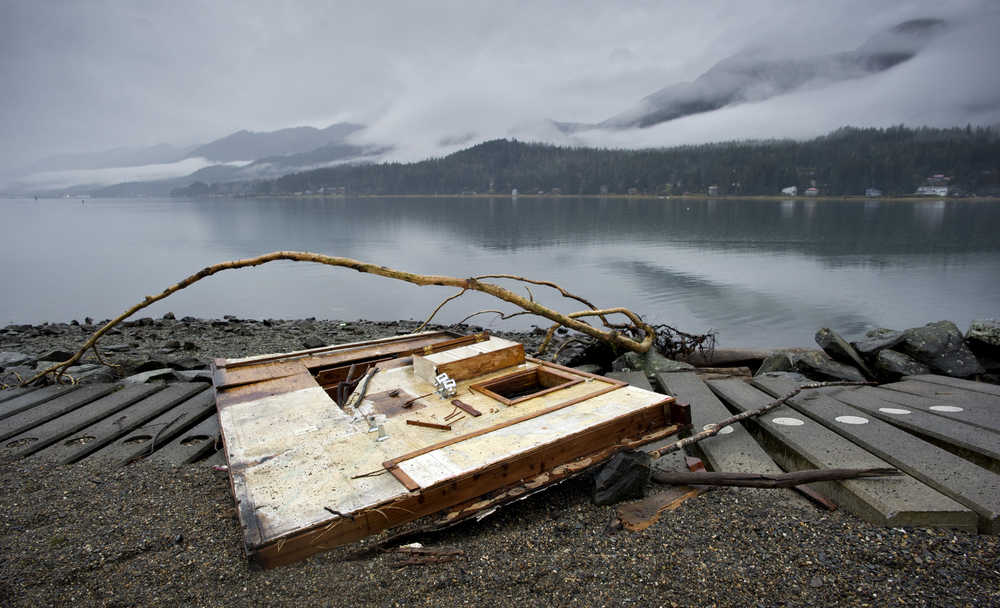
The tugboat Challenger is breaking apart.
One month after the 96-foot wooden boat sank in Gastineau channel, bits of it are starting to wash up.
Spurred by wind, wave and tide, debris is spreading. In Aurora and Harris harbors, city staff had to tow pieces of the boat from boat stalls last week. A bulkhead from the ship’s head — complete with toilet paper holder and bathroom vanity — floated ashore on the beach next to the DIPAC fish hatchery. Other pieces are still trapped by the oil containment boom around the wreck.
Those who see the remains of the Challenger emerge from the water at low tide should get used to it — officials say the Challenger’s owner isn’t cooperating, and the state doesn’t have the money to remove it on its own.
“He’s responded to our reaching out for communication, but he’s not cooperative as far as handling the problem,” said Rob Edwardson of the Alaska Department of Natural Resources.
Edwardson was talking about R.D. Robinson, a Douglas artist best-known for his work at the Shrine of St. Therese and the stonework in front of the Island Pub.
Robinson purchased the Challenger from Juneau resident Timothy Miles in 2014, and it had been a fixture in Gastineau Channel, where it was anchored. On Sept. 12, it sank on the Douglas side of the channel.
The U.S. Coast Guard responded quickly to the sinking to remove the boat’s remaining fuel and oil, and a bright orange containment boom has ringed the wreck as a precaution since it sank.
“For me, the oil is very much a reduced concern,” said Bob Mattson, who oversees oil spills in Southeast Alaska for the Alaska Department of Environmental Conservation.
Mattson said Southeast Alaska Lightering, using a handful of divers, pumped the fuel out of the boat soon after it sank, and the containment boom is a precaution to catch anything that seeps from the boat as tidal currents surge through it.
At this point, it’s important to note that while DEC is in charge of oil spills, garbage spills — which is what the Challenger has become — are a matter for the Alaska Department of Natural Resources, which oversees state land and water.
Where the DEC and Coast Guard rushed into service, the DNR must creep. The DEC and Coast Guard will be reimbursed by the national Oil Spill Liability Trust Fund — which gained teeth after the Exxon Valdez oil spill in 1989 — and that trust fund will seek repayment from Robinson. The DNR doesn’t have any financial help.
It doesn’t have the money to remove derelict vessels, it doesn’t have a federal source of funding for speedy cleanup, and it doesn’t have the authority to force boat owners to remove those derelicts. In fact, it can’t even issue fines without a court order.
“It really does tie our hands,” said Wyn Menefee, chief of field operations for the DNR. “For whatever reason, people seem to be more motivated when you’re required to pay. Not having that tool is like having your hands tied behind you’re back when you’re trying to deal with some of these issues.”
The Empire has attempted to contact Robinson numerous times about the Challenger without success. Edwardson, based in Juneau, said DNR staff have spoken with the boat’s owner.
“He will get in contact with us again and talk about certain things, but he’s reluctant to admit he owns the boat,” Edwardson said.
The Challenger isn’t a unique case. Across the state are hundreds of derelict boats. In Bethel’s Steamboat Slough alone are dozens of decaying hulls. DNR is in charge of what happens on state lands — in the Challenger’s case, it’s the land at the bottom of Gastineau Channel — and leaving a sunken boat on state property is the same as leaving a wrecked car on a state-owned lot.
“We are the landowner there, and we have to deal with that as a land management issue,” Menefee said.
Even though it’s the bottom of the channel, it matters because having the wreck of the Challenger there prevents others from using that space for a dock, say, or an undersea fiber-optic cable.
John Melino owns Melino’s Marine Services, a towing and salvage company based in Juneau. He knows what it will take to remove the Challenger: a lot.
“It’s no small feat,” he said. “You’re probably about just under a million dollars.”
Divers will be needed to cut the Challenger apart, and cranes will be needed to lift the wreckage on to a waiting barge.
“And the other issue — and it’s always an issue — what do you do with it once it’s on the surface?” Melino asked.
Most wrecked wooden boats are burned — but where would that happen in Juneau?
“This is a huge, huge deal to dispose of this thing,” Melino said.
