
By Mary F. Willson
For the Juneau Empire
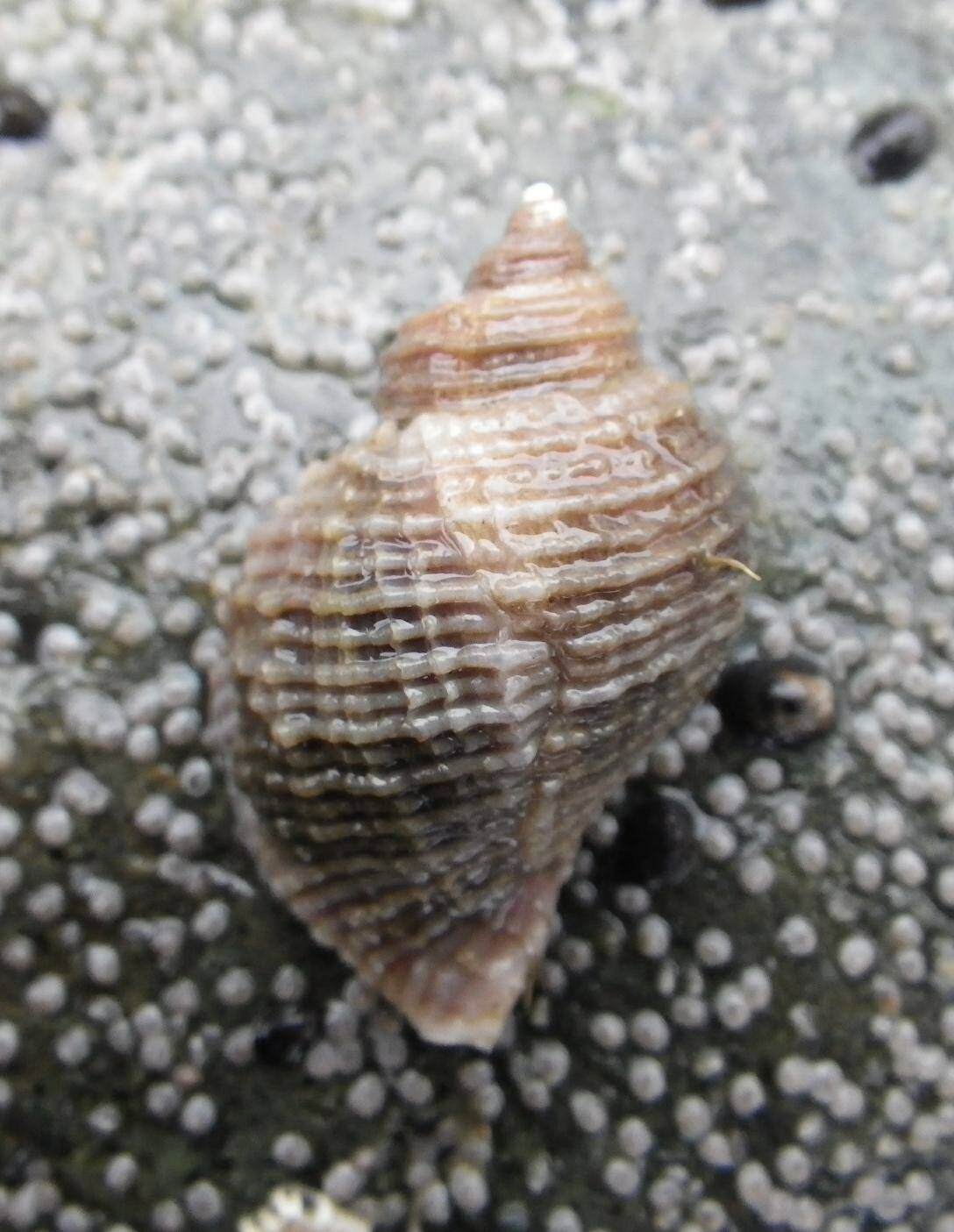
In the course of looking up some other information, I came across an interesting tidbit about whelks. Whelks are predatory snails; there are many species, belonging to several genera, some of which occur in our intertidal zones. Whelks generally feed by extending a proboscis that has a mouth, leading to the esophagus and stomach, and a file-like radula, bearing lots of small teeth, that shreds the flesh of the prey—conveniently near the mouth. The rasping teeth on the radula are replaced quickly when they wear out. Whelks often feed on bivalve molluscs such as clams and mussels, barnacles, and also various other invertebrates. Access to the body of the prey is commonly achieved by drilling a hole in the hard shell with the radula, assisted by secretions of a chemical that weakens the shell. In other cases, whelks insert the proboscis through a partially opened bivalve shell, sometimes wedging open the two parts of the shell with the edge of their own shell.
Here’s the bit that sparked my interest: Whelks can learn! In lab experiments, European dog-whelks (genus Nucella, related to ones that occur here) were fed on mussels for three months and then were presented with barnacles as prey. Initially, they drilled through the outer shell of the barnacle, but after sampling just a few barnacles that way, they began to shift methods: They started to enter the barnacle through the opercular plates (valves that barnacles open and close when they feed on small prey).This mode of entry is easier and quicker than drilling thru the barnacle shell, so the profitability of whelk foraging effort increased.
Similarly, dog-whelks that were initially fed on barnacles and then encountered small mussels learned to focus on the thinnest parts of the mussel shells. When presented with large, thicker-shelled mussels, they learned to attack the shell at a point above he most nutritious part of the mussel (the stomach area). So, although the foraging effort was high, the food reward for that effort was high.
It turns out that they can also learn to avoid areas when members of their species have been injured or eaten by predators. And they can remember that for several weeks.
These whelks can learn by experience, although they don’t have a real brain. Instead, they have a set of paired nerve clusters (ganglia) in a ring around the esophagus. Those ganglia are well-connected to each other (and the rest of the body), but this arrangement is not called a brain. (Hmm, I know some critters with proper brains who do not learn so quickly!)
Western hemlocks sometimes have trunks that are deeply ridged and furrowed; this is called ‘fluting’. The ‘flutes’ are the furrows; the ridges are referred to as buttresses. Fluted hemlocks are most common along the coast, with western exposure, in situations where the trees are exposed to wind (e.g., near beaches and shoreline cliffs, in clearcuts or other openings).
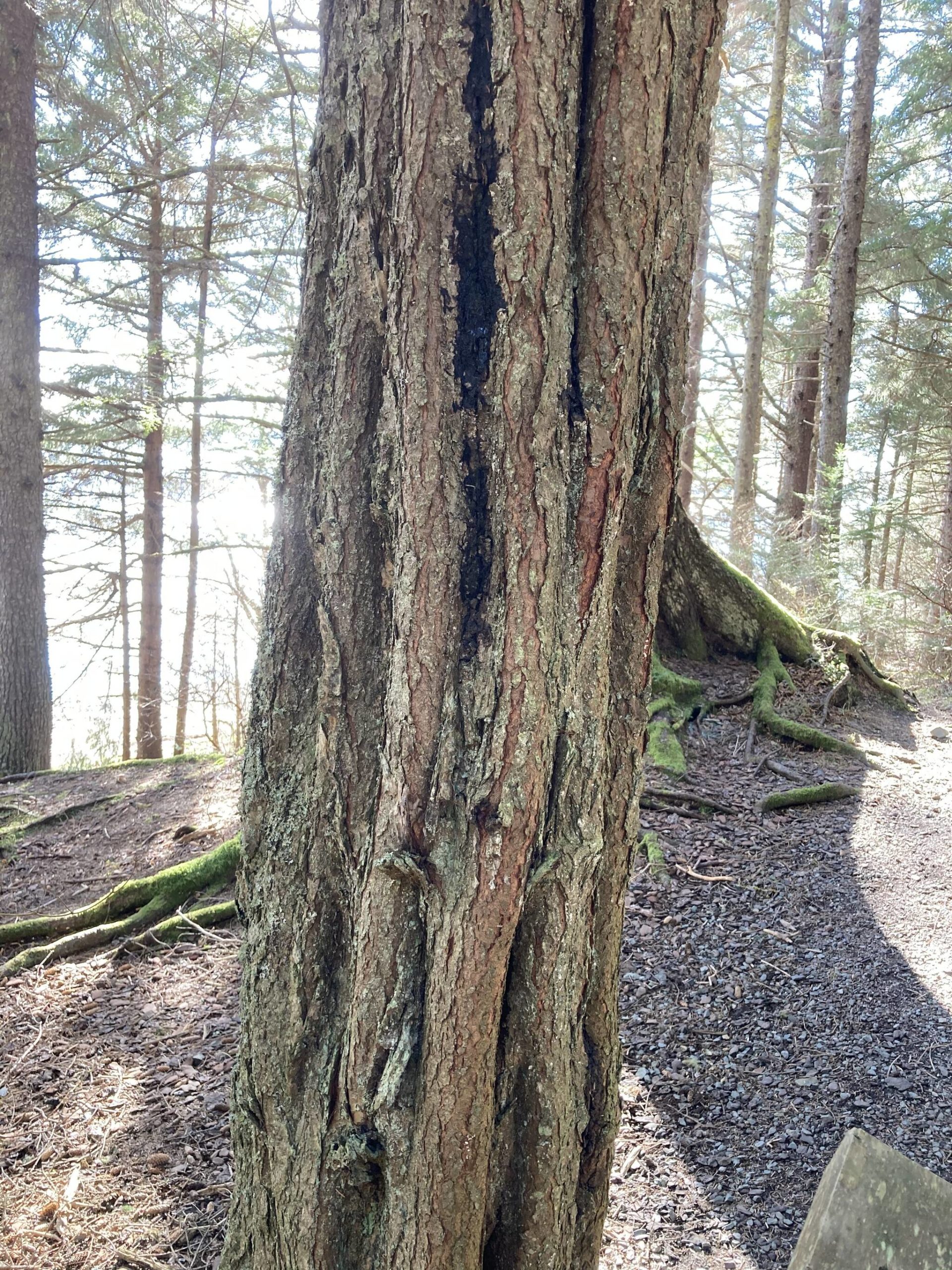
A fluted hemlock trunk shows the deep furrows between ridges/buttresses. (Courtesy Photo / Mary F. Willson)
The so-called buttresses and adjacent roots develop most strongly on the side away from the strong winds. In Southeast Alaska, fluted trees are common in the dominant trees of even-aged stands. Here, we see them commonly on west Douglas and near Auke Rec.
Flutes start to develop where branches emerge from the trunk, particularly when the branches in the lower crown of the tree become senescent and die. Researchers have suggested that branches interrupt the flow of nutrients to the cambium (the layer under the bark that lays down wood, among other things) in the trunk, and nutrients are not distributed equally around its girth. So the annual growth rings are not the same thickness all around the trunk—creating the ridges and furrows.
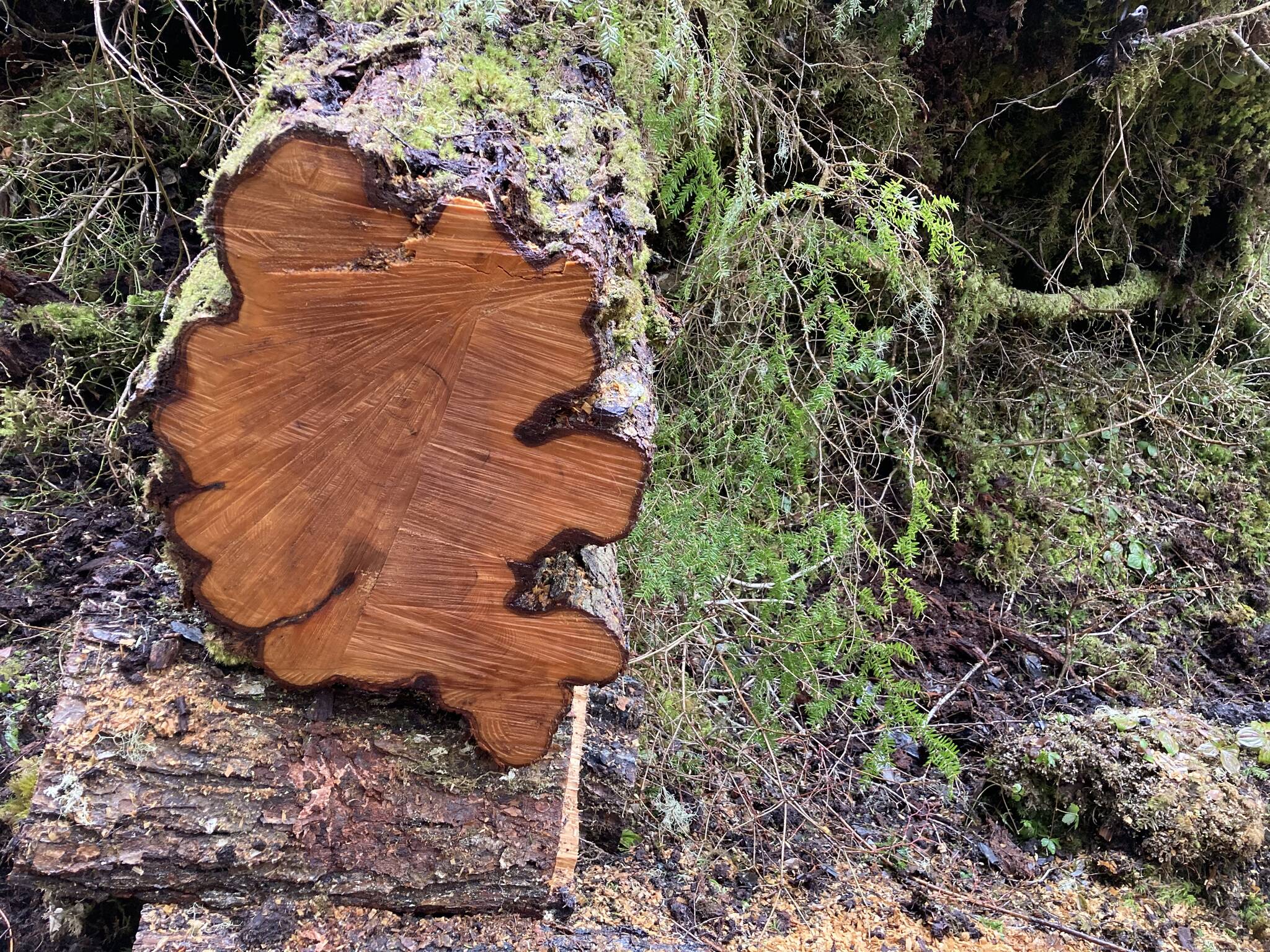
A cross-section of a fluted hemlock trunk shows a very deep flute and a flute that has closed. (Courtesy Photo / Mary F. Willson)
Flutes often start to develop near the base of a young tree. They gradually get deeper and deeper, sometimes (after many decades of tree growth) closing right over the bark in the furrow. Then the flutes are not so readily visible from the outside.
It seems that most of the research about hemlock fluting was done some years ago. Many questions are still out there. Why are western hemlocks particularly susceptible to fluting? What about mountain hemlocks? Exactly how does a branch change nutrient flow to the cambium? How do fluted trunks compare to cylindrical trunks in resisting wind? Are there certain genetic strains that tend to develop flutes or that favor windy habitats? And so on…
Thanks to Robin Mulvey, USFS, for help in getting references on hemlock fluting.
• Mary F. Willson is a retired professor of ecology. “On the Trails” appears every Wednesday in the Juneau Empire.
