
By Mary F. Willson
For the Juneau Empire
In mid-October, I made a quick trip back to my old stomping grounds in southern Wisconsin. In addition to blue skies and sunshine, some long-delayed (by COVID) good family time, a short, nostalgic trip on the little cable ferry over Lake Wisconsin at Merrimac, a fine symphony concert in Madison, visits to some excellent regional artists showing their work and early fall foliage colors, there were some natural history highlights.
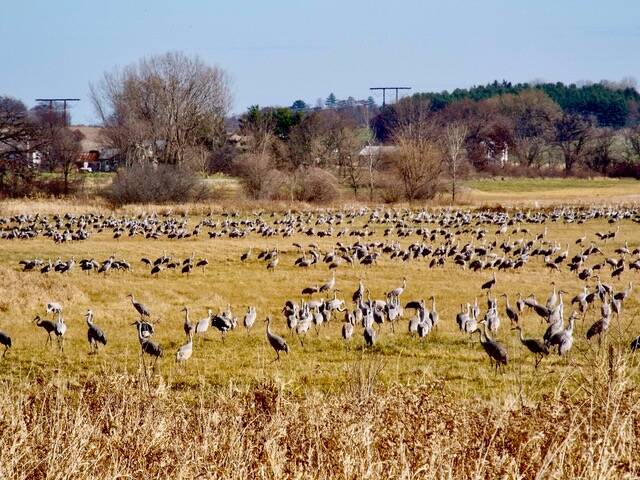
Just outside of my old home town, we found a lot of sandhill cranes in the stubble fields and pastures or flying overhead and calling. They come through every year from their nesting grounds farther north; they nest mainly across northern North America and most of them migrate to Texas and northern Mexico or Florida for the winter.
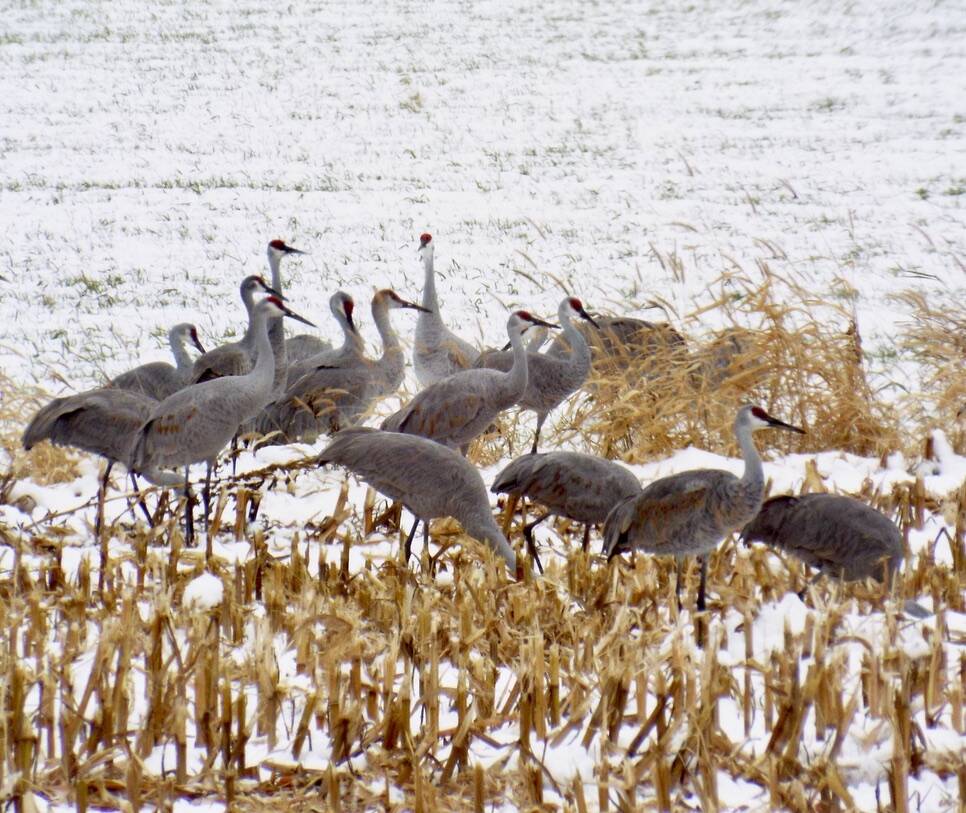
Sandhill cranes, like the ones in this photo, come through Southern Wisconsin every year from their nesting grounds farther north; they nest mainly across northern North America and most of them migrate to Texas and northern Mexico or Florida for the winter(. Courtesy Photo / J.S. Willson)
It’s always a big treat to see them, but there was an even better one: in one rather distant stubble field, all by themselves, were three whooping cranes, foraging, wing-lifting, and hobnobbing with each other. Whoopers formerly nested in prairie marshes all over north-central U.S., but their population declined drastically, chiefly because of habitat loss and heavy hunting. Now they nest only in three locations in North America: a natural, self-sustaining population in northern Alberta and adjacent Northwest Territories, a re-introduced non-migratory population in Florida, and a population in central Wisconsin (at the Necedah National Wildlife Refuge) that is maintained by re-introduced birds hatched and reared by captives (with human help) in facilities at the U.S. FWS Patuxent Research Refuge in Maryland and the International Crane Foundation in Wisconsin. Captive-bred juveniles are cared for by humans dressed in crane costumes and learn their proper migratory route by following older birds and special ultra-light aircraft. The Canadian contingent flies to Texas for the winter, and the Wisconsin nesters fly toward Florida, some over-wintering along the way.
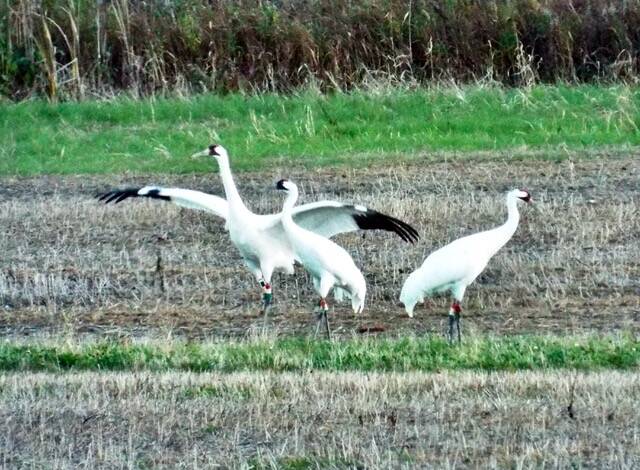
This photo shows whooping cranes. Whoopers formerly nested in prairie marshes all over north-central U.S., but their population declined drastically, chiefly because of habitat loss and heavy hunting. Now they nest only in three locations in North America: a natural, self-sustaining population in northern Alberta and adjacent Northwest Territories, a re-introduced non-migratory population in Florida, and a population in central Wisconsin(Courtesy Photo / J.S. Willson)
We visited the Necedah National Wildlife Refuge, about an hour’s drive northwest of town. There we saw trumpeter swans, a variety of ducks, and still more sandhill cranes, cavorting and calling. As we walked one of the wooded trails, off to the side there was a flash of black and white, flying from one tree to another. That deserved a closer look and yes!!—it was a red-headed woodpecker! When I was a kid, many long years ago, these woodpeckers were very common. Historically, this species has undergone large fluctuations in population size, partly related to fluctuations in a major food supply (acorns and beechnuts), but also lots of habitat loss, shooting, and other factors. There have been population declines in the past several decades, and the birds may still be endangered in some parts of North America.
Red-headed woodpeckers typically nest in open oak woodlands and in forest edges and clearing, using cavities in snags and dead branches. They eat all sorts of things, including insects (they are expert fly-catchers), fruit, occasional small vertebrates and eggs, as well as acorns and beechnuts, which are especially important in winter. They are one of the few woodpeckers that store food, cramming acorns and large insects tightly into cracks and crevices and behind bark; in some cases they make a big cache of many food items, probably re-storing them later in a more scattered distribution.
My hometown lies at the edge of the unglaciated Driftless Area, in a valley ringed by the remnant tops of ancient quartzite mountains that were made hundreds of millions of years ago and eroded over time. These hills now support varied habitats, including cliffs and talus slopes, oak savannas, dry hill prairies, and lots of deciduous forest. I take special pleasure in the diversity of trees in that forest; I can stand in one place and (depending just where I am) see six or eight or ten kinds of tree, each with characteristic branching pattern, leaf shape (and color, in fall), bark texture, and its own way of life. Mixed in with all the broad-leafed trees are scattered white pines.
Of course, it was also good to see old avian friends, such as white-breasted nuthatches, black-capped chickadees, cardinals, red-breasted woodpeckers, house finches and goldfinches, slate-colored juncos, and blue jays.
• Mary F. Willson is a retired professor of ecology. “On the Trails” appears every Wednesday in the Juneau Empire.
