
Most of us here live in a way that’s dependent on electricity, but we are generally unaware of electrical phenomena in natural environments (except for lightning). However, many kinds of animals are able to sense the small electrical fields that are associated with virtually every organism (and Earth itself). This sensory ability can be used in several ways.
Water is a better conductor of electrical signals than air, so even tiny inadvertent signals from individual electric fields can be transmitted better through water than through air. And many studies have explored electroreception in aquatic organisms.
Many fishes, both freshwater and marine, are known to have electroreception. The structure of electroreceptive organs varies among species and has evolved separately in different lineages, but these organs are generally located in the skin of fishes. The ability of electroreceptive fishes to locate prey has been well-studied, in some cases even locating prey that is buried in sediments. Some fishes extend their electrical ‘reach’ (beyond their individual electric field) by a special organ that generates a greater electrical discharge, which facilitates prey location. These “weakly electric” fishes (e.g., knifefishes) also use their electric capacities in social interactions, including recognition of species, sex, individual identity and the organizing of group hunting; they can adjust their electrical discharge to avoid jamming each other’s signals. In a few species (e.g., electric eel), that electric organ generates such a great discharge that prey can be stunned, incapacitated, and even killed.
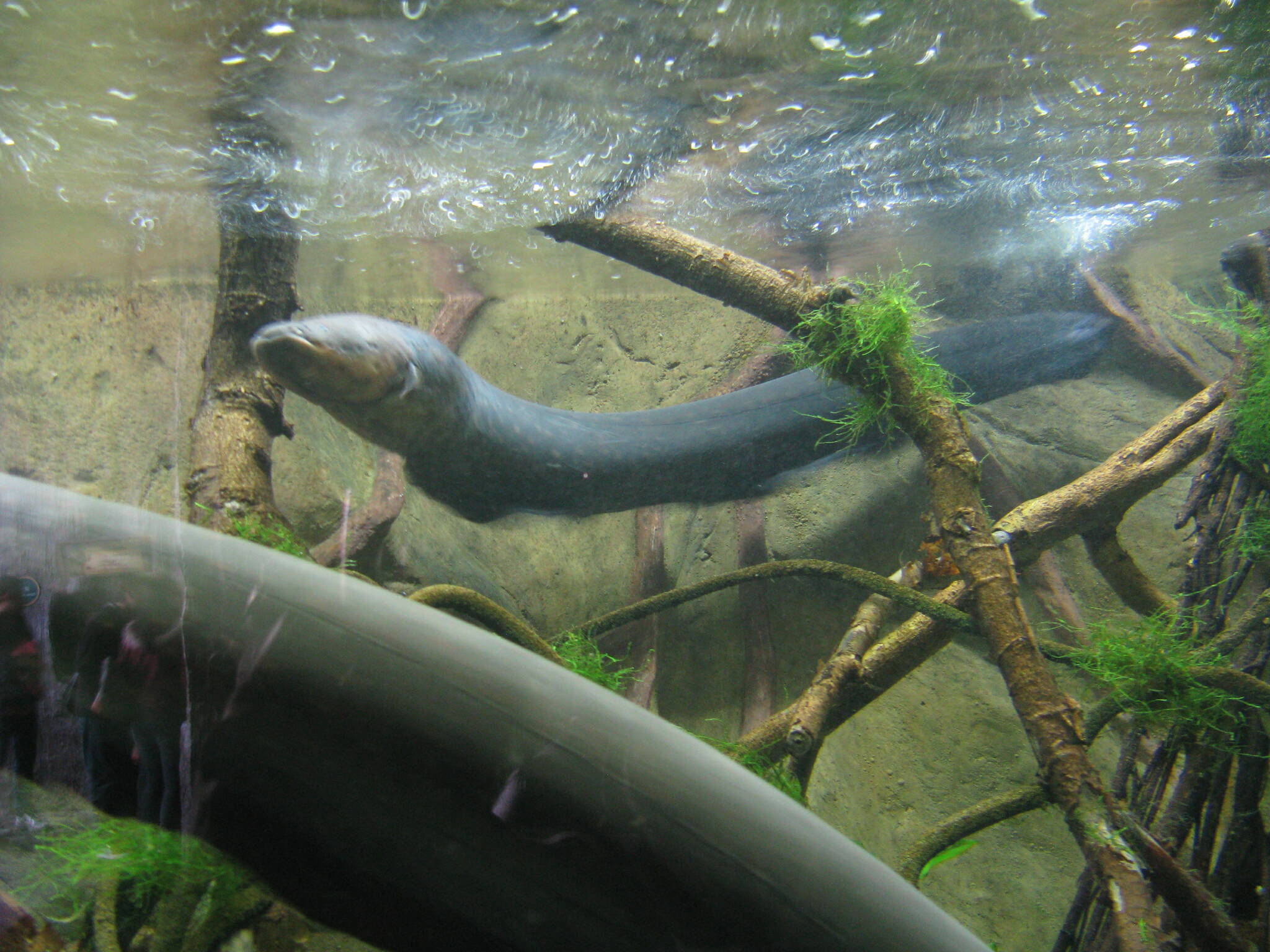
Electric eels swim fast inside a tank in this photo available under a Creative Commons license. (Shankar S. / Flickr)
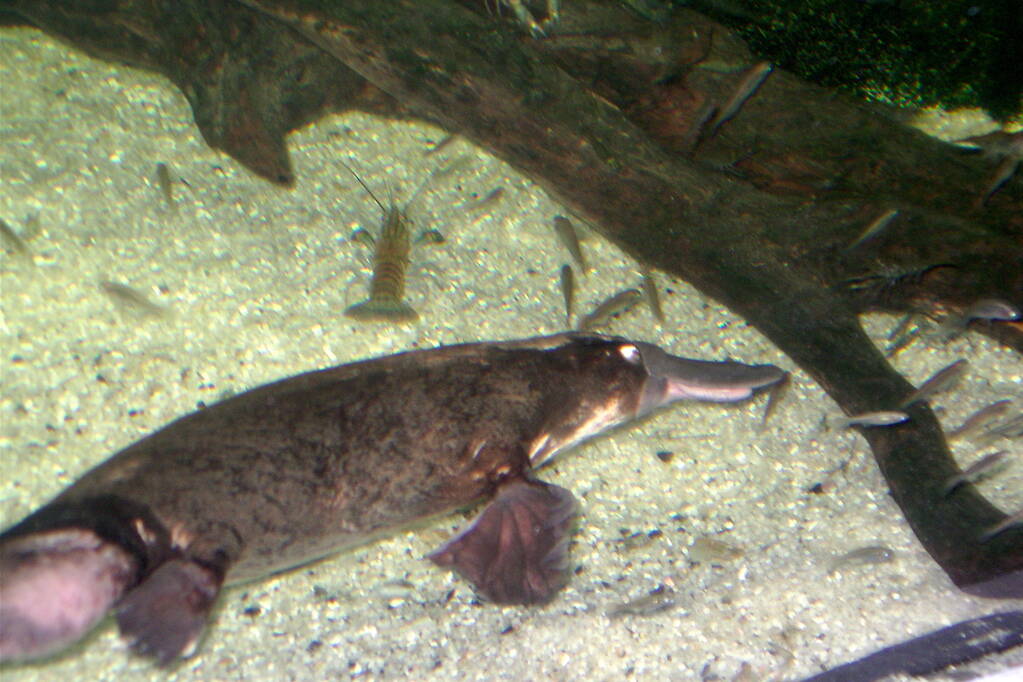
Some Australian mammals use their electrosensitivity to find food. The platypus closes its eyes and ears and nose when it dives, and swishes its bill back and forth in murky water and sediments, locating invertebrate prey with the many electroreceptors on its bill. At least some of the related echidnas (although not aquatic) have electroreceptors in their snouts, which appear to work when the animals root about in damp soil or water, locating worms and other prey.
Other vertebrates known to have electroreceptors include salamanders and at least one dolphin. The capacity may occur in other dolphins and has been suggested but not shown in a few other mammals (e.g., star-nosed mole). Even less is understood about aquatic invertebrates sensing electric signals.
The big surprise for many scientists was finding that electroreceptors also work well in air. Even though air is not a good conductor, aerial electrical signals can work over short distances. There are many examples, some well demonstrated, others still to be fully documented. For instance, geckos are famous for their ability to climb vertical walls and cling to ceilings, and electrical charges (in addition to other factors) in their feet assist this activity.
Bumblebees and hoverflies use electric signals from plants when they visit flowers, as discussed in a previous essay. Electrical signals may enhance the information transferred from one honeybee to another, when the waggle dance is communicating the location of foraging sites. Spider webs may be attracted to insects carrying the opposite charge, deforming a few millimeters toward a flying insect. Spiders and moth larvae often disperse by ballooning on long silk strands, which could interact with the atmospheric potential gradient from the earth in a way to increase the height of the airborne disperser and even affect the decision about when to start ballooning. Bacteria and their spores carry electrical charges that may contribute to their aerial dispersal by interacting with the atmospheric gradient. Tall trees can shield their surroundings from the atmospheric gradient, which would impact ballooning and possibly other aerial activities.
Now, consider an additional marvel. When an animal moves through its environment, it accumulates electrical charge; insects or birds in flight experience friction with the air, so do walking or running animals, which also brush against various objects in their path. Even rain drops, falling through the air, develop a tiny charge. These effects of motion are typically very small but potentially wide-ranging. For instance, some experiments have shown that more bacteria and viruses are deposited on flying insects that carry a charge. In addition, and closer to direct human concerns, more bacteria adhere to the garments of hospital workers as they whisk down the halls from room to room, suggesting that there is more clinical transfer of pathogens than we imagined.
It is also possible that electrical fields influence olfaction (sense of smell) in animals, by increasing interactions between airborne molecules and the olfactory organs. And since plants also communicate with aerial chemical signals, perhaps electricity is involved with that too!
We’ve just begun to explore the world of electric ecology and many hidden boxes remain to be opened. Meanwhile, we’ve learned that electroreception is a fact of life for many organisms, with vastly more still to be discovered and explained. Given that fact, we need to recognize that there are undoubtedly many aspects of human activity that affect the electric ecology of other organisms on earth. We already know something about anthropogenic pollution of water and land, light pollution, and noise pollution; now consider what we might do to electric ecology. For instance, spraying pesticides and fertilizers changes the electrical field of flowers and changes visitation by insects. Strong electrical fields around cables, power lines, and various man-made structures tend to be avoided by many animals. No doubt, more ways that humans can interfere with the rest of global ecology will emerge from continuing research in electric ecology.
• Mary F. Willson is a retired professor of ecology. “On the Trails” appears every Wednesday in the Juneau Empire.
