
After a slow start, the season has sprung into full swing.
The early avian harbingers have been joined by lots of other species in the first part of May. Out on the wetlands, flocks of small shorebirds and little brown songbirds swooped around and settled invisibly in distant sloughs or the brown grasses. Some of those little brown songbirds eventually turned into Lapland longspurs, savanna sparrows, and (near the forest edges) white-crowned sparrows.
On one lucky day, I saw four mountain bluebirds perched on the fence posts at the edge of the golf course; later I saw three of them perched on the tall, dried seed-heads of dock plants. That same day, three species of swallow (barn, tree, violet-green) coursed up and down one short section of a tidal slough. A big group of northern shovelers hung out on the river, more than I’ve seen together in one place previously. A few American pipits ran along the grassy edge of a slough.
Two days later, there were no bluebirds to be seen; maybe they took advantage of the good weather to make the trip over the mountains to the Interior. From the dike trail, I saw twenty-two white-fronted geese huddled on the river with a single snow goose. Out over the dry grasses, a northern harrier (in brown plumage, therefore female or juvenile) flew low, back and forth, and then dropped straight down to the ground and began pecking repeatedly at some invisible prey. Three ravens chased a hawk with agitated calls, disappearing into the distance. I had to wonder what that hawk had done—or was suspected of doing…
In other places: Kingfisher Pond hosted red-winged blackbirds, tree swallows, and a coot, with yellow-rumped warblers flitting in the shrubbery. Another observer there recorded Wilson’s warbler, green-winged and blue-winged teal. Hermit thrushes began to be heard in the forest. North Tee Harbor reported female bears with cubs, prowling about. A big bear wandered through my yard in the middle of the month. Little white butterflies flitted over the dandelions and emergent greenery. And fern-leaf goldthread flowers appeared along some wooded trails.
[On the Trails: Spring is slow to come this year]
Rufous hummingbirds always appear at my feeder a couple of weeks or more after they are reported from Fritz Cove Road. But they finally showed up, perhaps a pair, but they visit the feeder separately, usually in the afternoon.
A male hairy woodpecker landed on my deck railing and was chased off by a squirrel. He came back a couple of times and visited the peanut butter offerings. I was reminded that in a previous year a fatherly hairy woodpecker brought his fledgling to the deck for daily lunches. Could that happen again? The local red-breasted nuthatches are making lots of trips to the seed feeder for sunflower seeds, quickly zipping back into the spruces, sometimes returning so soon that I begin to think they are just stashing the seeds somewhere, for later eating. I hope they will nest here again. A varied thrush comes to collect seeds from the deck railing, but it spends most of its effort on a suet feeder—lunging up to jab the suet with its bill while madly flapping its wings (not a graceful hoverer).
The big excitement on my home pond was the unexpected appearance of two pairs of wood ducks. I’ve never seen them here before, although they’ve been rumored to nest occasionally in the lower Valley. As of this writing, the wood ducks have been here for over a week, and I saw one pair copulating. They nest in boxes and tree cavities, but I have no idea if suitable cavities are available near here. They got along peaceably with the mallards that remained on the pond.
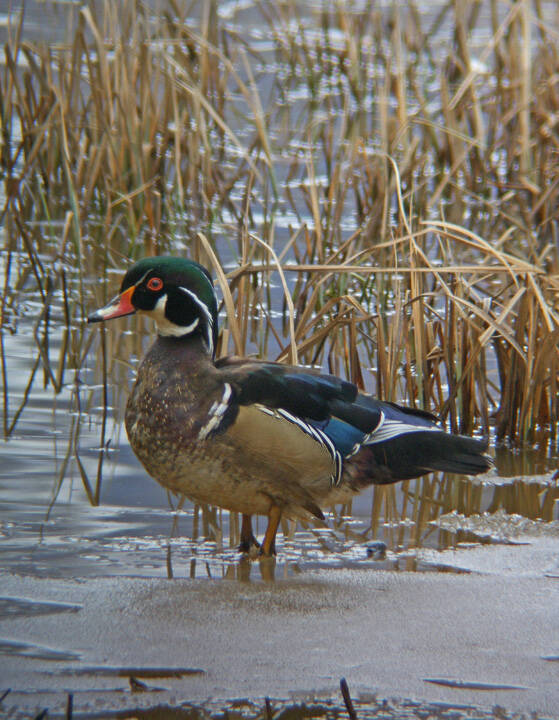
Wood duck males are colorful and rare in Juneau (Courtesy Photo / Bob Armstrong)
Sometime early in the month, all the females and most of the male mallards departed from my pond. A lone male floated on the pond for a few days and eventually was joined by a solo female who stayed for several days; they often rested side by side on the bank. I’m guessing that she had laid some eggs but lost them to a predator, and she was here to start another clutch. Mallards are ground nesters, relying on camouflage and concealment (and luck) to survive the long incubation process, but the eggs are vulnerable to wandering dogs, bears, ravens, and other predators.
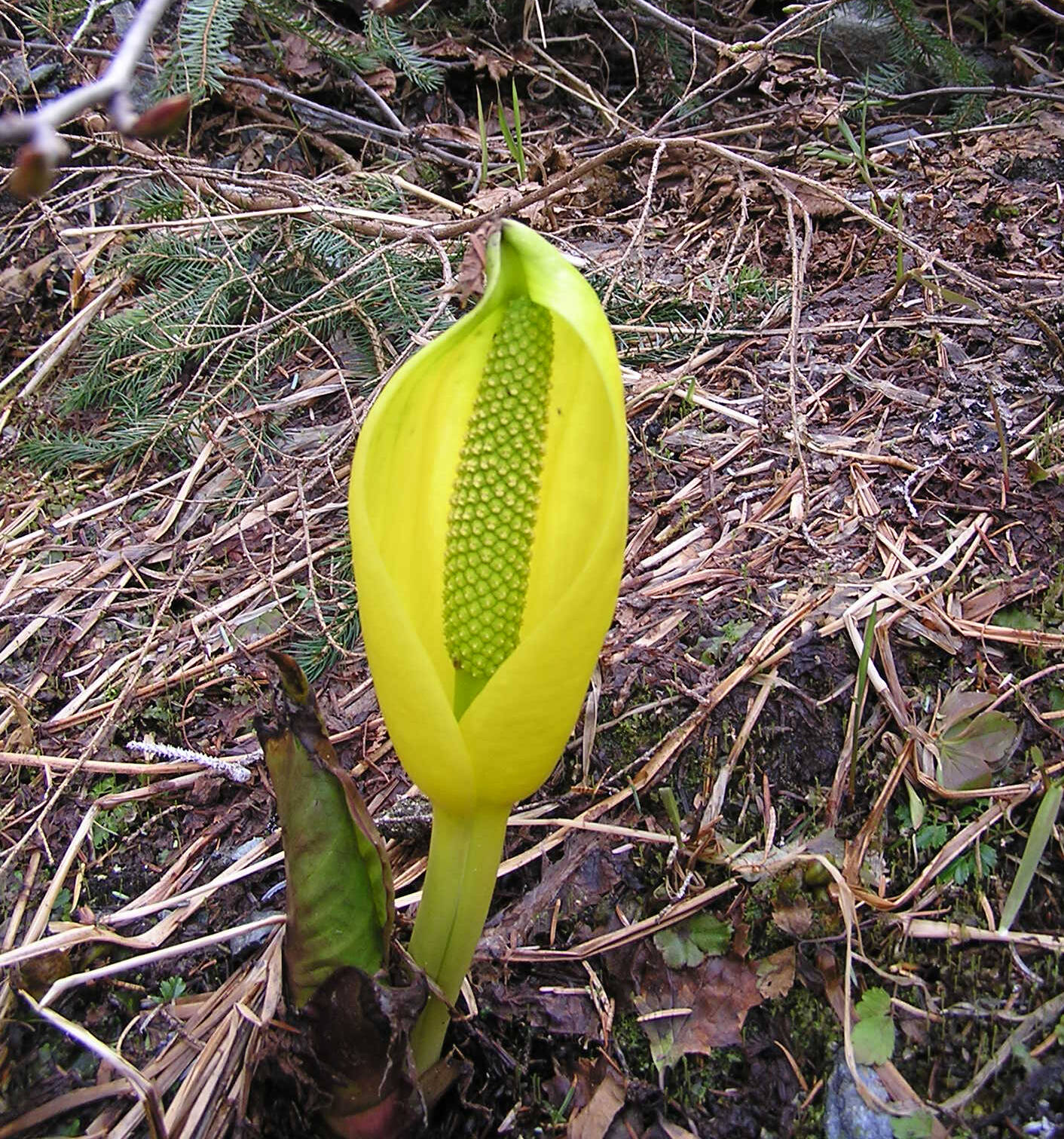
One of my favorite things in spring is watching the skunk cabbage plants. First, the little green spears emerge from the shallow waters, but I impatiently await the cheery, brilliant yellow spathes that announce the flowers of ‘swamp lanterns’. The hood-like yellow spathe (if not nipped off by frost or deer) surrounds the spike (or spadix) of densely packed flowers. Each of those flowers is female first—with pointy little stigmas sticking out for potential pollen reception. But the earliest plants to bloom, being all female, have no source of pollen, unless they can somehow pollinate themselves, as the flowers mature into the male phase. Eventually, all the flowers become male, producing yellow pollen. Now we begin to see insects hiding down deep in the spathe, sometimes tiny flies and dozens of black beetles. The beetles are thought to be pollinators, crawling over the male flowers, eating pollen and getting it all over their bodies, then carrying the pollen to later-blooming individuals, still in female phase. We never see as many beetles hiding in spathes around female-phase flowers as in spathes with male-phase flowers. And female-phase individuals often have no beetles at all, so it seems that beetle visits to females are intermittent, and I suspect that females send out air-borne messages that attract the beetles just when the time is right for pollination.
The red alder trees along the highway are popping out little leaves, catching up with some of the shrubs that leafed out earlier. Now every day may bring some new development for the season—such fun!
• Mary F. Willson is a retired professor of ecology. “On The Trails” appears every Wednesday in the Juneau Empire.
