
Humans have self-medicated for ages, in various ways (not always healthy ones!), commonly using plant-derived materials applied externally or used internally. Although many of these uses remain in the realm of myth and wishful-thinking, some have been scientifically shown to be effective, at least in certain circumstances, although the sample sizes are usually small and the studies need replication.
I take a walk every day and find that this almost always improves my outlook on life. Walking can serve many functions, often overlapping and interacting, including exercise, observations and exploration, socializing (and, if I am lucky, a friendly canine greeting), contemplation and assessment. I find it useful in all those ways and typically feel better after a walk, so, in effect, this is a form of self-medication — one that is unlikely to be harmful.
Other animals may self-medicate too, although the evidence is largely suggestive and needs fundamental experimental documentation. The circumstantial evidence lies in observations that strongly, logically, indicate a medical function but, of itself, it is not proof. Examples come from many kinds of critters.
— European wood ants incorporate lots of solidified conifer resin in their nests. This reduces the growth of micro-organisms (as it does in the originating trees).
— Certain tiger moth caterpillars (sometimes called woolly bears, but not the same as the ones we call by that name) selectively eat particular kinds of plants containing alkaloids that increase survival of individuals parasitized by tachinid flies.
— Fruit flies, which can be parasitized by certain wasps, seek out foods that provide ethanol. Ingestion of this alcohol decreases oviposition by the wasps and increases the death of any wasp larvae already in the host fly. (Note: this only works with generalist wasp species, not with the species that specializes on fruit flies).
— Monarch butterfly caterpillars feed on milkweed plants but don’t favor any particular species. Mama does it for them: if she is infected by parasites, she oviposits preferentially on milkweeds that reduce parasite growth in the caterpillars.
— Chimpanzees and other great apes in Africa sometimes eat parts of plants that have little nutritional value (e.g., bark) as well as whole leaves and clay. These dietary choices may be useful against intestinal parasites.
— Starlings (and many other birds) often place bits of aromatic herbs (such as fleabane and wild carrot) into their nests during the nest-building process. Males begin the nest building in a cavity, later joined by a female; experienced, adult males are more selective of particular plants than are first-year males. Placement of the herbs continues until the eggs hatch. The volatile compounds in the aromatic herbs in one experiment reduced infestations of blood-sucking mites on nestlings, although nestling survival did not improve significantly. Another experiment found no difference in the numbers of mites on the nestlings, and no difference in nestling survival, but a significant difference in chick survival to age one year.
— Hummingbirds in Patagonia select a rare moss for nest material, constructing most of the nest with this moss. The preferred moss has effective antimicrobial activity, and it also has toxic compounds that might deter predation on eggs and chicks by small mammals.
— Some parrots in some parts of Amazonia gather at clay banks, eating the clay. Some researchers suggest that the clay may neutralize toxins in the seeds that parrots eat, but others claim that the birds are getting scarce minerals, such as sodium. Still another notion is that adult parrots feed the clay to their chicks, which do not have much resistance to toxins.
— Songbirds sometimes hold ants (or millipedes) in their bills and smear the ants over their feathers; or sometimes they just sit closely on ant nests and let the ants crawl over them. Anting may deposit some formic acid on the birds’ skins, which could deter ectoparasites or just feel good or something else.
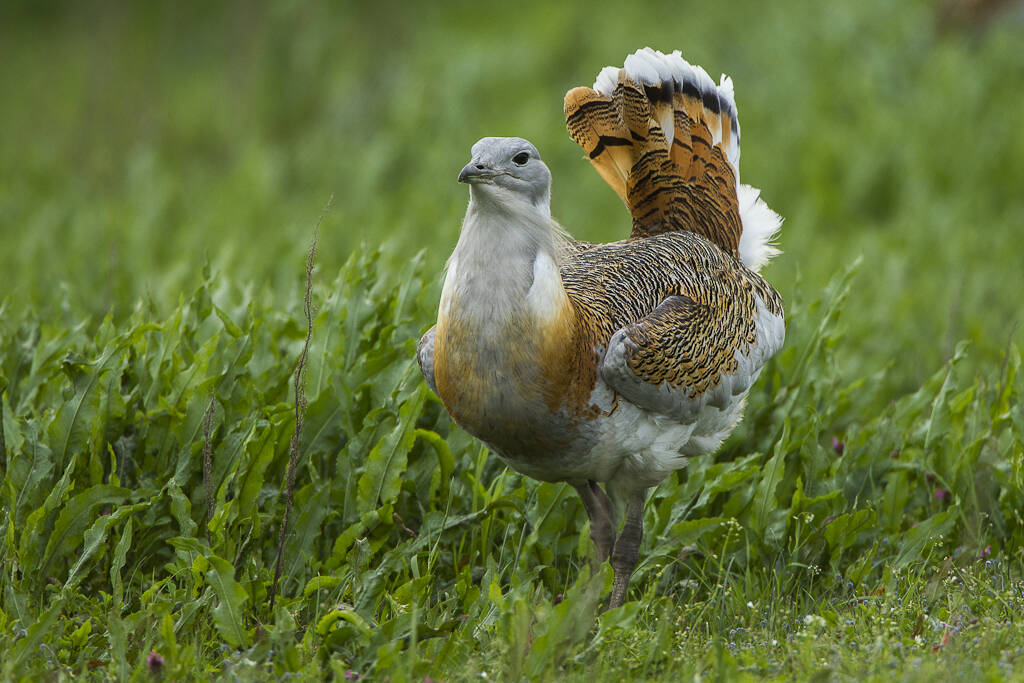
— Great bustards are big ground-dwelling birds of Eurasia. Males gather on communal display grounds called leks in the mating season, displaying vigorously and trying to attract females. The energetic displays divert energy from the immune system, so it is less effective. These birds, especially the males, selectively eat blister beetles that contain toxic cantharidin, but because the toxin is lethal to the birds except at very low doses, only one or two at a time. This toxin is known, from in vitro experiments in the lab, to kill fungi, round worms, and bacteria (although its activity in bustards has not been tested directly). Males (more than females) also prefer to eat certain plants (a poppy and a bugloss) containing compounds that are effective against protozoan and round-worm parasites. Selective eating of beetles and these plants has only been documented for the Spanish population of bustards, which is geographically isolated from other populations.
The courtship display of male great bustards includes raising and exposing the rear end, where the digestive and genital tracts end in a common cavity (the cloaca). A courting male presents his rear end to a prospecting female, which inspects the cloaca very closely. The cloacal opening is surrounded by small white feathers, where parasites or traces of diarrhea would be visible to a female. Absence of parasites (and resistance to the toxin) would be good indicators of male health, which in combination with other traits, allows the female to make a good choice. Females are extremely choosy and most males don’t get a mate.
A lot remains to be learned about self-medication!
• Mary F. Willson is a retired professor of ecology. “On the Trails” appears every Wednesday in the Juneau Empire.
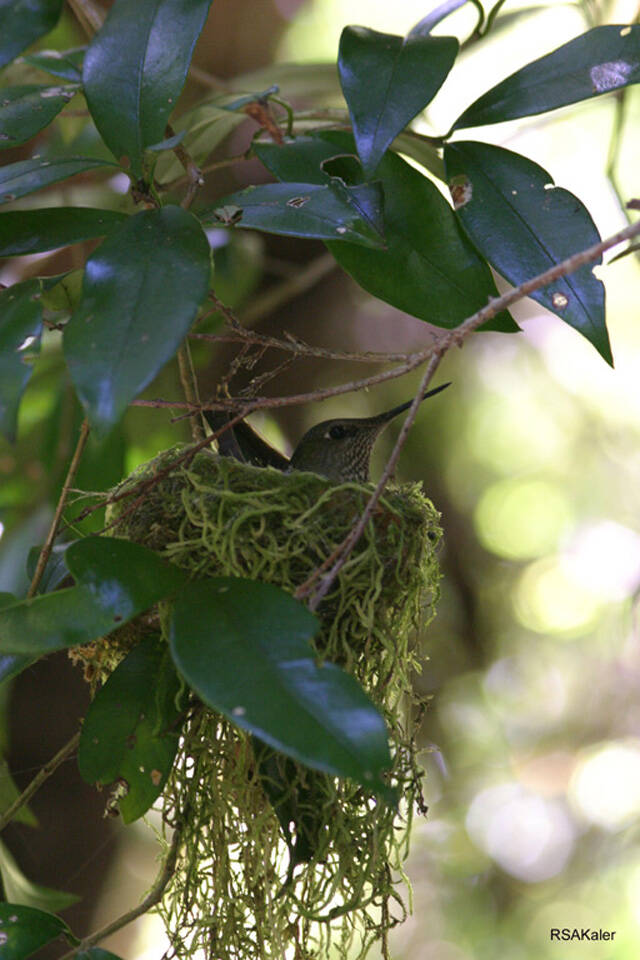
A hummingbird of Patagonia sits on her nest made of special mosses. (Courtesy Photo / Estacion Biologica Senda Darwin)
