
By Mary F. Willson
For the Juneau Empire
On a damp morning at the end of November, I wandered out on the wetlands near the golf course. There were rumors of short-eared owls foraging in the meadows, and I hoped to watch one in action. They commonly pass through the Juneau area on their seasonal migrations, especially in the fall (I think), and occasionally a few may stay the winter.
Some short-eared owls that nested in western and Interior Alaska were marked and followed to their wintering areas. Most of the marked birds went south on the east side of the Rockies, but some went along the coast. Winter quarters were spread from Montana to Texas and California to Kansas. Spring migration routes seem to be less well known.
About those short ‘ears’: They are not for hearing at all. They’re just little tufts of feathers that can be erected, presumably as some sort of social communication. The functional ears are asymmetrically placed on the sides of the head, which helps with pin-pointing prey locations.
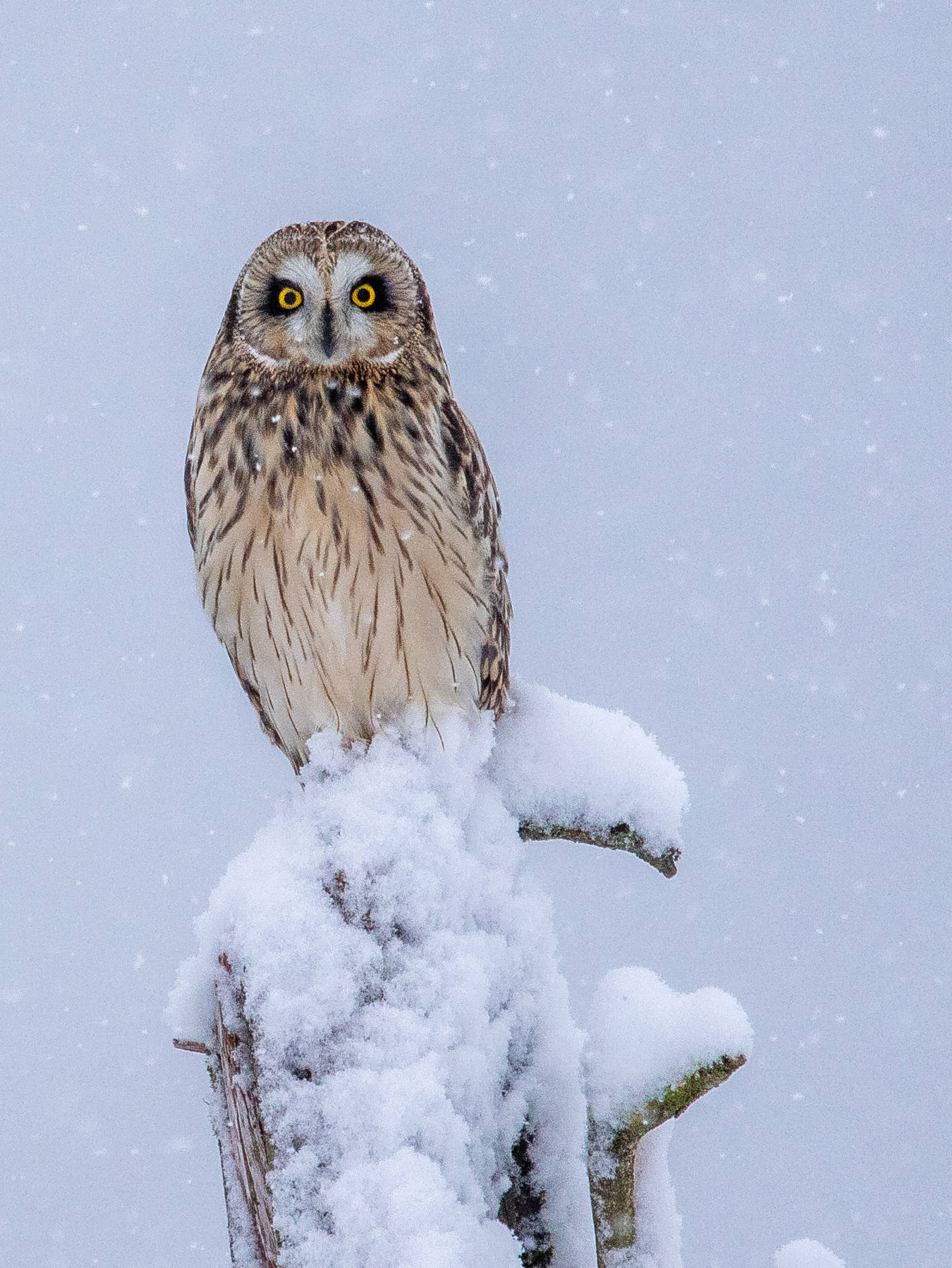
A short-eared owl perches on a snag while the snow falls. About those short ‘ears’: They are not for hearing at all. They’re just little tufts of feathers that can be erected, presumably as some sort of social communication. (Courtesy Photo / Kerry Howard)
Short-eared owls are open-country birds, nesting and hunting in tundra and grasslands. Unlike many owls, they often hunt during the daylight hours. Their main prey items are voles and other small mammals, often swallowed whole, but they also capture birds, commonly tearing off the wings before swallowing. Undigested remains are coughed up as pellets (so handy for curious naturalists who like to know what they were eating).
Short-ears hunt chiefly by coursing low over the meadows, occasionally hovering for a closer inspection. The wings look big compared to a relatively small body, and indeed this species has low wing-loading. That is the body mass (technically, not quite the same as weight, but close enough for many purposes) divided by the wing area. Those long, broad wings carry an owl smoothly and gracefully over their hunting grounds. The low wing-loading is said to enhance aerial agility, allow better hearing while in flight, and reduce detection by prey.
Owl spotting wasn’t good that morning, though lots of hopeful photographers were out there. I didn’t see an owl in flight or perched on a stump, but, guided by some friends, I saw one that had been dead for a few weeks. This bird apparently had been shot by some yokel with more ammo than brains — a wanton, useless act of vandalism that certainly reduced potential pleasures for wildlife watchers of all sorts. The body was carefully tucked up in a niche under a stump, maybe just to hide the evidence, but I’d like to think that someone had sympathetically said “Rest in peace.”
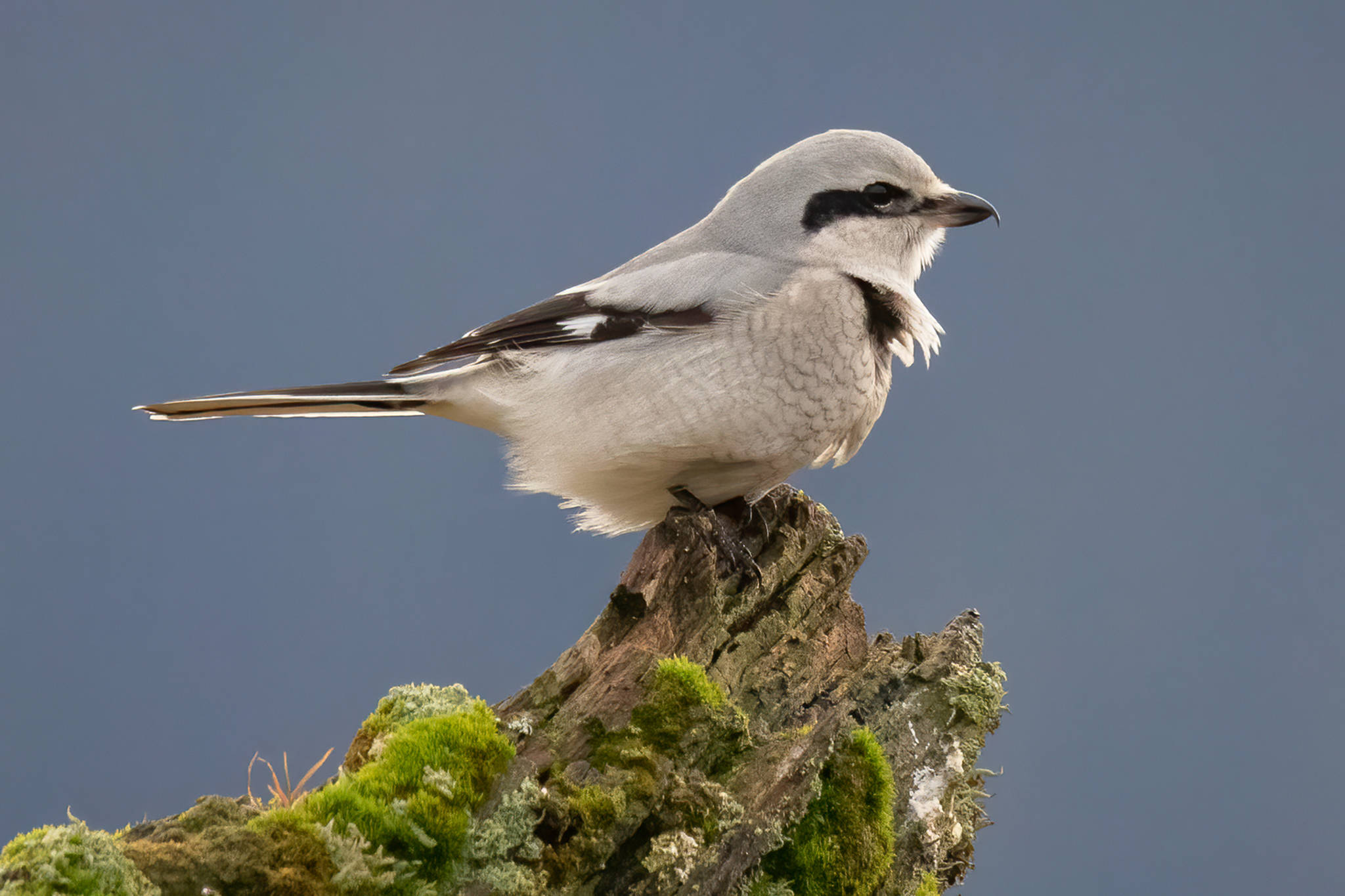
That was a sad finding, but there was also a good sighting — of a northern shrike. It perched on the long-stranded stumps and logs (with their lovely gardens of lichens and mosses), moving from one to another. Shrikes commonly hunt from elevated perches, most often in non-forested habitats. They eat mainly arthropods (e.g., beetles, grasshoppers and bees from which they remove the stinger and venom gland — or at least the experienced adults do) in summer. However, in winter, they eat more small mammals and birds, often killing these vertebrates with a neck bite. Shrike bills are stout and armed with not only a sharp hook, but also two smaller teeth on the upper bill that have matching notches on the lower bill—the better to break necks, tear flesh, and crack the exoskeletons of insects. Most prey is swallowed whole or in large pieces, but shrikes are said to lack crops, so they cough up undigested remains quite frequently.
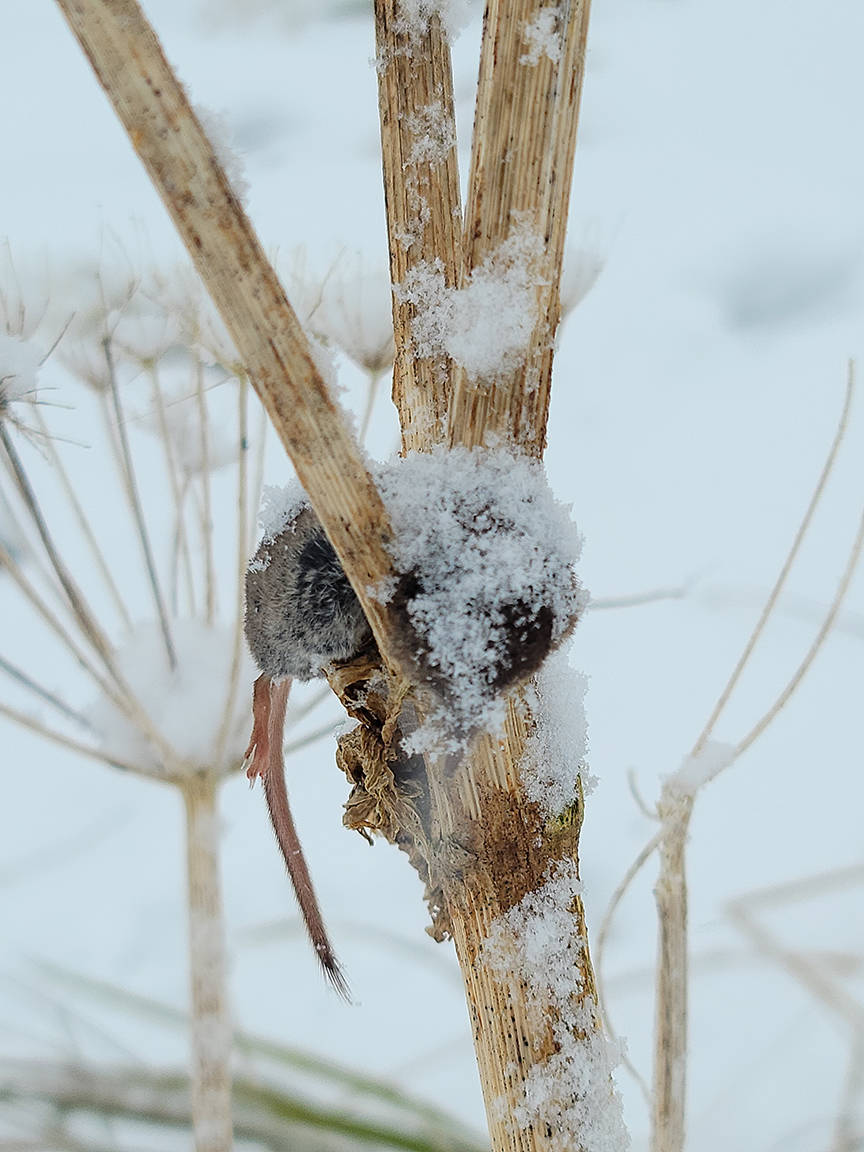
A shrike has cached its prey, a shrew, in an old stem of cow parsnip. Shrikes have a habit of wedging or impaling prey; this helps hold the prey for dismemberment and also stores food for later consumption.(Courtesy Photo / Gina Vose)
Shrikes are sizable songbirds that can catch prey larger than themselves. They are often called butcher birds, presumably for their habit of wedging or impaling prey; this helps hold the prey for dismemberment and also stores food for later consumption. In fact, the name for the genus of shrikes is Lanius, from a Latin word for butcher. There are reports of nest sites surrounded by scattered stashes of impaled prey, a larder for feeding chicks.
[Alaska Science Forum: Catching ‘butcher birds’ in action]
This species of shrike nests in shrubby, semi-open habitats all across the north, beyond the boreal forest. They migrate south for the winter and are then found widely scattered across the country. Occasionally they exhibit population irruptions, when large numbers of them appear in some winters, at least in some areas. Such irruptions in other species are commonly related to food shortages, but for shrikes, the reasons behind the irruptions are not clear. Here, we see shrikes only occasionally, mostly on migration but sometimes in winter. The shrubby flats on the shores of Mendenhall Lake and the wetlands offer the right sort of habitat locally.
Seeing this one was a treat. Its mostly gray plumage is not fancy, but the black and white patches on wings and tail were flashed conspicuously when it flew. Then it looked like a different bird altogether.
• Mary F. Willson is a retired professor of ecology. “On The Trails” appears in the Juneau Empire every Wednesday.
