
By Mary F. Willson
In the first part of July, I went to Gustavus for a short visit, and there was much of interest to be found. A walk near a shallow lake was the highlight. Thousands of tiny toadlets had recently lost their tadpole tails and were dispersing into the countryside. They thronged the lake edges, the gravel road that circles the lake, and the thick herbaceous vegetation on the far side of the road. Fortunately, that road had been temporarily closed to traffic, giving the little adventurers a chance to pursue their lives as terrestrial animals. Now, instead of filtering bits of aquatic vegetation, they’ll eat insects and worms and such. My companion and I walked that road very carefully, watching every footfall.
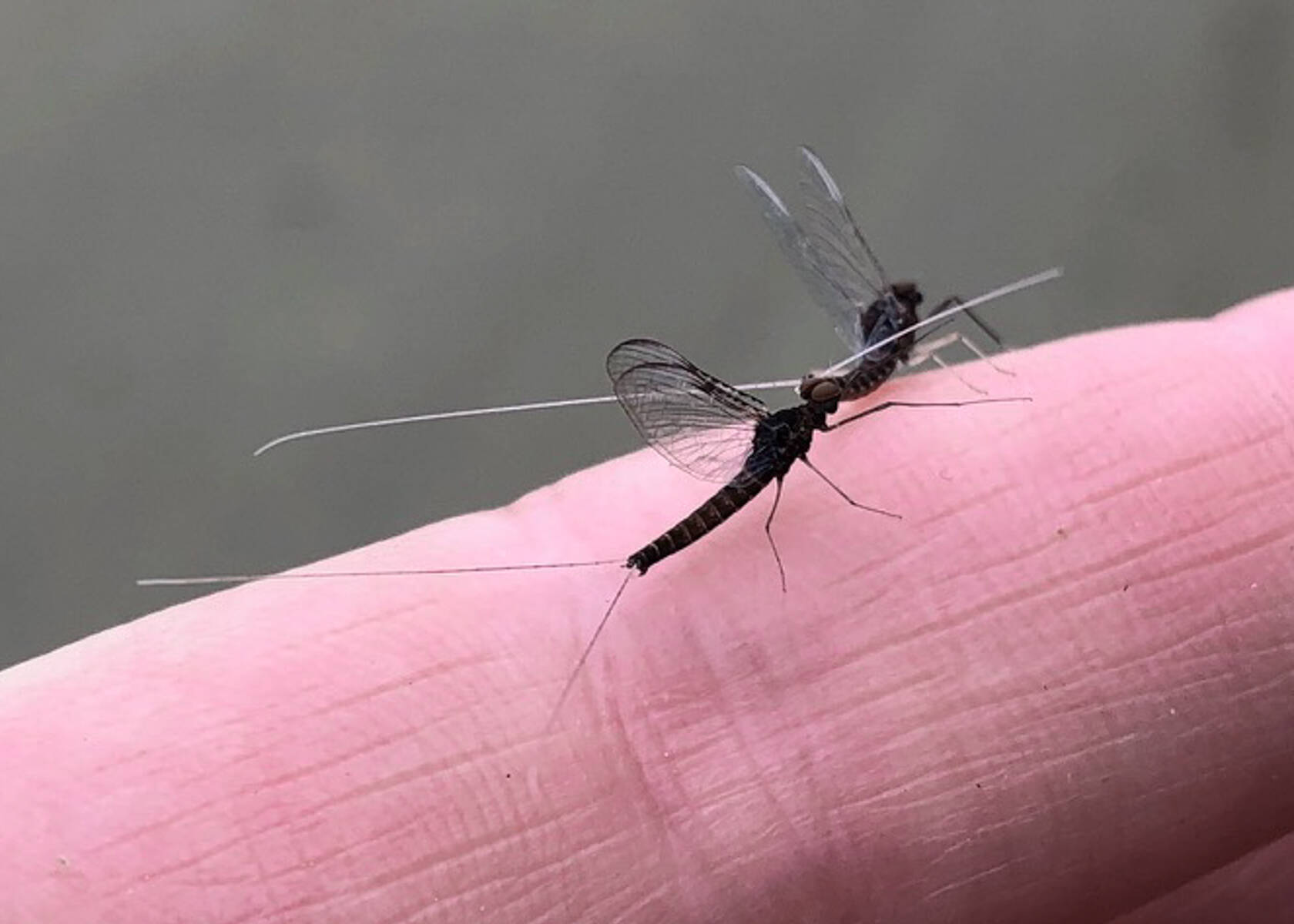
Above the hordes of venturesome toadlets, the air was full of gossamer-winged mayflies. Adults had recently emerged, leaving their old exoskeletons on the lakeside vegetation. They danced up and down, occasionally landing on our caps. The adults don’t live very long, only a day or two (hence their name of Ephemeroptera); after the mating dances, females lay hundreds of eggs on the water and die.
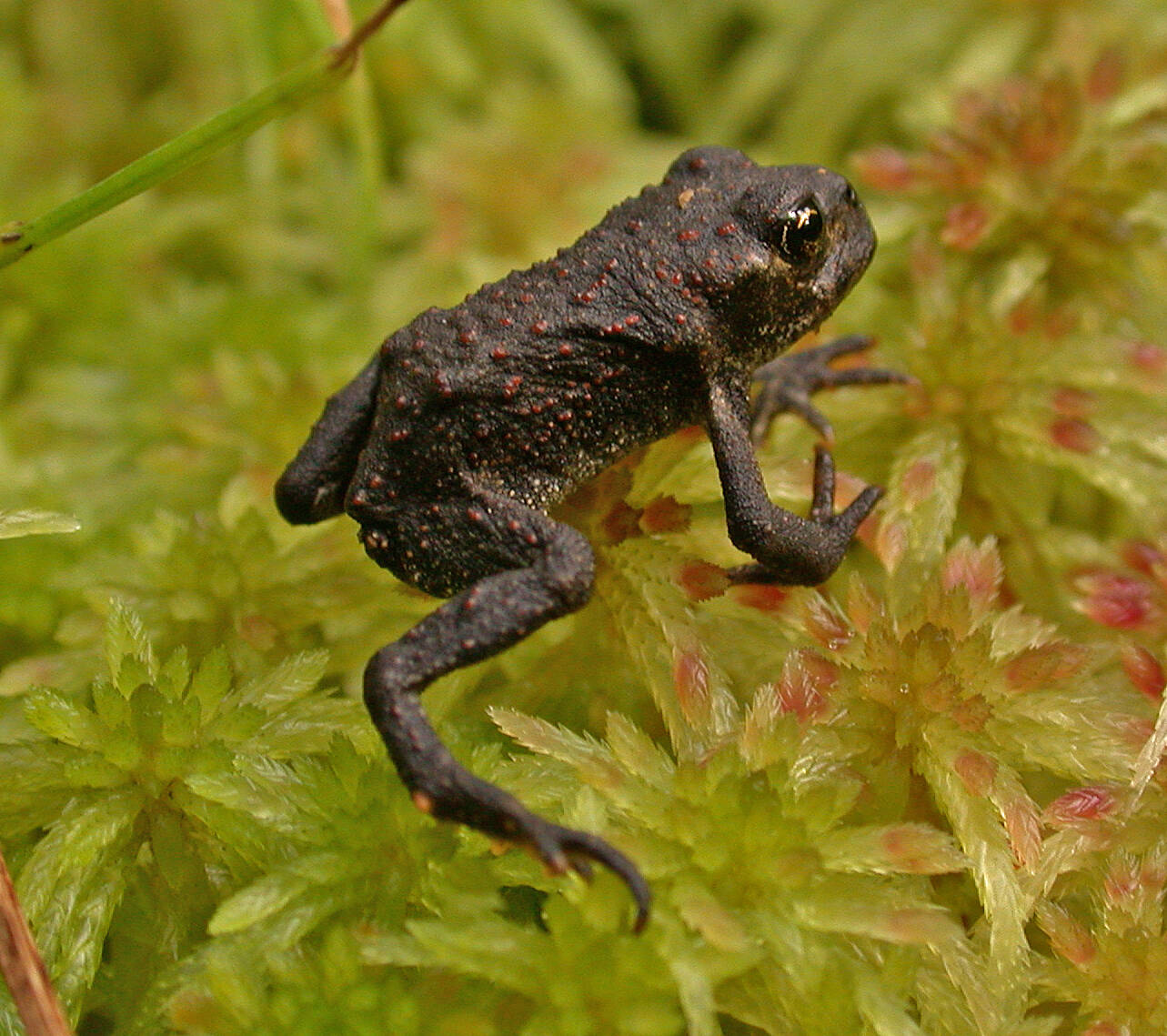
Courtesy Photo / Bob Armstrong A new toadlet of the boreal or western toad makes its way over the moss.
Mayflies have an unusual life cycle, with two ‘adult’, winged stages (Why?). The aquatic nymphs go through many molts as they grow, obtaining oxygen from the water through the integument primarily and, in older nymphs, through gills on the sides of the abdomen. The last nymphs empty their guts, fill the mid-gut with air, let go of the substrate and float to the surface. There, the exoskeleton splits open and wings come out, and the subadult floats for a day or so, until it is ready to fly. Then it flies to nearby vegetation, where it molts again, becomes sexually mature, and lives its brief life as a full adult.
Along other trails, many of the hemlocks had yellow needles mixed in with the normal green ones; they were afflicted by the hemlock needle rust, a relatively harmless fungus. The life cycle includes alternate hosts of blueberry (Vaccinium) species—spores from hemlock develop on the leaf litter of deciduous Vaccinium species but on the live leaves of evergreen species, and send the next generation of spores to hemlocks. When we looked closely at the undersides of some of those sick needles, we found tiny (about one mm.) critters, probably fungus gnat larvae, nibbling at the fungal pustules. They were transparent but the innards were reddish.
On the Nagoonberry Trail, we noticed clumps of sodden white fluff at the bases of several spruce trees. These turned out to be piles of cottonwood catkins with burst seed capsules; when not sodden with rain, the cottony fluff lets the seeds disperse on the wind. In the piles I inspected, there were almost no remaining seeds attached to the fluff. That suggested to me that red squirrels had collected the catkins when they fell to the ground and stashed them, eating most of the seeds and leaving the fluff in a small midden. In fact, one pile of fluff was on top of the customary spruce-cone midden. A bit farther on, we found catkins scattered singly all over the ground, as they had fallen. In some of them, the seeds were gone, as if a roaming squirrel had snacked en route, not collecting them. All of that was my squirrely notion, but my companion was skeptical.
A gigantic spruce had developed a monstrous crack up its trunk, letting the tree topple over to lean on a neighbor. It had been so thoroughly infected by dyers’ polypore fungus that the entire trunk was rotten, falling apart in chunks.
We snacked on wild strawberries as we strolled along and saw plenty of signs that bears and coyotes had done the same, leaving scats containing seeds and sometimes whole berries. On the subject of strawberries, but not related to their seed dispersal: I was surprised to see them growing along the roadsides in the company of grass-of-Parnassus, an unusual association.
Plants of alpine bistort (Polygonum viviparum) were common along the trail. Toward the top, the flowering spike bears small whitish flowers that are capable of setting seed but reportedly seldom do so. The lower part of the spike bears fat little bulbils that develop directly into young plants, sometimes producing green leaves even before the bulbil falls off the parent. That’s what gives this plant its specific name ‘viviparum’—producing ‘live’ young (as opposed to seeds)—as if seeds or the eggs of animals aren’t really alive until they sprout or hatch.
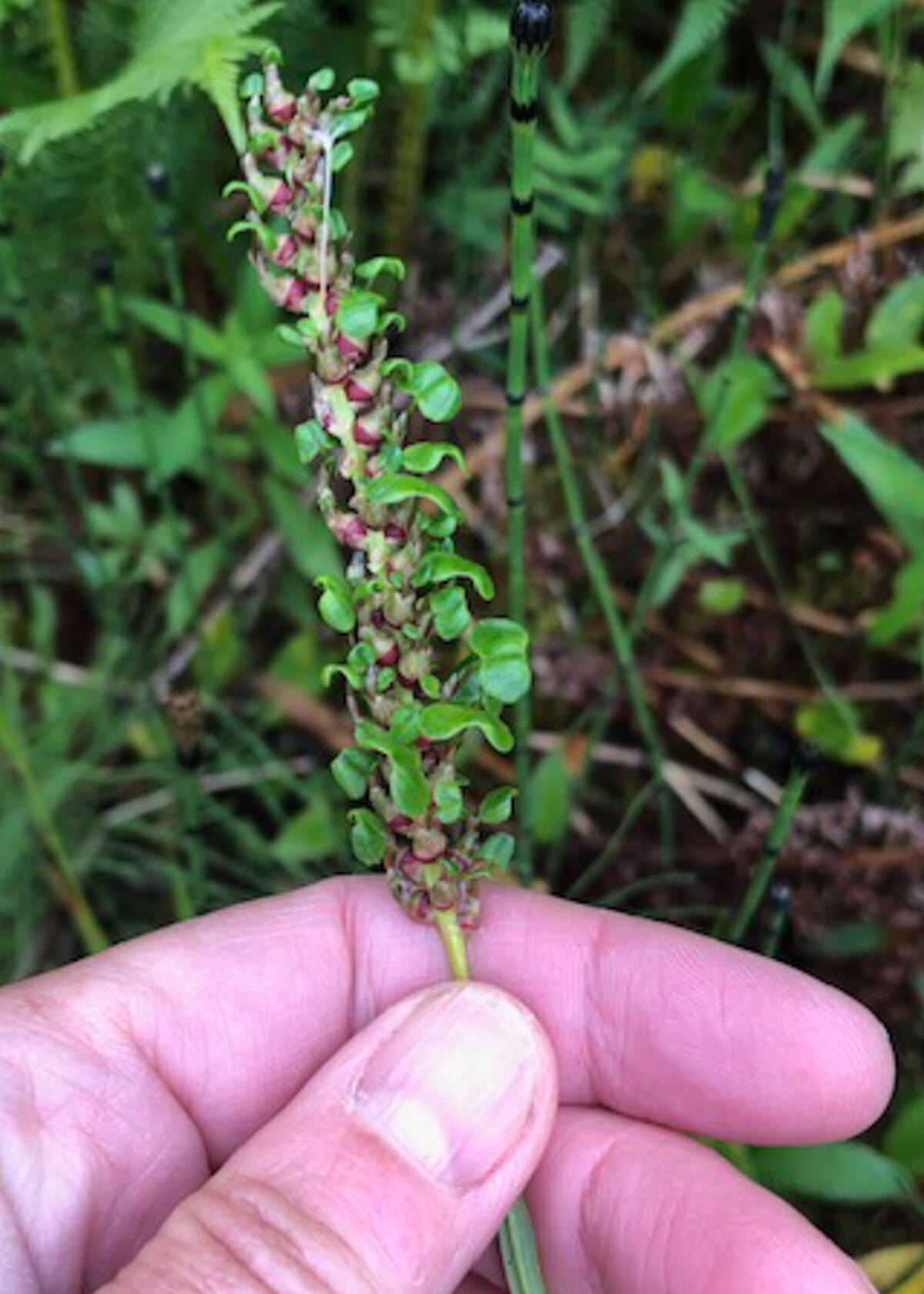
Courtesy Photo / KMHocker New plantlets of bistort often sprout while the bulbil is still on the parent plant; they fall off eventually
Extra tidbits: Chickadees were rearing a second brood in a nest box. Juvenile ravens were caught by a trail cam as they scavenged fallen cottonwood catkins and carried them away (would they eat them or just play with them?). Leaf-roller moth larvae had left their alder leaf-rolls full of digestive products (politely called frass) after the larvae had (presumably) dropped to the ground to pupate. And the so-called Indian paintbrush posed its usual puzzle about variation in flower color, ranging from yellow to orange.
• Mary F. Willson is a retired professor of ecology. “On the Trails” appears every Wednesday in the Juneau Empire.
