
On a cool, gray day just after the sunny summer solstice, a group of friends set out to enjoy the annual Cowee Meadow flower show. An incidental treat was the continuous rattling of kingfishers flying up and down the river. As always in June, there were dozens of kinds of flowers in bloom along the trail, with the fireweed still in bud. In previous years, we have often counted over five dozen kinds of flowers along the trail from the parking lot to the beach. However, on this day we focused mainly on variation in flower color.
Chocolate lily flowers are usually reddish brown, but there are occasional yellow ones and some intermediates. Lupines vary in the intensity of their blue/purple color, with occasional pink-flowered individuals. Geranium flowers are pale purple, sometimes pinkish, and rare individuals have all-white flowers. Yarrow customarily has white flowers, but sometimes they are pink (although transplanted pink-flowered individuals begin to make white flowers). Shooting stars and roses come in shades of pink, from deep magenta to almost white (some pink may fade toward white with age, but that does not account for all the variation).
The most spectacular color variation occurs in the wild iris that is so common out there. Some flowers are a deep, rich purple, some are pale lavender, with all the gradations in between. A few are a reddish-purple; there are scattered pink-flowered individuals and rare white-flowered ones.
All that variation raises a cloud of questions in my head. How much of that variation is genetic, and how much might be environmental (as it appears to be in yarrow)? Could growing conditions lead to epigenetic effects? If a bee moves pollen between purple-flowered individuals and a white or pink one, and pollination occurs, what is the flower color of the offspring? How does flower color affect pollinator behavior, pollination success, and seed set? Does it affect male reproductive success? Could flower color have no significant consequences for reproductive success but simply occur as a genetic correlation, a by-product, with some other traits that are favored because they do affect plant fitness?
We also noticed that white flowers predominated in forest habitat; most of the colorful flowers were in open habitats. White may be more conspicuous to pollinators in the shady situation. It would be good to know about patterns of UV reflection, which many insects can see; are UV patterns more common on white flowers and in certain kinds of habitats?
Another white-flowered plant noted on our trip to Cowee Meadow goes by the name of alpine bistort (Polygonum alpinum). We do see it in subalpine areas, but the meadows are at sea level, so the name is a bit misleading. A globally widespread species, it has the unusual habit of vivipary: bearing live young. Most mammals and a few fishes and reptiles are viviparous, but vivipary is not common in plants. (The term is also used, confusingly, for seeds that germinate precociously within a very ripe fruit (e.g. tomatoes, squash), but that’s a different matter.) Alpine bistort flowers commonly make bulblets or bulbils (instead of seeds) on the lower part of the stem. Bulblets are a type of vegetative reproduction; they develop without pollination and contain embryos; sometimes a leaf emerges while the bulblet is still on the parent plant. When the bulblets fall off the parent plant, they can develop immediately, giving them a head start over offspring coming from seeds. While flowers on the upper stem may produce cross-pollinated seeds that are more diverse than bulblets, they depend on the chancy business of a pollinating bee or fly visit and the seeds may have a dormancy period before they can germinate. So bistort has two reproductive strategies, hedging its bets.
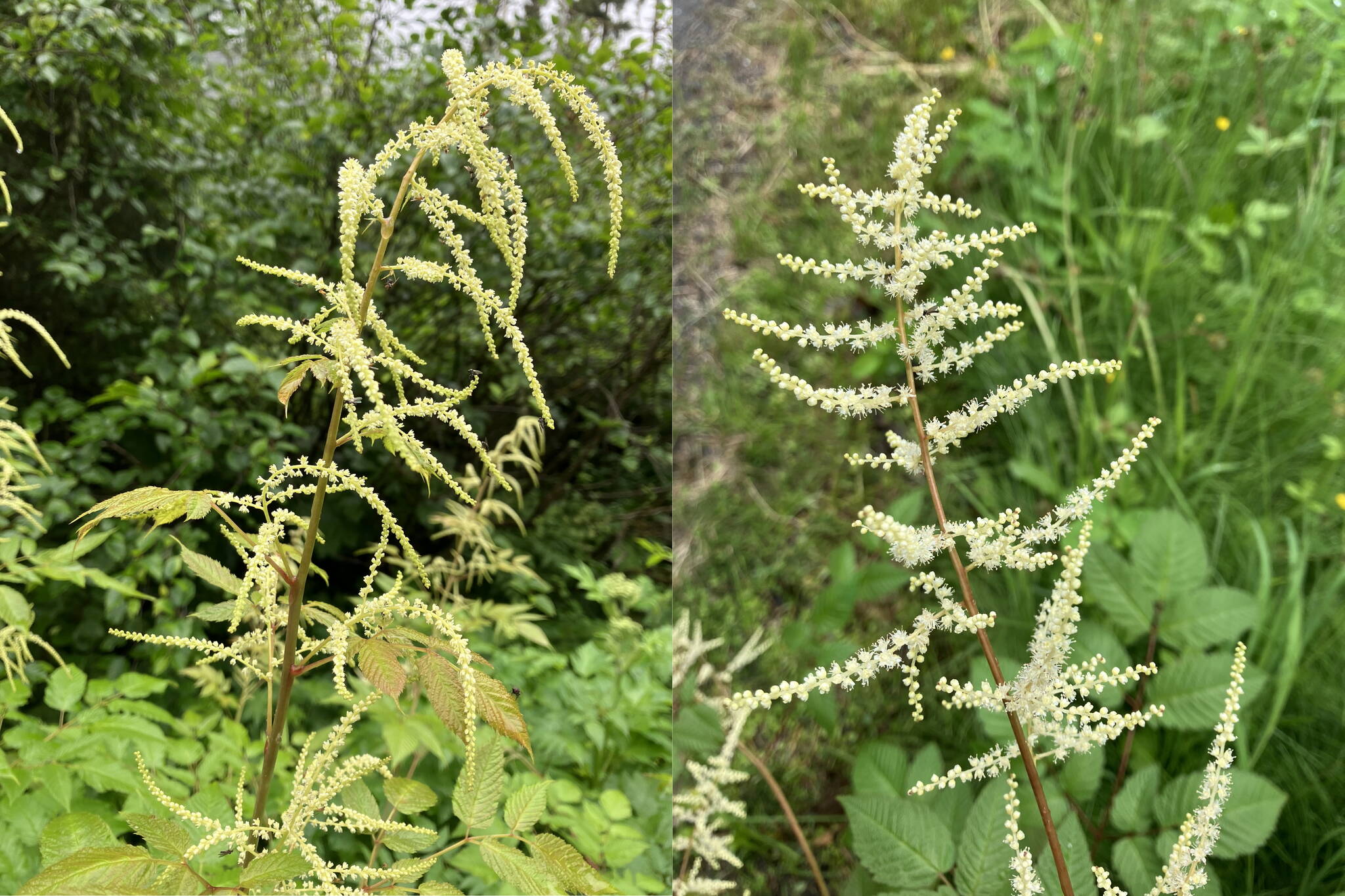
Thinking about white flowers: late June is the prime season here at sea-level when goatsbeard’s creamy-white plumes line the roadsides so decoratively, although some inflorescences are finishing and a few are still in bud. The genus name, Aruncus, actually means “goat’s beard” in Greek. Sexes are separate in this species, male and female on different individuals, hence the species name of “dioicus” (from the Greek “two houses”). Aruncus dioicus is widespread in North America and beyond, and it is popular among gardeners. The tiny flowers in the plumy inflorescences are sometimes populated with hordes of miniscule insects that I don’t even attempt to identify. The flowers may contain a bit of nectar, and various butterflies, bees, and flies are probable pollinators. Male inflorescences are more showy than those of females, because the flower petals are a tiny bit larger and the several protruding stamens add some apparent size to each flower. I surveyed dozens of plants in several different places and, in every case, males out-numbered females, for some reason, but the disparity in numbers varied from place to place. In eastern U.S., goatsbeard is the host plant for the larvae of certain species of azure butterfly, but I have not (yet) found out if any of our azures feed on it here.
