
There were good minus tides in May and June, and I went out with some friends to take a look at the intertidal zone in two places that we’ve checked in previous years. We found lots of small white cucumbers, numerous green sea urchins, and the usual sea stars, but fewer of them—and only one baby king crab, no whelks, few hermit crabs or lined chitons, and so on. In general, the diversity and abundances of intertidal critters seemed low to all of us who had looked there in other years.
Strange things have been and are happening in the regional and local environment. Sometimes devastation of intertidal communities is widespread; for instance, in 2021, high temperatures wiped out invertebrate populations, exposed at low tide, for many miles of coast in southern British Columbia and northern Washington. But locals surely would have noticed if such a major event had occurred here (although a recent Pacific marine heat wave may have left residual effects in our area).
Other effects are more localized. Outbreaks of the wasting disease have damaged sea star populations. Heavy rains can overwhelm the local wastewater treatment system, so that dirty water enters the marine system. The past winter brought very cold temperatures, big storms, and the risk of wind-chill to exposed intertidal invertebrates. Massive winter snowfall followed by heavy rains and unusually warm temperatures in spring increased freshwater input to coastal waters, and the present summer brought extremely high air temperatures for days at a time. These kinds of extreme conditions probably affected many intertidal animals (and plants). Such effects would probably vary among local areas, depending on exposure to sun and wind and freshwater input, slope of the rocky beaches, among other factors. As a marine biologist commented: things seem to be somewhat out of balance and the consequences are likely to be patchily distributed.
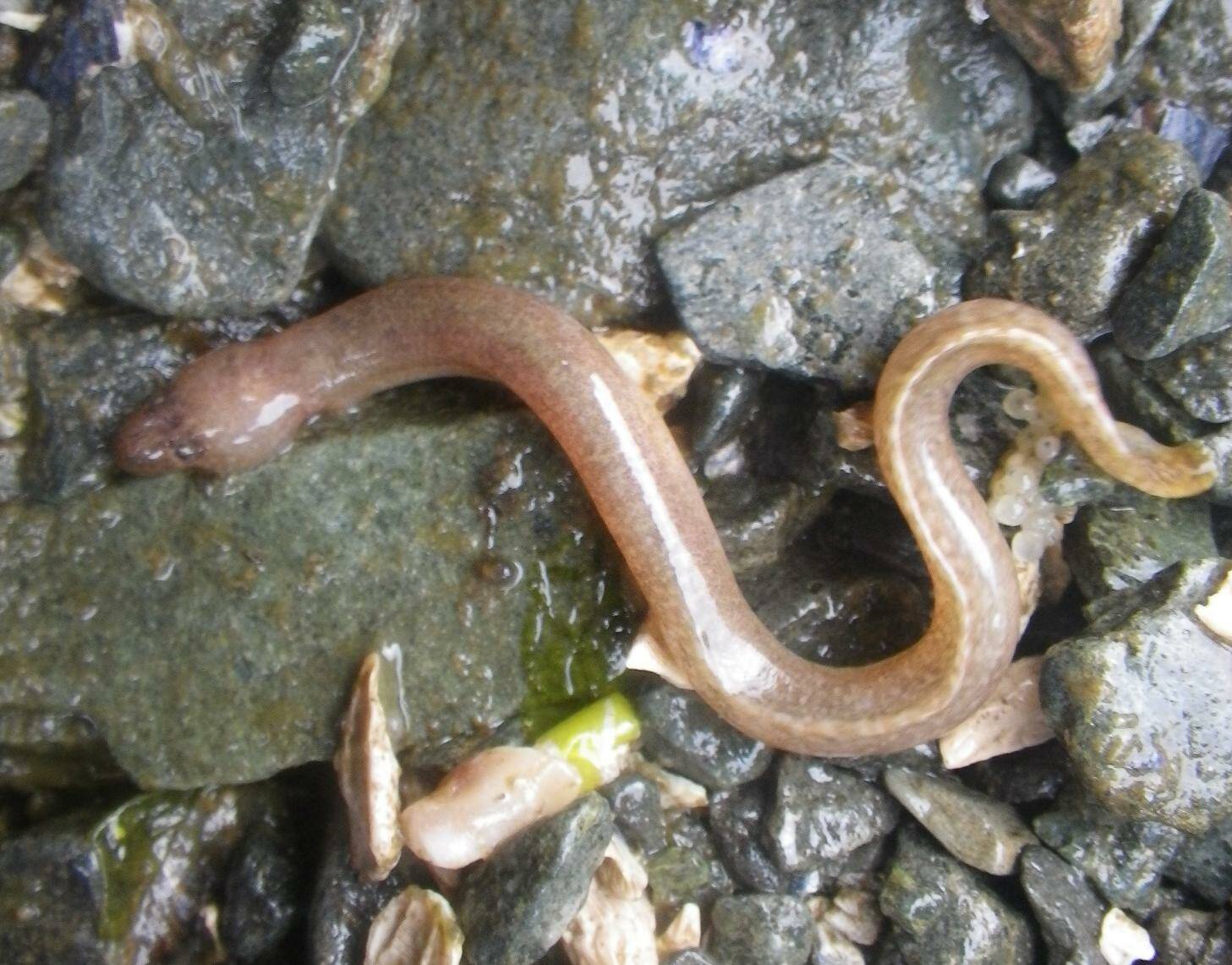
One day in July, I went out (on another good minus tide) to one of the places we visited in May and June, not wanting to believe the impression of a depauperate fauna. I didn’t change my mind on that, but I had one piece of good luck: lying on the mud under a small, flat rock, I found a little fish that was obviously not the usual gunnel or prickleback. It was a graveldiver! It had a long, thin body with a slightly knobby head—looking (as some have said) like a tiny snake; its tan color was distinctive (although some individuals may be darker). I found a good match for this creature in Aaron Baldwin’s online field guide (Sea Life of Southeastern Alaska, co-authored by Paul Norwood). And I gently replaced the sheltering rock.
That was exciting! But it seems that very little is known about the biology of these little fish—I reckon that they are hard to study in detail. Some researchers suggest that they may burrow very deeply and carry on their reproductive activities deep in the sediments and gravels. They have tiny, sharp teeth and are presumably predators.
Bits and pieces from other places: Out at Point Louisa, I saw a shrub that looked strangely lacy from a distance. Close up, I could see that it was an alder almost all of whose leaves were severely skeletonized.
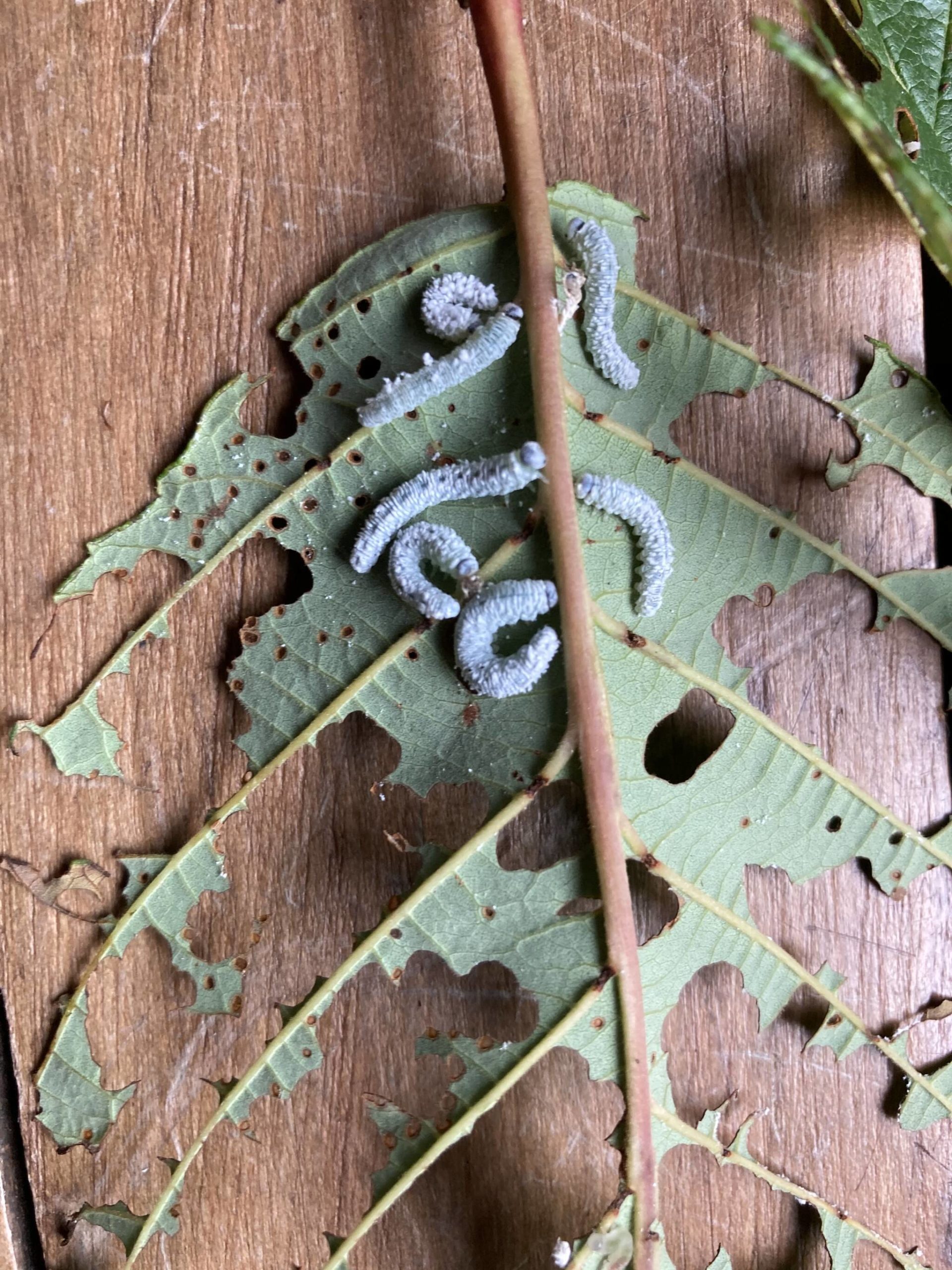
Woolly alder sawfly larvae have eaten most of this leaf. (Mary F. Willson / For the Juneau Empire)
The agents of defoliation had been chewing all summer, and I found the culprits working away on the few remaining leaves that had green tissue between the veins. They were woolly alder sawflies, a European species that occurs in various parts of North America, including British Columbia and Alaska. Female sawflies lay their eggs near the midrib of the leaf. The larvae are reported to feed first on the upper surface of the leaf and later move to the under-surface. The last larval instar of this species is covered with a white, woolly secretion, giving it its name. They overwinter in cocoons in the soil, emerging as adults next spring.
In mid-July, as I walked along the Boy Scout Camp Trail, I spotted an extremely small shrew, sitting in the middle of the trail, having lunch. I stopped and watched; it calmly nibbled away for a few more seconds and then scooted off the trail. I presume this was a young individual of one of our relatively common species here, which weigh roughly five or six grams as adults; the one I watched was that big. There are, in Alaska, two shrew species that are extremely small: the pygmy shrew, at about three grams (slightly smaller than most of our rufous hummingbirds), and the Alaska tiny shrew, at approximately two grams. But they live Up North and are not recorded from Southeast. (For the record, shrews are too small to store enough fat to overwinter, and they stay active all winter long, looking for food, burrowing through the snows.)
In Haines, there is time between ferry arrival and departure (after the loop up to Skagway and back) to take the convenient Haines Shuttle out to the Battery Point Trailhead for a short walk; walking on conifer needles instead of roots and rocks was a treat. Baneberries were ripe; the common color is bright red, but there were two plants with white berries, an uncommon mutant form.
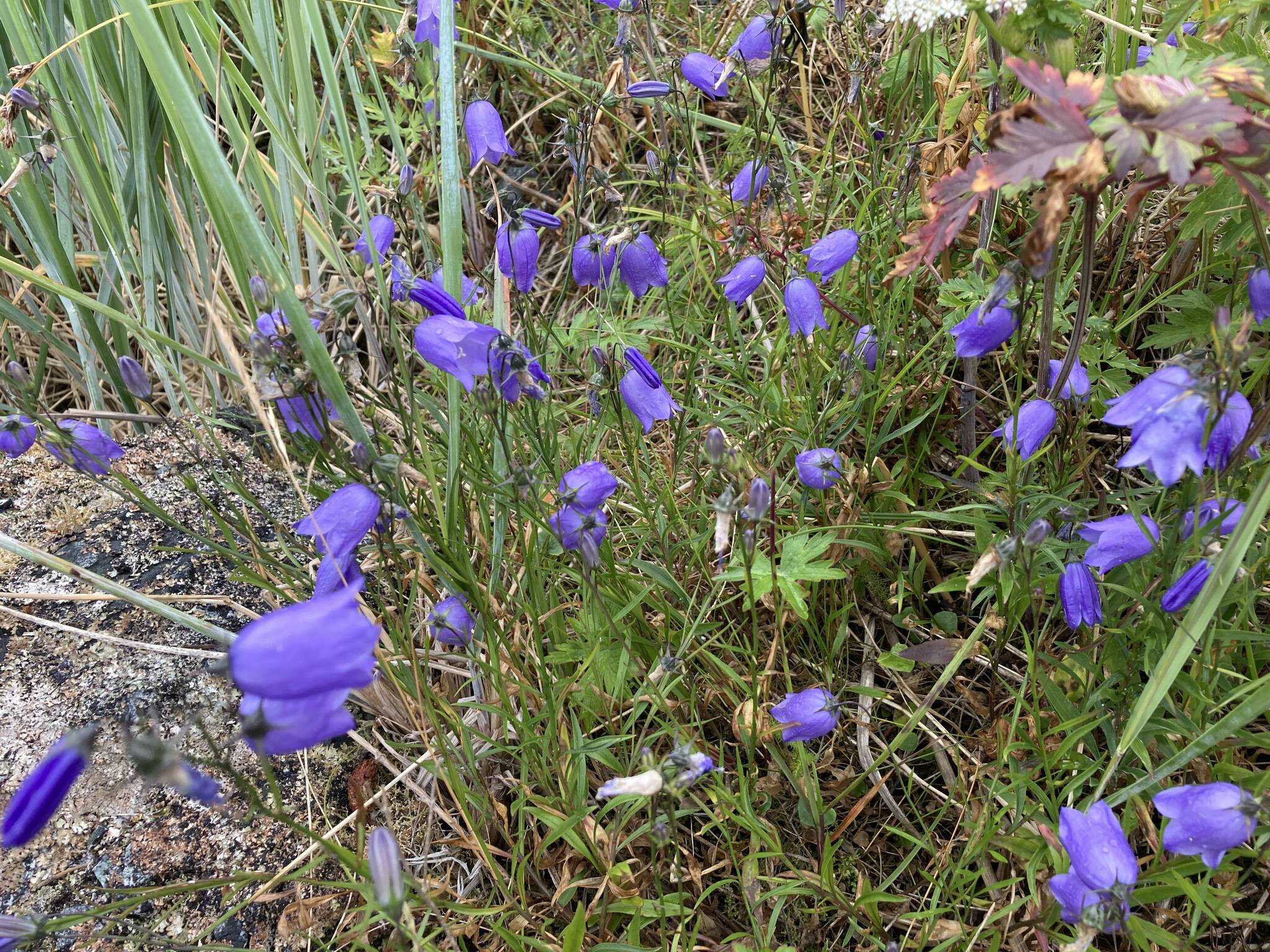
Harebells grew in clusters among the rocks at Point Kelgaya. (Mary F. Willson / For the Juneau Empire)
Partway along that trail is Kelgaya Point, a lovely, rocky headland with a variety of micro habitats for plants. In late July, numerous small iris plants showed no evidence of having flowered, with one lone exception. A ground-covering mat of crowberry, which we more usually see at mid-elevations, had apparently produced no fruit at all. The flower show was provided by spectacular stands of yellow paintbrush and blue harebells.
• Mary F. Willson is a retired professor of ecology. “On the Trails” appears every Wednesday in the Juneau Empire.
