
By FREIDA FRISARO
Associated Press
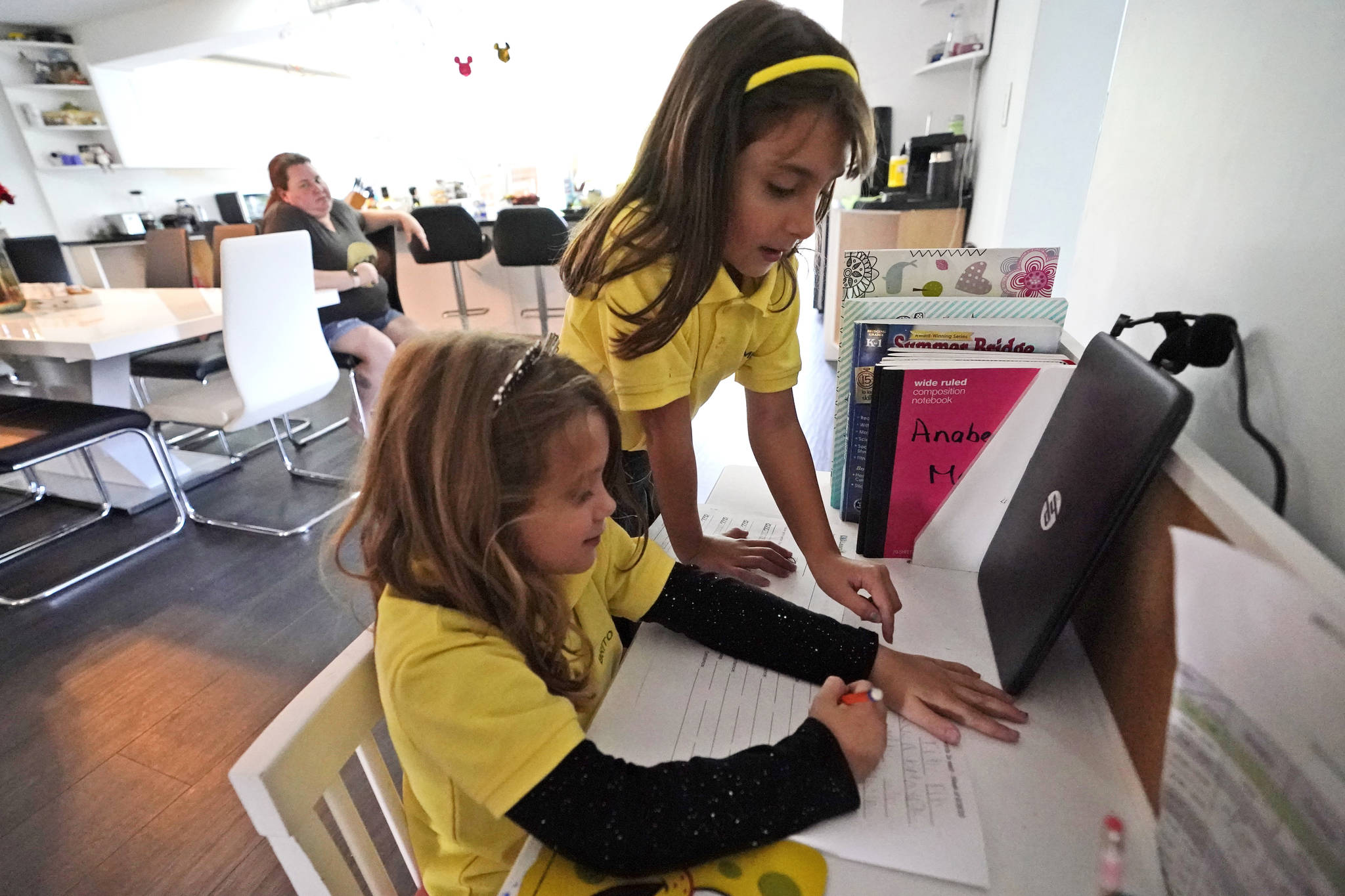
FORT LAUDERDALE, Fla. — Rather than wait to see how her children’s Florida public school would teach students this fall, Erica Chao enrolled her two daughters in a private school that seemed better positioned to provide instruction online during the uncertainty of the coronavirus pandemic.
The virtual lessons that Emily, 8, and Annabelle, 6, received in the spring while enrolled at a Miami-Dade County elementary school became a “free for all,” Chao said. The private school classes, by contrast, hold the girls’ attention, and their mother no longer worries they will fall behind if she doesn’t attend school with them at home.
“For the first time since March, I was able to walk away,” Chao said.
Parents across the country have faced similar choices about whether to keep their children in public schools as the pandemic extends into a new academic year. Some opted for private or charter schools. Others are dedicating themselves to homeschooling, hiring tutors to oversee multi-family “learning pods” or struggling to balance their children’s educations with work when school times and technology keep changing.
Such personal decisions could exacerbate the financial problems of public school systems that receive a set amount of state funding for every student they enroll, which are the vast majority. With preliminary figures showing unexpected enrollment declines in many places, school officials used letters, phone calls and volunteers going door-to-door to persuade parents to register their youngsters before this month’s fall student census.
The superintendent of Georgia’s fifth-largest district spelled out the financial implications on YouTube after only 2,912 pupils were enrolled in virtual kindergarten classes by mid-September. Clayton County’s public schools usually greet 3,500 to 3,600 new kindergarteners.
“Kindergarten parents, wherever you are, remember this….When you enroll your child in kindergarten this year, that means we get funding next year,” Superintendent Morcease Beasley said, explaining that would mean fewer services for students starting first grade in fall 2021.
Similar appeals came from other public education systems where fewer students showed up either online or in person last month, especially in the lower grades. The Los Angeles Unified School District, the country’s second-largest school system, saw kindergarten enrollment go from 42,912 to 36,914 this fall, a decrease of 14%. In Nashville, Tennessee, public kindergarten enrollment is down about 1,800 students, or 37%.
“If families are not enrolled this week, we want them enrolled next week, next month, as soon as they can, for the benefit of their kids,” Colorado Gov. Jared Polis said two days before the state’s scheduled attendance count last week.
The governor encouraged parents to sign up their children in a different district if they were unhappy with the quality of the distance learning offered last semester, saying education was “not something to be taken lightly.”
“Don’t just think you’re homeschooling because you’re giving your kid a book all day and leaving them at home,” Polis said.
In states where education funding is awarded under a per-pupil formula, losing even a small number of students adds up for schools. Miami-Dade County had 12,518 fewer students at the end of September than in fall 2019, three-quarters of them missing from pre-kindergarten to third grade, officials said. Since Florida gives schools roughly $7,800 for every student, the nation’s fourth-largest district stands to lose about $97,640,000.
Lawmakers and state education officials are scrambling to come up with temporary funding mechanisms while districts brace for future shortfalls, if enough families pull out of public schools. The Texas Education Agency gave districts six more weeks to do their official counts so schools could “make operational and budget adjustments based upon clearer information.” California lawmakers agreed to use last year’s enrollment numbers when calculating the money schools would get this academic year.
In Florida’s Palm Beach County, where the school district is the largest employer, school board member Erica Whitfield said during a September board meeting that she was “beyond terrified” that lower enrollment will eventually lead to layoffs. The district had 5,471, or 2.8% fewer students this fall.
“I’ve been watching the homeschooling numbers. I’ve been watching people leaving to go to private schools. And I know it’s larger than it’s ever been,” Whitfield said.
Many school districts hope to get students back when in-person classes resume and to stem the hit to their budgets in the meantime by improving virtual instruction. But having fewer dollars for teacher salaries, computers and classroom equipment could exacerbate the problems that are causing parents to seek out other options during the pandemic.
More affluent families may have chosen private schools or homeschooling because they did not like the pre-packaged curricula that many public school systems are using for online learning, and they are unlikely to return to public schools any time soon, University of Wisconsin education professor Michael Apple said.
But the enrollment declines schools are seeing can’t just be attributed to affluent families choosing other options, Apple said. The children of poor, homeless or immigrant parents living in the country illegally face hurdles such as lack of internet access, computers or a suitable space for learning, he said.
Apple foresees enrollment decreases expanding to upper grades during future waves of the coronavirus if teenagers need to get jobs to help support their families or are left in charge of younger siblings.
“This crisis is national and, in fact, it is international,” he said.
Carla Engle moved to Williamson County, Tennessee for the school system, but said her children learned nothing after classes went virtual last March. She was equally unimpressed with the online program the school system offered for parents who didn’t feel safe sending their children to a brick-and-mortar school this fall.
Engle took her seventh and eighth graders out of their public school and enrolled them in an online-only school Connections Academy.
“It is all-around heartbreaking. I called the principal to unenroll, and she and I both cried,” Engle said. “I love the teachers. They love my kids just like I love my kids.”
