
An unused U.S. Forest Service building in Kake may soon be a healing center for the community to move forward from generations of trauma after a boarding school harmed members of the Alaska Native population.
When Joel Jackson, president of the Organized Village of Kake, saw the building on an access road between Kake and Petersburg, he said he was surprised. “A cultural healing center has been on my mind for decades,” he said. “I said to myself, ‘Hey, there’s our cultural healing center.’”
Now, with nearly $93,000 in reparations money, Jackson can insure the building and move towards renovations. Quakers with the Alaska Friends Conference and from Washington and Oregon contributed money with the goal of helping to repair the damage from colonial influence and boarding schools in Southeast Alaska at the turn of the century.
Quakers built a mission in Kake in the 1890s before the federal government handed the Quaker building over to the Presbyterian Church, which operated a boarding school there. Jackson said the legacy of forced assimilation has been hard in his community.
“I never knew anything about intergenerational trauma until I attended a few workshops when I traveled to different conferences. And then I realized how that can be passed on through the generations and how it affects our people. That made sense to what I witnessed growing up,” he said.
Jackson said he witnessed people in his community struggle with alcohol as they aged and he sees that as a result of forced assimilation among people who experienced boarding school and their children. “That was the generation that was subjected to forced assimilation, where they couldn’t speak their language or do the things that they normally do,” he said.
He said the colonial presence also disrupted transmission of the Tlingit language by supplanting it with English. “We have very few fluent Tlingit speakers anymore. Most of them are leaving us,” he said, referring to how many fluent elders have died.
“Hopefully we can get people over here that are struggling with addiction and alcohol. It’s not just going to be for our community, it’s going to be regionwide,” he said. “I want to open it at first to the rural smaller communities because a lot of times they don’t have the option of going to treatment because, you know, most centers are in the bigger cities. And there’s usually a waiting list to get in there. So yeah, I want to open that up for them.”
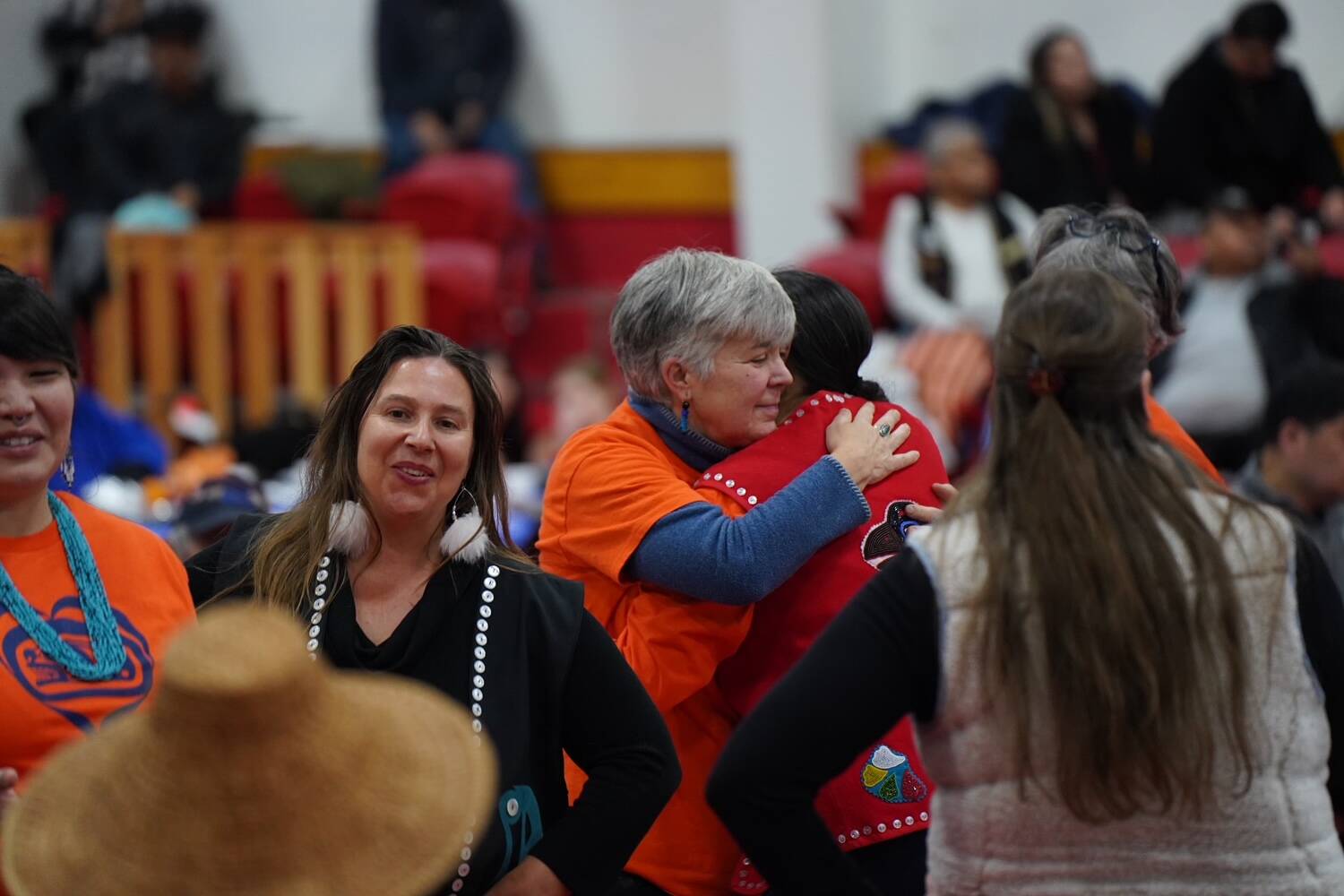
The reparations were announced at Kake Day, a yearly celebration of when the Southeast Alaska city incorporated in 1912 and its residents became the first Alaska Natives to have United States citizenship and have the right to vote. The reparations follow an apology the Quakers made in Juneau in 2022 to the Alaska Native community for the harms of boarding schools.
How it happened
Jamiann S’eiltin Hasselquist, a regional healing catalyst for the nonprofit Haa Tóoch Lichéesh, said the reparations followed testimony she and Jim LaBelle gave at the Sierra Cascades yearly meeting outside of Portland, Oregon.
“This is a monumental moment in history,” Hasselquist said. “I hope it leads to the righting of relations, joining hands together in healing for people on our own land.”
Hasselquist is involved in work that re-centers Alaska Native presence in Juneau’s history, such as cleaning up a neglected Alaska Native cemetery on Douglas Island and finding the location of a former Quaker boarding school there. She is an advocate for right relations and healing.
Hasselquist said she is the great granddaughter of a woman born on Douglas Island who would have experienced the harms of a boarding school. She was prepared to meet with the descendant of a Quaker missionary in Kake, but bad weather delayed the woman’s flight. She said she sees this event as part of a bigger “river” of healing.
“Everything that was taken from us through the genocide of our people through residential boarding school institutions, which are government-funded and church-run institutions — the things that they took from us are the very things that are going to heal us,” she said.
She pointed the Quakers to Joel Jackson, that they might support his healing center project.
Hasselquist was first introduced to the Quakers through Jim LaBelle, a boarding school survivor, who has spoken out previously about his experience and how those harms have affected his life and the lives of his peers. He joined Hasselquist to address the Quakers in Oregon.
“I believe that our stories were very impactful because they recognized that they had a role that they played in attempting to Christianize and colonize Native people up here,” LaBelle said. “And I think they were very surprised how traumatic that attempt was. Some of it was successful. But others were left with long-lasting effects that they passed on to their family members throughout the generations.”
He said the moment was special because some members of the audience were the descendents of the Quaker ministers that were sent to Alaska in the late 1800s and early 1900s.
“They were so affected by our story. I remember a number of times, individual descendants — and they were in their 80s and 90s — would come to our table and just make a heartfelt apology for what happened,” he said.
LaBelle said he has hope that reparations like this one will be part of the future relationship between Alaska Native people and churches. He pointed to a bill in Congress that calls for healing centers, the return of land, and help rebuilding Native language fluency.
When he reflected on what his younger self would have thought of the apologies and reparations, he paused: “That would have been quite a revelation, pardon the pun,” he said. “I would have been ecstatic. The reason I’ve been so passionate about doing this line of work for so long is that I was robbed of my childhood.”
He said that at the Southern Baptist Church in Wrangell he was told that his mother was involved in devil worship when she sang, danced and drummed.
“When you’re an impressionable little kid, and you hear that over and over and over, you start believing it.” he said.
An apology
Cathy Walling, a member of the Chena Ridge Friends Meeting in Fairbanks, and Jan Bronson, an Anchorage Quaker, traveled to Kake to apologize and contribute the money on Thursday.
But their path towards right relations with Alaska Native people began years ago, when they joined with First Alaskans Institute, an Alaska Native advocacy nonprofit, to learn about their religion’s history in Alaska.
“First Alaskans encouraged us to learn our history as missionaries in Alaska. So that’s what got us started. We spent a year doing research, reading what we could, talking to people,” Bronson said.
While Quakers didn’t run a boarding school in Kake, they had a mission and supported teachers working at the government school for about 20 years.
The women presented the Kake community with nearly $93,000 to insure the building that will become the healing center because they said they are coming to understand that healing begins with cultural and community connections.
“This is lifelong. This work is lifelong for us,” Bronson said. Then, she quoted another Quaker: “We don’t imagine that a few tens of thousands of dollars is commensurate to the past evil or the present need. We have heard that it will help in the healing and we are glad to be able to give it. More to come.”
