
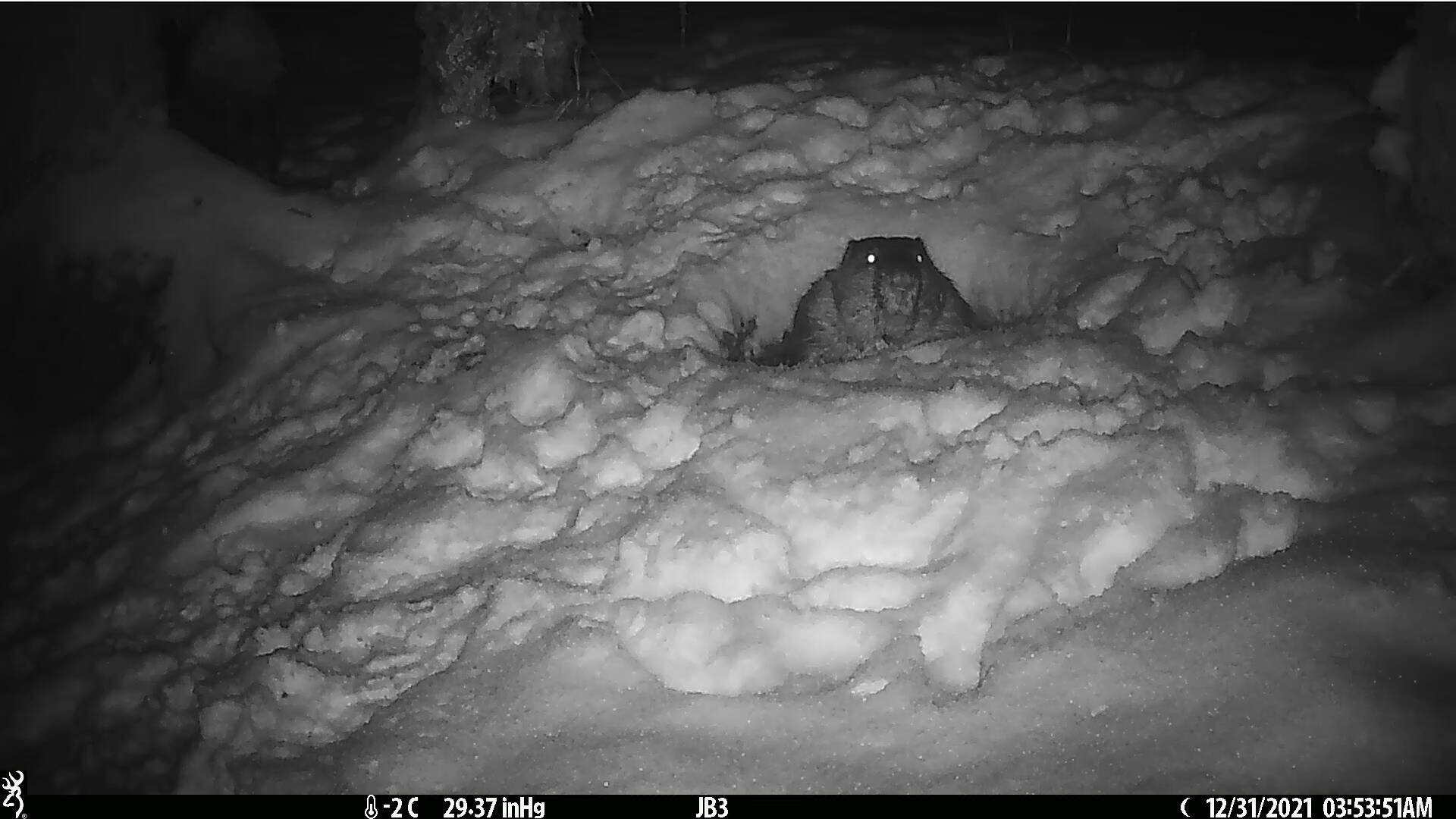
A spell of warm temperatures before the winter solstice let beavers continue stocking their caches with branches. Although adult beavers can live off stored fat for quite a while, young ones are still growing and need to eat. So a beaver family caches a nice pile of fresh branches not far from their lodge entrance. Here are excerpts from a Dredge Lake area trailcam video of a beaver systematically de-branching a little tree and toting away the branches for its cache. I noticed two uncommon things that this beaver did; readers might like to check the video and see if they can spot these two things (https://vimeo.com/785319266 ). (My two choices are given at the end of this essay; no peeking!)
Busy beavers. 12-14-2023 from Jos Bakker on Vimeo.
The solstice came and went, but it will be a while before we can really sense the lengthening days. Meanwhile, a couple of days after the solstice, I wandered over to the Dredge Creek area. The recent deep freeze had covered the ponds with strong ice, shutting down beaver activity for a while. A snowfall had brightened the landscape and registered movements of small critters. I found a trail left by a shrew, making short bounds under a bush. Another shrew had trotted across an open space and under a log.

Mary F. Willson / For the Juneau Empire A shrew left a trail as it bounded over the snow.
Bigger tracks were left by an otter moving up Dredge Creek. There was a little bit of open water just below the beaver dam we call Nemesis, and the otter had come up from under the ice of the Holding Pond, gone over the frozen splashes of the dam overflow and onto the frozen surface of Dredge Creek, disappearing upstream.
At the very end of the year, beavers at another lodge came out to work on their caches. Temperatures were absurdly mild, but snow had accumulated near the lodge.
While I’m thinking about beavers, I’ll take this opportunity to discuss them as carriers of disease. In a recent essay I mentioned tularemia, sometimes carried by beavers. But we hear more about another ailment, for which beavers are often blamed. Giardiasis is caused by Giardia, a one-celled protozoan that can infest the small intestine, causing diarrhea and other digestive distress in humans, cats, and dogs. There are several species of Giardia, specifically afflicting various kinds of animals (e.g., mice or birds or amphibians), but only one (commonly called G. lamblia) is known to parasitize humans as well as many other mammals. It seems that most of those mammals are asymptomatic carriers of Giardia; at least I found (so far) no reports of sickness except in humans, dogs, cats and maybe pigs (all of which can also be asymptomatic carriers).
The life cycle of this parasite includes an active, reproductive phase (called a trophozoite), which multiplies in the airless intestine, and an inactive encysted phase. The disease is transmitted by the cysts, which are passed out of the digestive tract with feces (trophozoites may be excreted too, but they soon die). When another animal ingests fecal matter (directly or on vegetation, for example) or water with cysts, the cysts pass into the gut, where they open and release trophozoites, which feed and multiply rapidly. It can take up to two weeks for a new infection to produce symptoms.
Although the cysts can be passed from one animal to another by contact with fecal matter, they are more famously acquired from feces deposited in water. There can be thousands of cysts in one drop of water; they can persist for weeks and be taken up from water drops by swimmers or paddlers. The association with water, and thus with beavers, led to the affliction being called “beaver fever.: But that is totally unfair! At least in some areas, humans are the main transmitter of cysts, via improper disposal of sewage. Furthermore, muskrats, dogs, moose and deer, and many other mammals that defecate in or near water also contribute to the spread of the disease.
**Here are the uncommon activities that I noticed in the video. 1. One of the branches selected by the beaver appears to be dead—barkless, budless, and white. In another segment of video (not shown), a similar branch is also taken. No good for the food cache — beavers feed on the bark of living branches. Could they possibly be constructing something else? 2. This beaver held one branch in its mouth while chewing off a second one, and then dragged both branches off to the cache in one trip. The big space between the front, cutting, incisors and the grinding molars to the rear of the jaw is called a diastema. The lips can be closed behind the incisors when the beaver is chewing a branch off, keeping loose chips from going down its throat. This beaver, however, appears to hold the first branch in the diastema while gnawing at the second one.
Thanks to Jos Bakker for the trail cam photo and video.
• Mary F. Willson is a retired professor of ecology. “On the Trails” appears every Wednesday in the Juneau Empire.
