
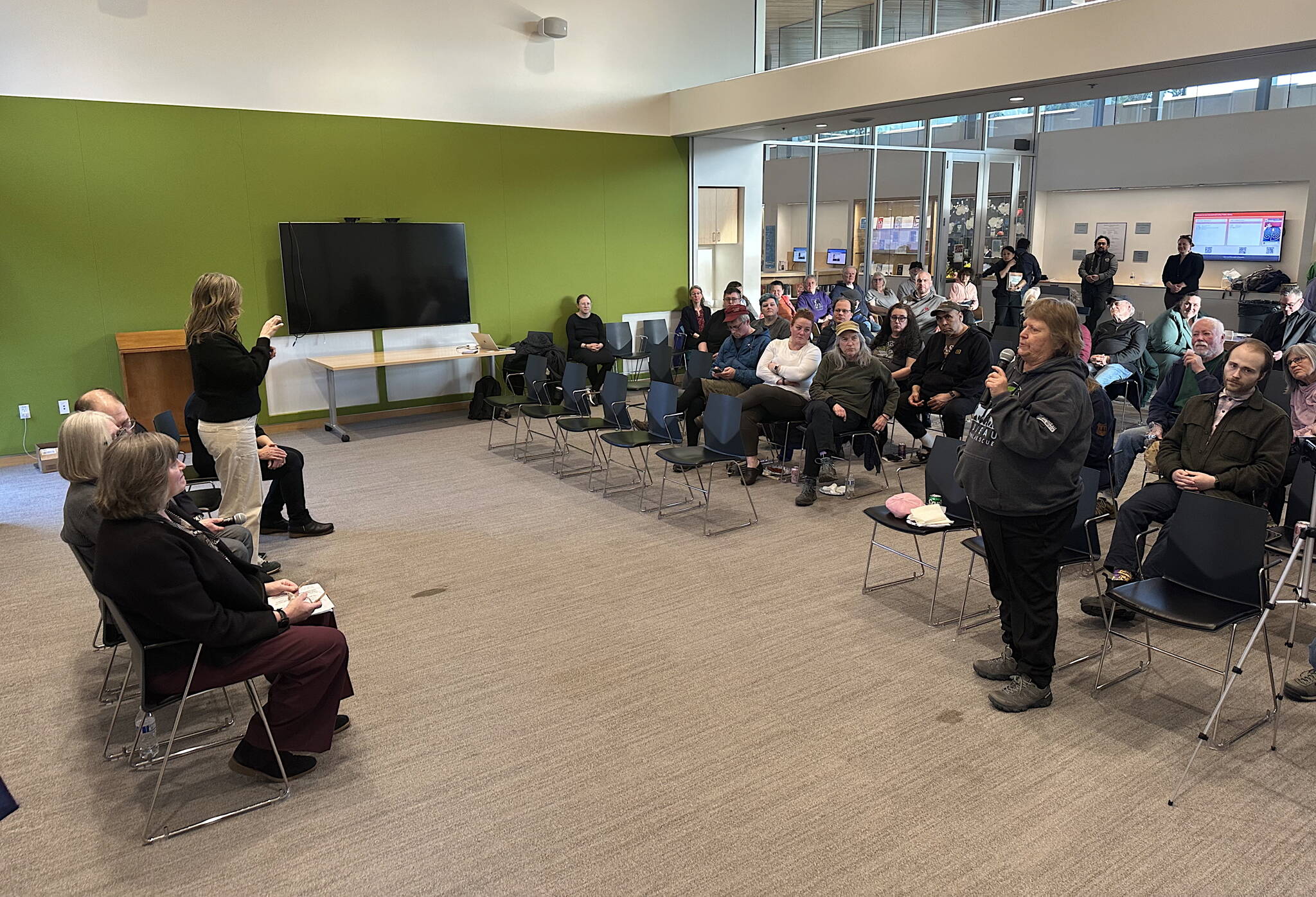
Staying in their lanes is the most effective way of navigating through a snarl of situations people say are spinning out of control, Juneau’s three-member legislative delegation told constituents at a town hall Thursday night.
Extraordinary uncertainty about everyday aspects of life such as access to medical care, senior assistance, tourism, LGBTQ+ rights and economic stability has arisen since the Alaska Legislature and President Donald Trump began their current terms a day apart toward the end of January. The Legislature passed the halfway point of the 121-day regular session a week ago, but many of the questions at the town hall had to do with a presidency still in its initial stages.
The dominance of federal actions during Thursday discussion among a few dozen people at the Mendenhall Valley Public Library was set with the opening question by Paula Kalbrener, a former elementary school teacher.
“I’m a little concerned here the way the federal government is turning its back on vaccines, and I see what’s happening across the south involving measles and worried that’s going to come up here,” she said. “Is there a way that the state can pick up that ball and help those kids, or vaccinate those kids, so that we don’t have those outbreaks — especially in the villages where that would be really disastrous?”
People shouldn’t expect the Legislature to alter the course of Trump administration actions such as vaccine-skeptical policies that health officials say are furthering a measles outbreak in some Lower 48 states, the town hall audience was told by the all-Democratic delegation of Rep. Sara Hannan, Rep. Andi Story and Sen. Jesse Kiehl. But they said there are in-state options legislators can support and influence.
“At first blush you might think Alaska’s in a poor situation with our remote communities, but remember we have a large number of tribes and therefore we have a large diffused network of tribal health services,” Hannan said. “So we’ve got public health aides in very small communities who stand and we get those vaccines. And although tribal health gets federal money, it’s not federally controlled. It was one of the reasons why during COVID Alaska was able to get vaccines spread through our state so quickly in comparison to other states.”

State Rep. Sara Hannan (background left), Rep. Andi Story (center) and Sen. Jesse Kiehl (right) talk with constituents following a town hall with the all-Democratic local delegation Thursday night at the Mendenhall Valley Public Library. (Mark Sabbatini / Juneau Empire)
The state Division of Public Health also has a program that allows providers across Alaska to pool vaccine resources so one provider with a surplus is able to share them without cost to others with shortages, Kiehl said. That program relies on funds provided by the Legislature rather than the federal government.
“I don’t know what I can do for the folks in Texas, but we’re doing all we can to take care of Alaska,” he said.
But difficulties in providing funds for many sought-after items were also reiterated by the delegation, echoing a theme throughout the Alaska State Capitol this session that the state is facing its worst fiscal situation in many years. While the state has more than $80 billion in the Alaska Permanent Fund, spending is constrained to a portion of its earnings as well as other sources such as oil revenue and federal dollars — both of which are in notable declines.
“So it’s a very, very difficult budget and I fear that we will not smile when we pass it at the end of the session,” Kiehl said.
The financial reality was cited in response to fund senior programs such as Meals on Wheels, a proposed education funding increase and the amount of this year’s Permanent Fund dividend. The latter two in particular are intertwined in one of this session’s biggest debates — essentially that increasing one will shrink the other — with Story as co-chair of the House Education Committee telling the audience her focus is on how lack of student funding is having broader adverse impacts.
“It’s one of the foundational things that people with businesses look to when they’re coming here,” she said. “They want to know how your schools are. And if you look at the headlines it does not bode well for public confidence when you see all these introductions of cuts. And so we’ve heard it from the Coast Guard, about ‘Hey, I don’t know if we can come here. You’re not supporting your schools and housing is really out there too.’”
Hannan is a member of the House Finance Committee, which is in the process of drafting a budget for next year that at the moment contains a so-called “full” PFD that at present would be about $3,400 — and result in a deficit approaching $2 billion in a $14 billion spending plan. Legislators almost universally agree such a PDF isn’t realistic, instead eyeing a potential dividend of about $1,400 based on the formula used to calculate last year’s payout, but that would still leave a deficit of nearly $700 million at current spending levels.
“I know you are not unified in viewpoint on this, but by and large my district says that give up some PFD to make sure their roads are plowed, schools are open, hospitals function (and) there’s ferry service,” Hannan said.
Kiehl is a member of the Senate Finance Committee, which is moving toward a spending plan that includes a $1,400 PFD, a $680 per-student education funding increase rather than the $1,000 in a bill passed by the House, and would tap into the $2.8 billion Constitutional Budget Reserve to cover a shortfall likely to be in the hundreds of millions.
Members from both chambers typically meet near the end of the session to work out a compromise budget. But Rep. Gov. Mike Dunleavy holds considerable leverage due to his line-item veto authority.
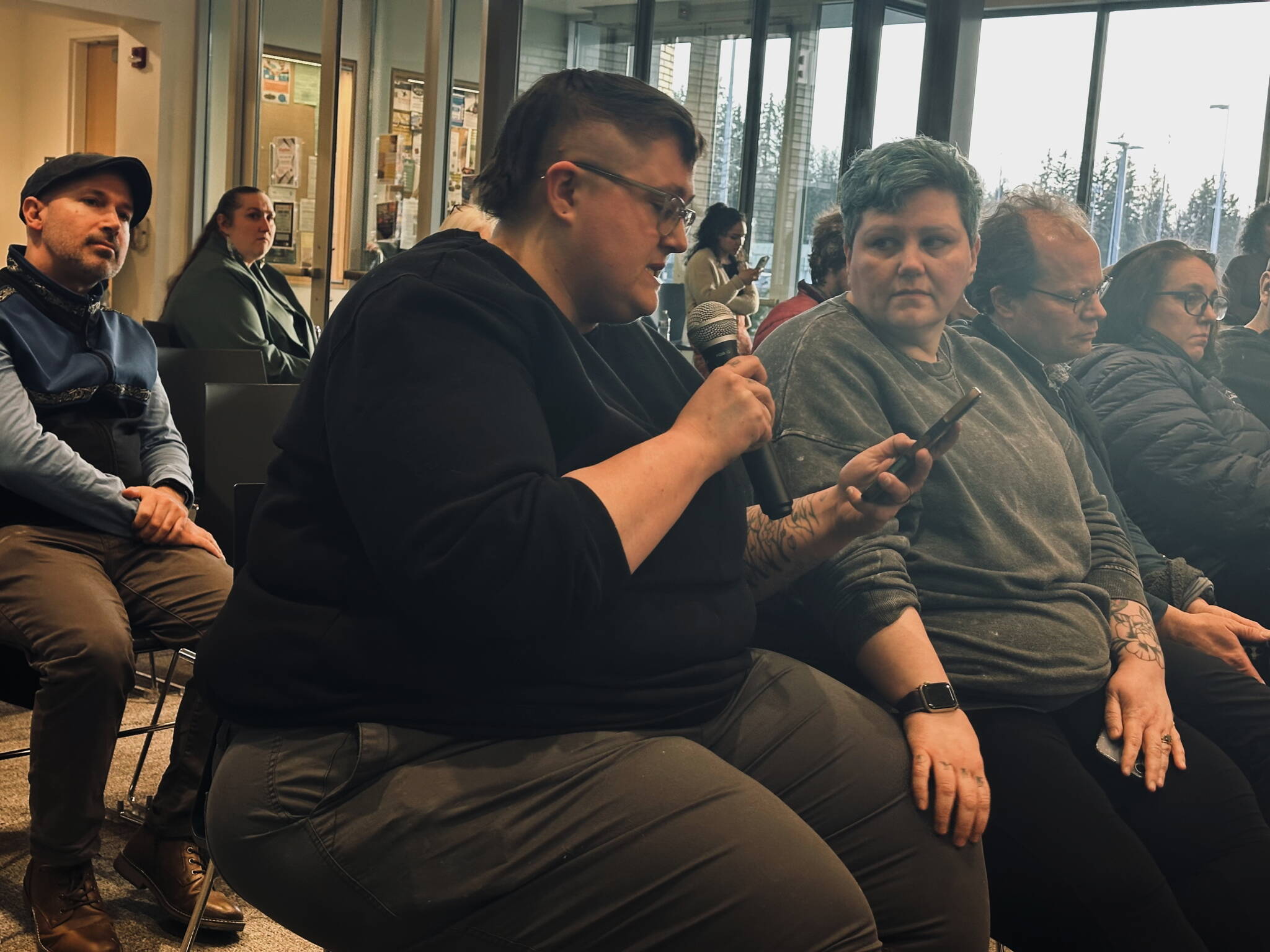
Kiernan Riley, left, accompanied by spouse Kay, asks a question about LGBTQ+ health care rights during a town hall with the three members of Juneau’s state legislative delegation Thursday night at the Mendenhall Valley Public Library. (Mark Sabbatini / Juneau Empire)
That said, leverage works both ways, Hannan said in response to a question from a constituent concerned about a policy bill by the governor that would place limits on the rights of people to record conversations.
“If the governor came to me and said ‘I’ll pass a tax bill on income tax, I’ll close the S-corp loophole, I’ll give you a $1,000 permanent BSA and I’ll give a decent PFD; the only thing you got to do is give me two-party recording’ then I’d have to think about it,” she said. “But I will tell you Gov. Dunleavy has been in town 13 days since we started the session. He’s not asking me for those. And my price to do it would be really high.”
A similar response was offered when Kiernan Riley asked the delegation about the Alaska State Medical Board last week voting to ask the Legislature to ban hormonal and surgical gender-transition treatments for minors. Riley said among the concerns is a wider policy push at the state and federal levels to restrict LGBTQ+ rights, with transgender issues particularly prominent.
“How do you actually push back against the rise of extremist legislation that seeks to overstep my constitutional right to privacy, and seeks to erase me and my community from history?” Riley said.
Kiehl said there appears to be little chance any such legislation would be enacted by the current Legislature, which has bipartisan majorities in both the House and Senate where Democrats have the largest share of members.
“You can’t stop bad bills from being introduced,” he said. “We can stop them from passing.”
• Contact Mark Sabbatini at mark.sabbatini@juneauempire.com or (907) 957-2306.
