
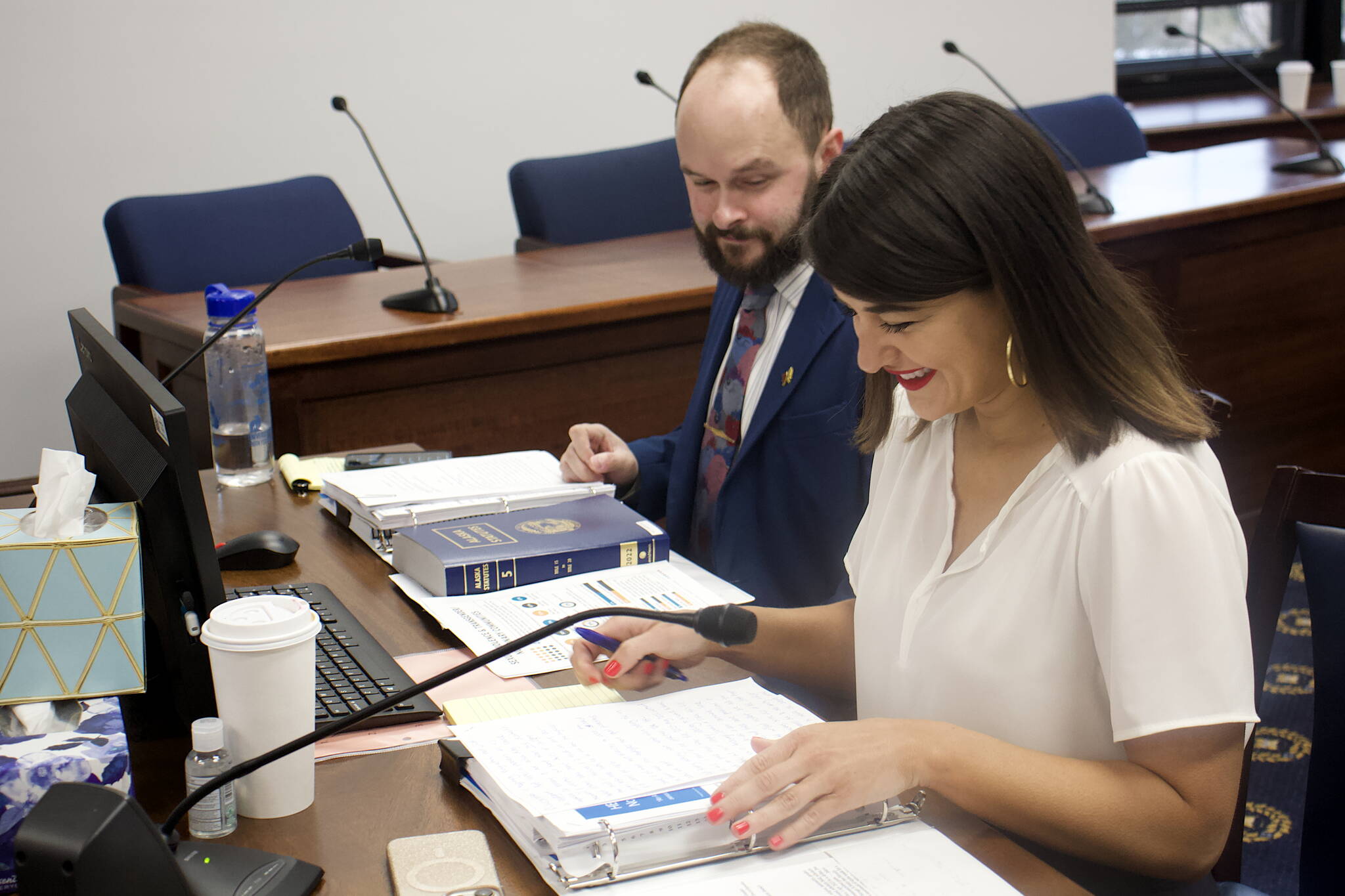
Debate about a bill seeking to prevent LGBTQ+ discrimination caused so much buzz — which was actually due to faulty broadcasting equipment —the participants had to evacuate the room, but the discussion that continued after it was relocated remained plenty charged, even after the official hearing was over.
House Bill 99, advanced out of the House Community and Regional Affairs Committee on a 4-2 vote Tuesday, with Republican Rep. Justin Ruffridge of Kenai joining three members of the Democratic-led minority voting in favor. Rep. Jennie Armstrong, an Anchorage Democrat sponsoring the bill, said it seeks to revive a ban on discrimination against LGBTQ+ individuals that was in place for most of Alaska until the state’s civil rights agency quietly dropped it last year on the advice of Attorney General Treg Taylor
“If we want more businesses to invest in the state, which we desperately need, we need to make sure their employees have equal protections across the state,” Armstrong said during Tuesday’s committee hearing.
A companion bill, SB 108 by Sen. Scott Kawasaki, a Fairbanks Democrat, has its first hearing Monday in the Senate Labor and Commerce Committee. Other bills related to LGBTQ+ matters have also received considerable attention this session, most notably HB 105 by Gov. Mike Dunleavy that would severely curtail sex and gender content in public schools.
Armstrong’s bill would redefine “sex” in existing anti-discrimination law — which also applies to race, nationality and other personal traits — to include sexual orientation, gender expression and gender identity. The law applies to situations including employment, housing, financing, government practices and public accommodation.
Some communities including Juneau and Anchorage have implemented their own anti-discrimination policies. But Armstrong noted such local-level authority in Alaska is limited to first-class cities, meaning many residents especially in remote areas can’t get such protections even if local leaders support them.
Opposition by committee members Tuesday focused on two matters: what types of people should legally qualify for anti-discrimination protection, and societal/safety issues related primarily to transgender access to bathrooms and locker rooms.
The legal debate was initiated by Rep. Kevin McCabe, a Big Lake Republican, who introduced an amendment limiting the bill to employment, which he said is the only protection granted by a landmark 2020 U.S. Supreme Court decision regarding sexual orientation and gender identity.
Because of that limit, he also asked Armstrong if the bill grants additional protections if “political expression” — such as a person displaying a Gadsden or Confederate flag — deserves to be among them.
“I’ve heard many stories of people being discriminated against,” he said. The stories include “people being harassed because they have a Confederate flag in the back of their truck or a Gadsden flag, or something like that.”
Armstrong said she isn’t seeking to add any categories to protected classes, but redefine an existing one to a way it’s been previously interpreted.
The societal objections were voiced by Rep. Tom McKay, an Anchorage Republican who has been outspoken about the issue and is sponsoring a bill prohibiting transgender girls from participating on girls’ school sports teams. He said while Armstrong and other bill supporters talk about LGBTQ+ protections, “who protects my granddaughters? Who protects the women in a women’s prison from a male rapist who enters the prison expressing himself as a female? “
“We’re not God who gets to define if we’re male or female,” he said. “Just because a man puts on a dress that doesn’t make him a woman.”
Armstrong, who identifies as part of the LGBTQ+ community as pansexual, said it’s offensive LGBTQ+ individuals are increasingly being labeled as predators, since they’re more likely to be victims and a majority of violence is committed by heterosexual males.
“God made me, too,” she said, “I’m not trying to play God. I’m trying to play legislator.”
The debate didn’t end with the vote to advance the bill, with lawmakers trading heated words during an at ease immediately afterward.
Public testimony on the bill has been equally divided — and at times even more blunt. Most of the spoken and written testimony is from residents supporting the legislation (although many of the written comments are slightly modified form letters), while some opponents openly stated they favor allowing discrimination.
“I run a bed and breakfast and host events open to the public,” wrote Rebecca Hinsberger, a Kasilof resident. “I will not endure having forced inclusion of serving LGBTQTA activists on my property. Private schools and businesses hosting public events should not either.”
Grey Mitchell, a Juneau resident, stated in written testimony that such legislation in other states allows LGBTQ+ supporters to “discriminate against religious freedoms,” including filing numerous lawsuits that in some instances have reached the U.S. Supreme Court.
“A man should not have grounds to sue because he is not allowed to use a woman’s bathroom, stay in a women’s shelter, compete in woman’s sports, etc. simply because he says he thinks he is a woman,” he wrote.
The bill still needs to get past the House Judiciary Committee before reaching the floor, which may be a tall task since the five Republicans on the seven-member committee are among the most conservative lawmakers at the Capitol. Committee chair Sarah Vance, a Homer Republican, has voted against similar previous legislation and vice chair Jamie Allard, an Eagle River Republican, has stated “I truly believe those who are transgender are mentally ill.”
Vance, during a news conference Tuesday, was evasive when asked about the bill, talking instead for several minutes about other legislation the committee has considered that toughens penalties for sex-based crimes. When asked again about HB 99 she said “that bill has not come to my committee yet. I have not had time to read it and I will prioritize it like every other bill.”
• Contact reporter Mark Sabbatini at mark.sabbatini@juneauempire.com.
