
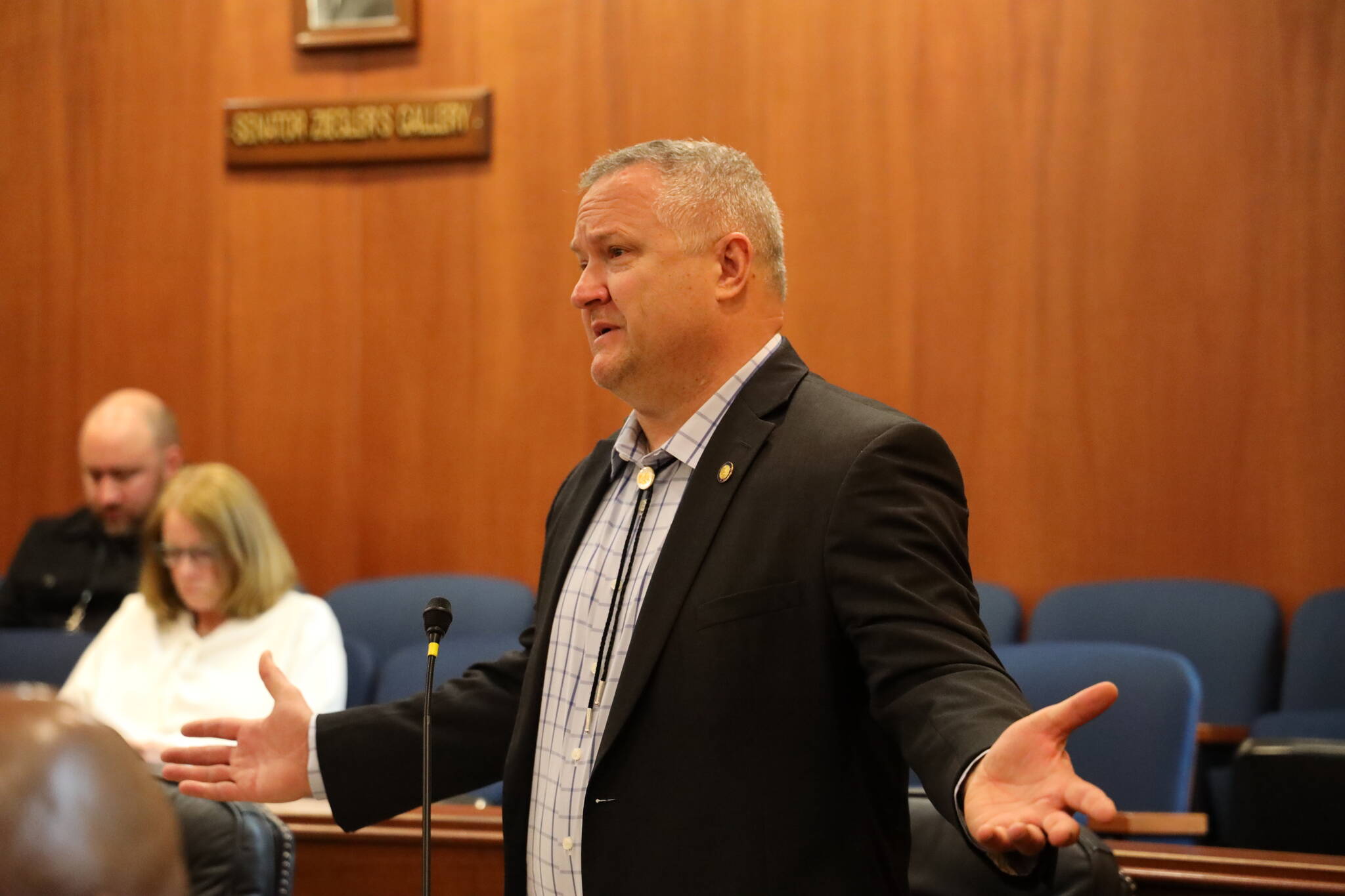
This story has been updated to correct the Senators who sponsored the amendments on the bill.
A new way of calculating the Permanent Fund dividend that would drastically shrink payments to residents so more money is available for state spending passed the state Senate on Monday. But opposing votes by several members of the majority caucus may endanger its already dubious prospects during end-of-session negotiations with the House or a subsequent veto by the governor.
Senate Bill 107 implements a so-called “75-25” system, where 75% of available Permanent Fund earnings after inflation proofing would be available for state use and the remaining 25% for the PFD, with exceptions if the state generates a large amount of new revenue and has a rosy financial outlook. Practically speaking, that would result in a PFD this year of about $1,300 and a balanced state budget, compared to a “50-50” plan supported by House leaders that result in about a $2,700 PFD and $600 million deficit.
The dilemma is Senate leaders have stated they aren’t willing to support a 50-50 dividend that results in a deficit, while the Republican-led House majority opposes the 75-25 concept. A number of additional financial pieces are likely to be part of the picture during the final two week of the session as lawmakers seek not to just a budget for this year, but a stable long-term fiscal plan, with Permanent Fund earnings currently by far the biggest piece of the puzzle in terms of sheer dollars.
“Unless we come up with some method that pins something down I firmly believe we are stuck in the mud,” said Sen. Lyman Hoffman, a Bethel Democrat who carried the bill during floor consideration. “We are moving nowhere fast.”
The bill does contain a provision allowing a 50-50 dividend if the state generates $1.3 billion in new revenue and has a balance of at least $3.5 billion in the Constitution Budget Reserve, which legislators have used in most recent years to cover shortfalls in the budget.
The legislation passed by a 12-7 vote, with four members of the bipartisan majority joining the three minority members in opposition, and one majority member absent. State Sen. Jesse Kiehl, a Juneau Democrat, was among the votes in favor.
The smaller PFD wasn’t necessarily what troubled majority members opposing the bill.
“I ran on a comprehensive fiscal plan, as did many of us, and it’s for that reason I cannot vote yes on this legislation, because I do not believe it is comprehensive in that way,” said Sen. Forrest Dunbar, an Anchorage Democrat, who was among the majority member opposing the bill.
Noting no revenue-generating measures such as a new tax have reached the floor yet, he said “this might be an important step forward, but I am worried it is the only step we take this session.”
Monday’s margin (and even an additional yes vote from the missing member) would not be enough for the three-fourths vote of the Senate (along with the House separately) to tap into the CBR if the final budget does incur a deficit, nor enough to override a veto if Gov. Mike Dunleavy rejects the bill. His budget contains a “statutory” PFD of about $3,500 based on calculations used until 2016 — and a resulting deficit of more than $900 million — but has indicated he’s willing to consider alternatives while still favoring the largest divided that’s practically feasible.
The strongest opposition during Monday’s floor session and several amendments were offered by the three minority members, who are all considered conservative Republicans. Sen. Robert Myers, a North Pole Republican, said he feels supporters are relying solely on smaller PFDs to balance the budget, without giving enough consideration of other budget-balancing actions such as spending cuts and new taxes.
“I think we all agree in crafting a fiscal plan the PFD is going to be part of it,” he said. “What I object to is it being all of it.”
Myers said a majority of residents have historically favored prioritizing dividends over state spending with Permanent Fund earnings, and a recent state Chamber of Commerce poll asserts 88% of respondents don’t want fund earnings to be the only element of a long-range fiscal plan.
“I can see it being a great plan for two groups,” he said. “People who rely on government for their livelihood because it keeps the money flowing. And it’s a great plan for people at the upper end of the economic spectrum who want government spending to continue, but don’t want to pay for it.”
The philosophical difference in prioritizing the PFD vs. state spending was illustrated when Senate Majority Cathy Giessel, an Anchorage Republican, said she supports the bill because agencies such as the one that’s been in a crisis-level food stamps backlog for months are clearly in need of additional funds for adequate staffing and equipment.
“How about we give them the Permanent Fund dividend so they can go buy their groceries?” retorted Sen. Shelley Hughes, a Palmer Republican who’s among the three minority members.
Senate leaders supporting the bill, as well as House leaders and Dunleavy, have all emphasized they believe a combination of actions are necessary for a fiscal plan.
Bert Stedman, a Sitka Republican and co-chair of the Senate Finance Committee, argued the state has cut spending significantly since lawmakers began changing PFD payouts in 2016. He said while the amount is the same in “nominal dollars,” that amounts to a 14% reduction when inflation is taken into account.
“That goes through two governors — one of those governors is in his second term — four-and-a-half legislatures and we now have unprecedented inflation expenditures we’re trying to hold back.”
An amendment by Hughes to change the Senate bill to a 50-50 plan was rejected by a 16-3 vote. Similarly rejected was an amendment by Myers putting the issue to voters on a ballot.
Kiehl said it’s improper for the Legislature to delegate such authority because voters can use initiatives to enact law or overturn an action by the Legislature.
“It is not for the Legislature to delegate our job, our authority, what the Constitution puts in our hands,” he said.
• Contact reporter Mark Sabbatini at mark.sabbatini@juneauempire.com
