
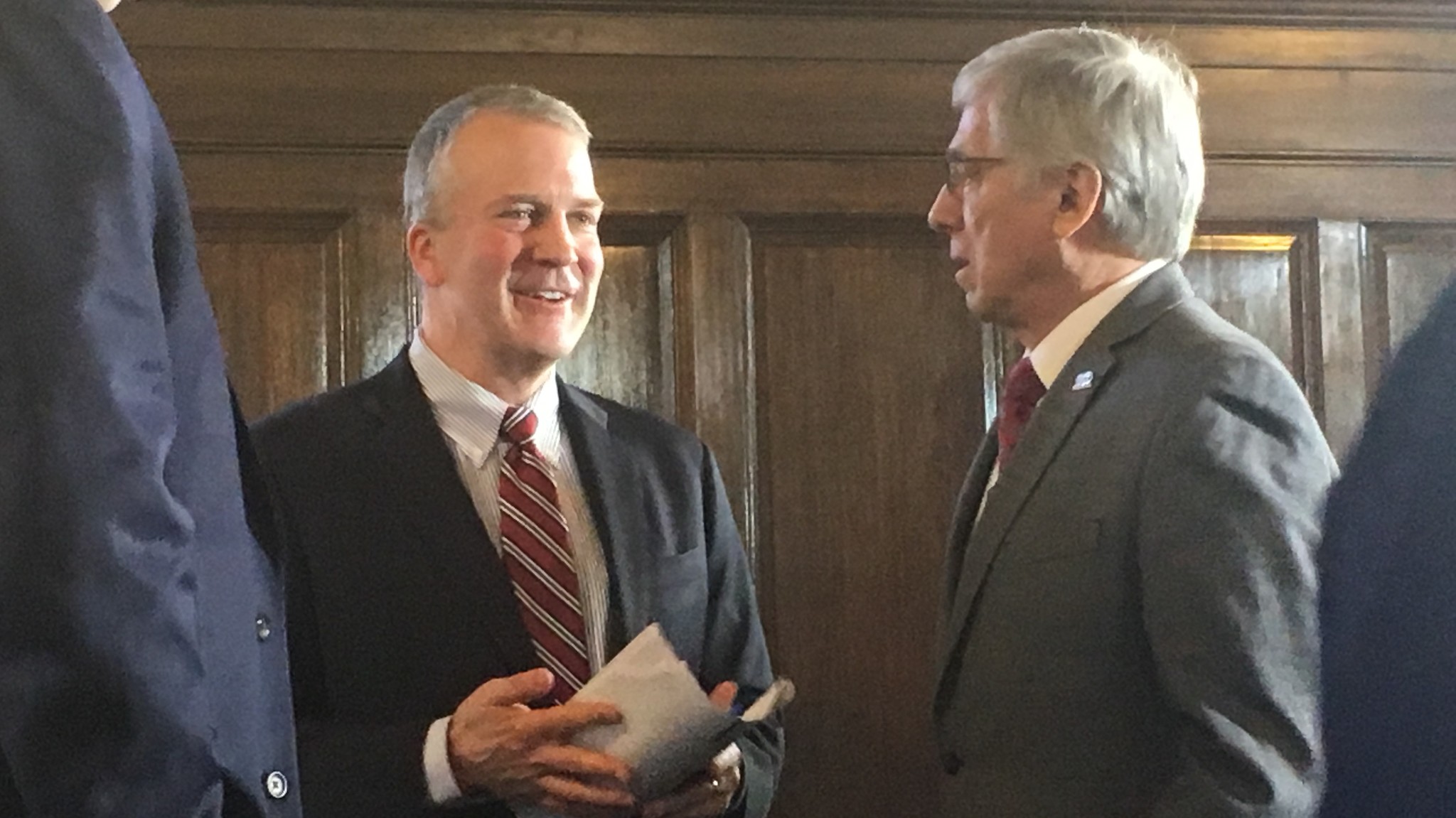
The Alaska House’s representative for the North Slope welcomed U.S. Sen. Dan Sullivan to the Capitol with a gift Friday: A fresh resolution proclaiming the Legislature’s support for oil and gas drilling in the Arctic National Wildlife Refuge.
House Joint Resolution 5 passed a final hurdle in the House with a 32-4 vote, and Rep. Dean Westlake, D-Kotzebue, handed a copy of the resolution to Sullivan following the Republican senator’s speech to the Legislature.
“This kind of resolution is really, really important, because there’s narratives back in DC that it’s only Republicans that want (ANWR drilling),” Sullivan said. “This shows unity in Alaska on this issue.”
Westlake, who has repeatedly said ANWR drilling is about jobs in his district, was accompanied by Speaker of the House Bryce Edgmon, D-Dillingham, and Rep. David Talerico, R-Healy; both men supported the resolution, and Talerico had proposed his own version alongside Westlake’s.
“We need jobs, we need economic development. We need a future for Alaska,” Edgmon said.
With oil and gas prices low, drilling in federal waters of the Arctic Ocean is likely uneconomical. ANWR’s coastal plain, adjacent to the existing Prudhoe Bay infrastructure, is cheaper and faster to develop, but even if Congress were to approve drilling tomorrow, it would take years ─ if not decades ─ for the first ANWR-produced oil to enter the trans-Alaska Pipeline System.
Four Democratic House representatives continued their opposition to ANWR drilling: Rep. Geran Tarr, D-Anchorage; Rep. Zach Fansler, D-Bethel; Rep. Justin Parish, D-Juneau; and Rep. David Guttenberg, D-Fairbanks.
Each Legislature since 1995 has approved a resolution favoring ANWR drilling; the four ‘no’ votes in the House tie with 2005 for the most opposition.
Senate action
In the Senate’s Friday floor session, there was a brief procedural battle as members of the Senate Majority introduced Senate Bill 70, a measure that includes the core of the majority’s plan to fix Alaska’s $2.7 billion annual deficit.
If enacted, SB 70 would cap Permanent Fund Dividends at $1,000 for three years, spend a portion of the investment earnings of the Permanent Fund on state services, and enact a tight cap on future spending. SB 70 would be combined with $750 million in budget cuts over the next three years.
SB 70 was referred to the Senate Finance Committee for consideration, but not before members of the Democratic Senate Minority attempted to send it to the Senate State Affairs Committee first.
The State Affairs Committee is chaired by Sen. Mike Dunleavy, R-Wasilla, who has proposed a plan of his own to balance the budget, and he has thus far declined to let two other Permanent Fund-spending bills (one from the governor, one from Sen. Bert Stedman, R-Sitka) leave his committee.
The procedural move was easily defeated by the Senate Majority, 14-3, and Dunleavy himself voted against it. The first hearing on SB 70 is 9 a.m. Monday, and a second is scheduled for 1 p.m. Wednesday.
Bills on the move:
• On Friday, the House special committee on fisheries advanced a proposal to boost the maximum limit of state-subsidized loans to fishermen. House Bill 56, sponsored by Rep. Dan Ortiz, I-Ketchikan, increases that limit to $400,000 from $300,000. The bill advances to the House Finance Committee.
• The House’s special committee on military and veterans affairs has approved a bill of its own making that extends workers’ compensation protection to members of the state militia while they are on training or deployment. The militia is the force mobilized when the National Guard is unavailable. House Bill 126 now advances to the House Labor and Commerce Committee.
• Anyone who loses property due to an Alaska Department of Transportation project will get a little more compensation if House Bill 131 passes the Legislature. The measure, sponsored by the House Transportation Committee, advanced from that committee on Friday. It heads to the House Finance Committee.
• The proposed tripling of the state’s gasoline tax has advanced from the House Transportation Committee. House Bill 60, which was proposed by the governor, advances to the House Finance Committee for consideration.
• In the Senate, the Community and Regional Affairs Committee has approved a museum grant fund proposed by Sen. Gary Stevens, R-Kodiak. Senate Bill 7, which advances to the Senate Finance Committee, creates a fund for museum renovations and construction. Given the state’s financial situation, it only creates the fund ─ it doesn’t put any money into it.
Coming up
This week, the House and Senate finance committees will be the center of attention. The House Finance Committee will focus on putting the finishing touches on a proposed budget (how to pay for that budget has not yet been decided). Lawmakers will consider subcommittee suggestions through Wednesday, then take public testimony Thursday and Friday on the resulting product.
Members of the House Finance Committee could vote on the budget as soon as next week; the budget process is a long way from complete, however ─ the Senate still needs to examine the House’s work, and lawmakers still haven’t figured out how to pay for the budget.
In the Senate, finance committee members are scheduled to spend Monday and Wednesday examining the Senate Majority’s proposal to pay for the budget with some of the investment earnings of the Alaska Permanent Fund.
Either Monday or Wednesday, the House and Senate will each take floor votes on a pair of proposals.
In the House, a bill legalizing “ballot selfies” is up for a vote, as is a measure that would remove the requirement for the Alaska Judicial Council to collect statewide information on civil litigation settlements.
In the Senate, lawmakers will be asked to confirm the names of the two new Alaska-class ferries under construction in Ketchikan and approve a resolution naming February 2017 Black History Month.
Contact reporter James Brooks at james.k.brooks@juneauempire.com or 419-7732.
