
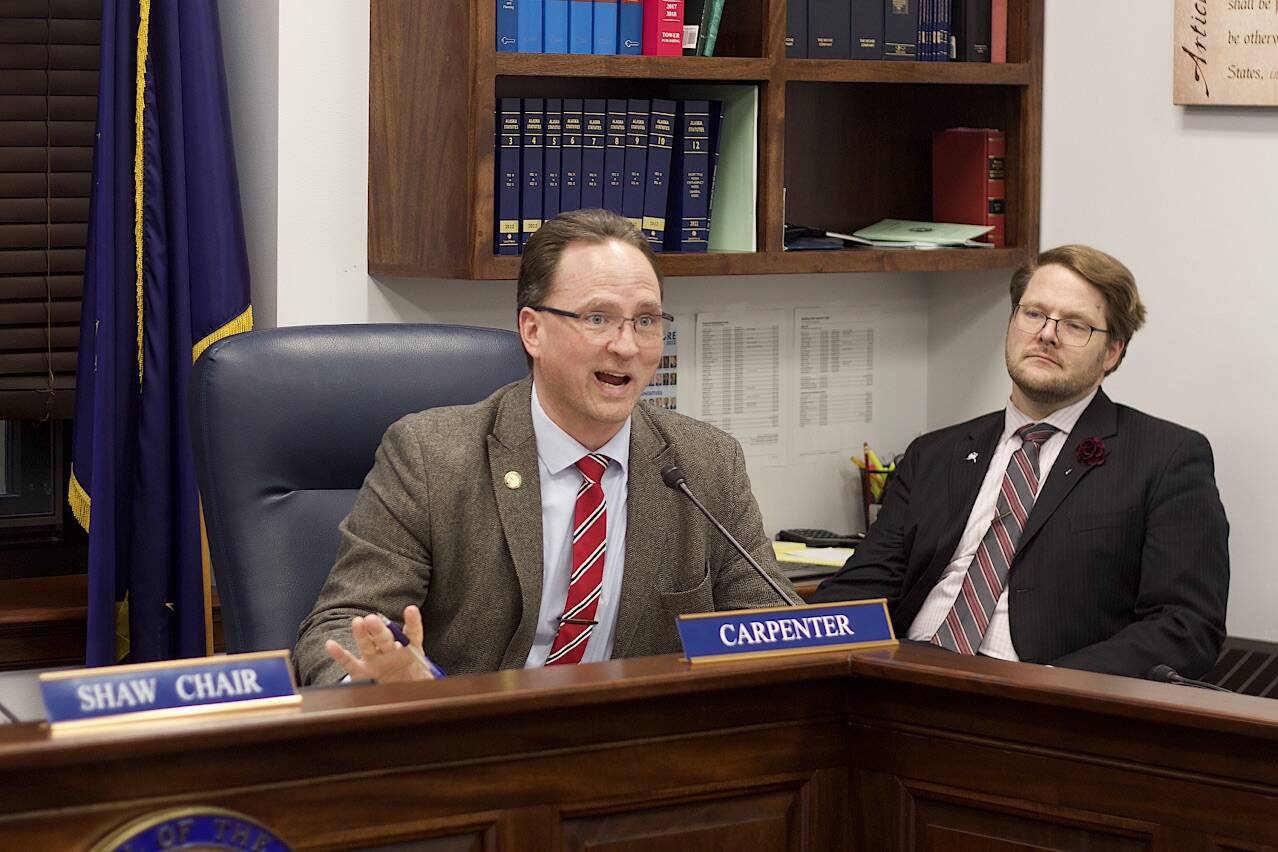
KENAI — The central Kenai Peninsula’s representatives in the Alaska House of Representatives have their eyes on state finances this week.
Reps. Justin Ruffridge, a Soldotna Republican, and Ben Carpenter, a Nikiski Republican, both introduced bills this week that address state finances. Carpenter’s latest bill would implement a statewide 2% sales tax, while Ruffridge’s would reject efforts by the Alaska State Officers Compensation Commission to increase pay for lawmakers and state executives, including the governor and lieutenant governor.
The bills come as the Alaska Department of Revenue estimates Alaska will take in less revenue than expected for the current and upcoming fiscal year due to a lower outlook for oil price and production. The department said last week that the state’s unrestricted general fund revenue forecast for the current fiscal year, which ends on June 30, was reduced by $246 million, while revenue for the upcoming fiscal year, which begins on July 1, was reduced by $679 million.
Carpenter said Tuesday that the bills he has introduced so far stem from a fiscal policy working group, established by the 32nd Alaska Legislature in 2021. That group was tasked with developing policy recommendations that would provide financial certainty for the state, such as through balancing the state budget and resolving annual debates over Alaska Permanent Fund dividend payments.
That group recommended, among other things, that lawmakers take up a predictable PFD solution, reform state spending limits and explore potential sources of new revenue.
So far this session Carpenter has introduced House Bill 142, which would establish a 2% statewide sales tax; H.B. 109, which would reduce corporate income taxes; and H.B. 110, which would transfer administration of the permanent fund dividend to the Alaska Permanent Fund Corporation and take the dividend out of the state’s appropriations process.
“While an amendment to Alaska’s Constitution (is) needed to enable a constitutional dedication of income from the permanent fund, H.B. 110 makes the intent of the legislature to pay a dividend by statute clear,” Carpenter wrote in a sponsor statement accompanying H.B. 110.
Of H.B. 109, Carpenter said Tuesday that the state’s high corporate income tax rates may be disincentivizing companies from doing business in Alaska. Per that bill, corporations would not pay any income taxes if the total amount of taxable income is less than $25,000. If a corporation’s taxable income is more than $25,000, the state tax would be 2%.
“If that’s the activity we want to attract … then we need to incentivize that behavior,” Carpenter said of encouraging businesses to operate in Alaska.
Carpenter said there is a “one percent chance” that any of the initiatives cross the finish line this year, but he hopes the ideas will at least marinate in lawmakers’ minds until next session. They’re issues he said the Legislature has, over the last two years, not taken up, and will roll over to next year.
“The majority that was in charge didn’t want to have those conversations,” Carpenter said of the two most recent legislative sessions. “ … We’re having them now.”
Because the bulk of Alaska’s revenue comes from oil, the Alaska Permanent Fund and the federal government, Carpenter said there is sometimes a reluctance in Juneau to talk about economic issues that are outside of those topics.
As the pieces of a fiscal plan for the state come together, Carpenter said it will be important for lawmakers to take a “holistic” approach. No one element of the plan, he said, will pass on its own, and Alaska statute prohibits the combination of bills that have different subjects.
“The lens … I am looking at these through is, ‘What is going to enable us to grow our economy?’” Carpenter said.
The latest installment in Carpenter’s package of financial bills came as Ruffridge spearheaded an effort to curb pay hikes for lawmakers and state executives.
Ruffridge on Monday introduced H.B. 136, alongside 10 co-sponsors, which would reject a pay raise for Alaska’s state lawmakers and executive officials recommended by the Alaska State Officers Compensation Commission earlier this month. As reported by the Anchorage Daily News, the recommendations came the day after Gov. Mike Dunleavy replaced all five members of the group.
Ruffridge in a March 25 opinion piece submitted to the Clarion denounced the recommendations, which would bump lawmakers’ pay by 67% and executive pay by about 20%. He specifically criticized the process so far, which included the replacement of group members, Dunleavy’s veto of a bill rejecting the increase and the Senate’s refusal to meet to override that veto.
“Our State needs a strong fiscal plan, and now is not the time to increase salaries for legislators,” Ruffridge wrote. “We need to focus our efforts on our economy, education and workforce development issues, not our own pay.”
H.B. 136, introduced Monday, has since been referred to the House State Affairs Committee.
Other legislation sponsored by Ruffridge so far this session includes H.B. 56, which would exempt Alaska’s veterinarians from the state’s opioid Prescription Drug Monitoring Program; H.B. 112, which would clarify the powers and duties of the Alaska Board of Pharmacy; and H.B. 139, which would adjust the amount of money correspondence schools in Alaska receive from the state for special needs programming.
Sen. Jesse Bjorkman, a Nikiski Republican, has introduced two bills this session. The first, Senate Bill 82, would establish a permit buyback program for Cook Inlet’s east side setnet fishery. As of Tuesday, that bill had not yet been heard in committee. It was referred to the Senate Resources Committee on Feb. 24.
Bjorkman’s other bill, S.B. 87, aims to make locally milled lumber more widely available for construction by establishing a grade training program under the Alaska Division of Forestry. Senate President Gary Stevens, a Kodiak Republican, and Sen. Forrest Dunbar, a Anchorage Democrat, have signed on as co-sponsors of the bill, which is scheduled to be heard in the House Resources Committee on Wednesday.
Reach reporter Ashlyn O’Hara at ashlyn.ohara@peninsulaclarion.com.
