
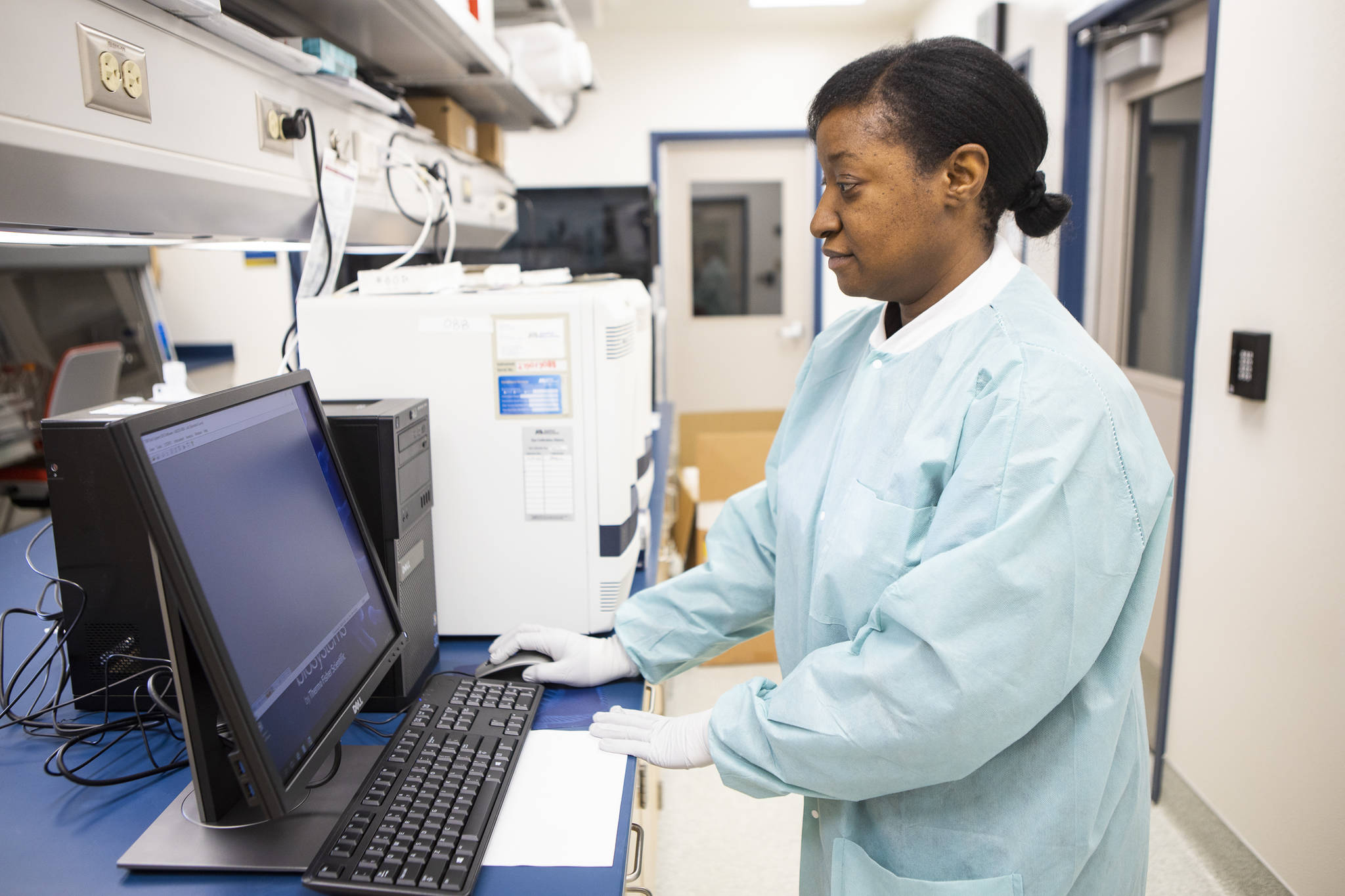
The City and Borough of Juneau is considering buying a piece of lab equipment that would allow COVID-19 tests to be completed locally and set the city up as a regional testing hub.
City staff are deciding whether to purchase one of two testing machines sophisticated enough to process COVID-19 test samples and would be installed at Bartlett Regional Hospital or another local facility. The main difference between machines the two is capacity, with the larger, more expensive machine being able to complete up to 4,000 tests in a day.
“Probably the larger capacity option would really only be necessary in worst-case scenario,” said Robert Barr, planning section chief for the city’s Emergency Operations Center. “Being able to process and get our results locally gives us local control over (the testing process). The quicker we can process that test the sooner that we can know they are or aren’t (COVID-19-positive) the quicker we can take appropriate action.”
In a memo sent to Assembly members this week, Barr said local health authorities had discussed establishing local testing in Juneau in early May, and the Economic Stabilization Task Force supported the idea. Currently, local samples can’t be processed here and have to be sent to a laboratory in Anchorage, Fairbanks or the Lower 48. With its own testing machine, Juneau would be able to reduce that turn-around time and better prioritize testing.
[Mayor recovers from COVID-19, emphasizes importance of testing]
“We lose local control when we (send tests out),” Barr said. “We don’t have a good handle on how long it’s going to take. There’s a whole lot of different variables.”
Weather, courier services and demand at labs can make wait times even longer, according to Barr, and with its own machine, Bartlett can prioritize testing for not only Juneau, but Southeast as well.
The larger machine costs roughly $700,000, according to Barr’s memo, and could process up to 4,000 tests a day. A smaller unit able to process 1,300 tests per day would cost $350,000, and would be able to be housed at Bartlett. Because the expense is directly related to COVID-19, the city could use some of the $53 million in CARES Act federal relief money to pay for the machine.
Neither machine would require adding specialized personnel to the Bartlett Regional Hospital payroll, Barr said.
Setting up testing in Juneau is something the city has wanted to do for some time, according to City Manager, Rorie Watt.
“We have enough CARES Act funds to purchase the equipment,” Watt said, “as we open the economy we shouldn’t be looked at as a town of 30,000. We’re a hub, we should feel like a much bigger place.”
The machine could be useful in the future as more people begin transiting through the city and tourism eventually returns, Barr said.
[Traveler tested at airport tests positive for COVID-19]
The city does have rapid-tests available, but supplies are limited and in high demand nationally. Furthermore, the memo says, rapid tests are less sensitive than lab-processed tests, and results are always forwarded on to the lab for confirmation.
There are multiple areas in Southeast that could cause a spike in demand for testing, the memo says.
“Other areas of potential high demand include JSD/UAS, fish processing facilities, the Legislature, rural Southeast communities, the mines, other critical infrastructure surveillance testing, congregate living facilities, small cruise ships (especially those homeporting in Juneau) and anywhere an outbreak occurs and a large contact tracing investigation ensues. Large cruise ships remain a significant unknown at this time,” the memo says.
On Thursday, the state reported an additional 17 COVID-positive cases, two of which were in Juneau. There have been a total of 37 positive cases in Juneau, according to city data, with 8.67% of the population being tested.
CBJ Assembly members will hear public comment on Monday, June 29, at 7 p.m. for ordinance 2019-06(AI), appropriating $700,000 to BRH for the purchase with CARES Act funds.
• Contact reporter Peter Segall at psegall@juneauempire.com. Follow him on Twitter at @SegallJnoEmpire.
