
On the third day of the Alaska Legislature’s gas pipeline special session, there was a shift in the questions asked by lawmakers.
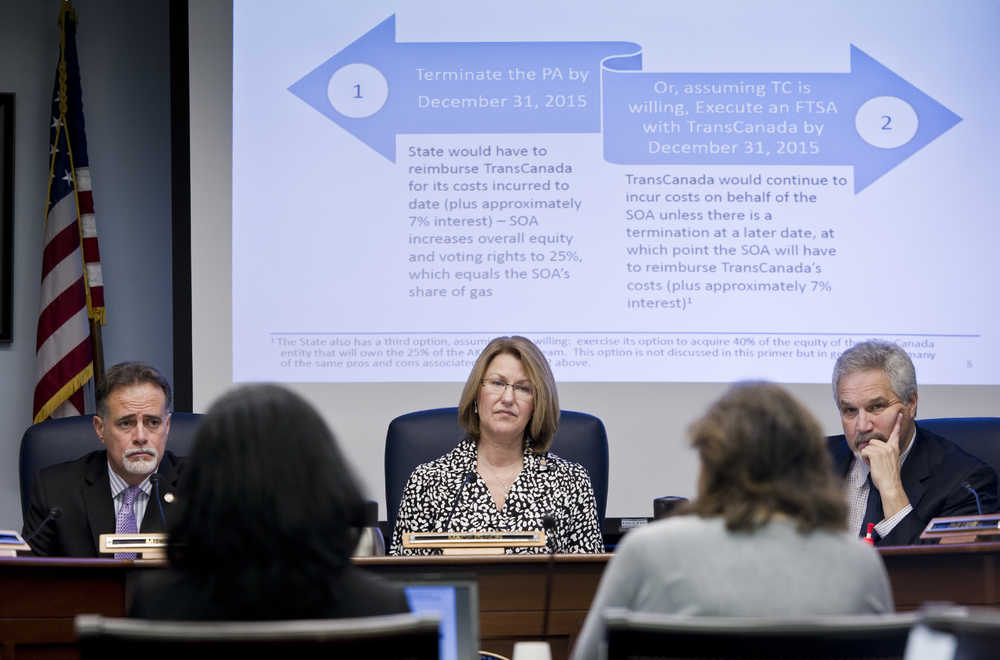
In hearings held by the House and Senate finance committees, there was less talk about the state’s proposed buyout of pipeline builder TransCanada and more talk about what happens afterward.
“I’m convinced that (the TransCanada) relationship has done its job and the sunset is on it,” said Sen. Donny Olson, D-Nome and a member of the Senate Finance Committee. “The problem that I have is what kind of safeguards do you have in place so bureaucrats … are indeed competent to do that?”
With the state-owned Alaska Gasline Development Corporation preparing to take a 25 percent stake in the $65 billion AKLNG project, that’s no small question.
Late Sunday, Rep. Mark Neuman, R-Big Lake and chairman of the House Finance Committee, asked an even bigger question: Can the AGDC legally do what the state is asking it to do?
At the end of the day Monday, lawmakers still weren’t sure.
“We have not gotten that information,” Neuman said after a hearing on Monday. “AGDC’s coming before us tomorrow, so that question will be posed to them.”
Neuman and many other legislators have been asking tough questions about how closely the pipeline project is hewing to Senate Bill 138, which — when it was passed in 2014 — contained a rough path for the project to take.
“We’re now asking to be voting on a step in the process that’s been laid out through 138 and some of the steps in that process that were to be completed to this point are not done,” Neuman said.
SB138 doesn’t explicitly state whether the AGDC can steer the state’s share of the pipeline project, and lawmakers worry it might not have the ability.
“The Department of Law is still looking into this,” wrote Katie Marquette, spokeswoman for Gov. Bill Walker, in response to an emailed question.
Not everyone believes there’s a problem. Rep. Sam Kito, D-Juneau, said because the state’s plan allows it to exit the TransCanada deal, he thinks it has the implicit ability to think about what comes after.
“If there is a legal issue, then I’d like to hear from the attorneys about what the legal issue is, because when we passed SB138, an offramp was clearly envisioned, so I don’t think the offramp was going to go off a closed road,” he said.
With the authority question unresolved, Senate President Kevin Meyer, R-Anchorage, and House Speaker Mike Chenault, R-Nikiski, have met with Gov. Bill Walker to request that he expand the mission of the ongoing special session to cover the AGDC’s authority.
On Monday, Meyer said Chenault is driving the request. “He doesn’t believe … AGDC does have the ability or authority to take on TransCanada’s share of the project if we do indeed proceed,” Meyer said.
Late Monday, Chenault said the issue is still unresolved.
The only official question on lawmakers’ agenda in this special session is whether to allocate $157.6 million pay for the state’s share of the first phase of the AKLNG project, a mammoth undertaking to bring natural gas from the North Slope to Cook Inlet for export.
To avoid paying up front for its one-quarter share in the $45 billion to $65 billion project, the state entered into a contract with Canadian firm TransCanada. Under the terms of the agreement, the Canadians pay all of the state’s direct costs until construction begins, then half of the state’s share of construction costs. In return, the state gives TransCanada a cut of its revenue once gas starts flowing.
If the pipeline deal falls apart for any reason, or if TransCanada wants to walk away from it, the state must repay TransCanada every dollar plus 7.1 percent interest.
That’s a high interest rate compared to the open market, which is why the state is considering a buyout and has earmarked $68 million of the legislative request to take an “offramp” built into the TransCanada contract. If the state doesn’t act by Dec. 31, its next offramp is years (and hundreds of millions of dollars) later.
