

A bill reviving a traditional pension system for public employees nearly 20 years after it was eliminated passed the Alaska House of Representatives on Monday, the first major step in what supporters say is a two-year process that will continue during next year’s legislative session.
House Bill 78 passed by a 21-19 vote, with all members of the Democratic-led majority in favor and the 19-member Republican minority opposed. The Senate is not expected to begin detailed consideration of the bill until the session reconvenes next January.
Sharply divided House floor debate saw supporters argue the state can’t afford not to restore pensions due to high employee turnover and shortages, which costs the state $76 million a year just for recruiting and retraining. HB 78 would add an average of $39 million a year to state public employee retirement costs between 2027 and 2039, according to a legislative financial analysis.
“This is the cost of doing nothing,” House Majority Leader Chuck Kopp (R-House) said during floor debate. “It is huge. We are burning huge bonfires of money.”
Opponents argued the pension system was shut down in 2006 due to skyrocketing costs that left the state with billions of dollars in unfunded liabilities — and cited a Reason Foundation analysis that claims HB 78 will result in Alaska incurring an additional $2.1 billion to $11.4 billion in total costs during the next 30 years. Public employees hired since 2006 have been covered by a 401(k)-style defined contribution plan that workers contribute to without guaranteed income from the state.
“That ‘failed experiment’ — if that’s what you want to call it that — has saved the state from bankruptcy,” Rep. Cathy Tilton (R-Wasilla) said, referring to the current retirement system and how it was characterized by an HB 78 supporter.
Kopp called the Reason Foundation’s analysis a “scare tactic” by an “outside group” that relies on false numbers. He said the official analysis conducted by the state-hired risk management firm states the maximum cost to the state is $600 million over 14 years. Tilton, in response, said that projection is based on “overly optimistic” investment earning projections that are higher than recent levels.
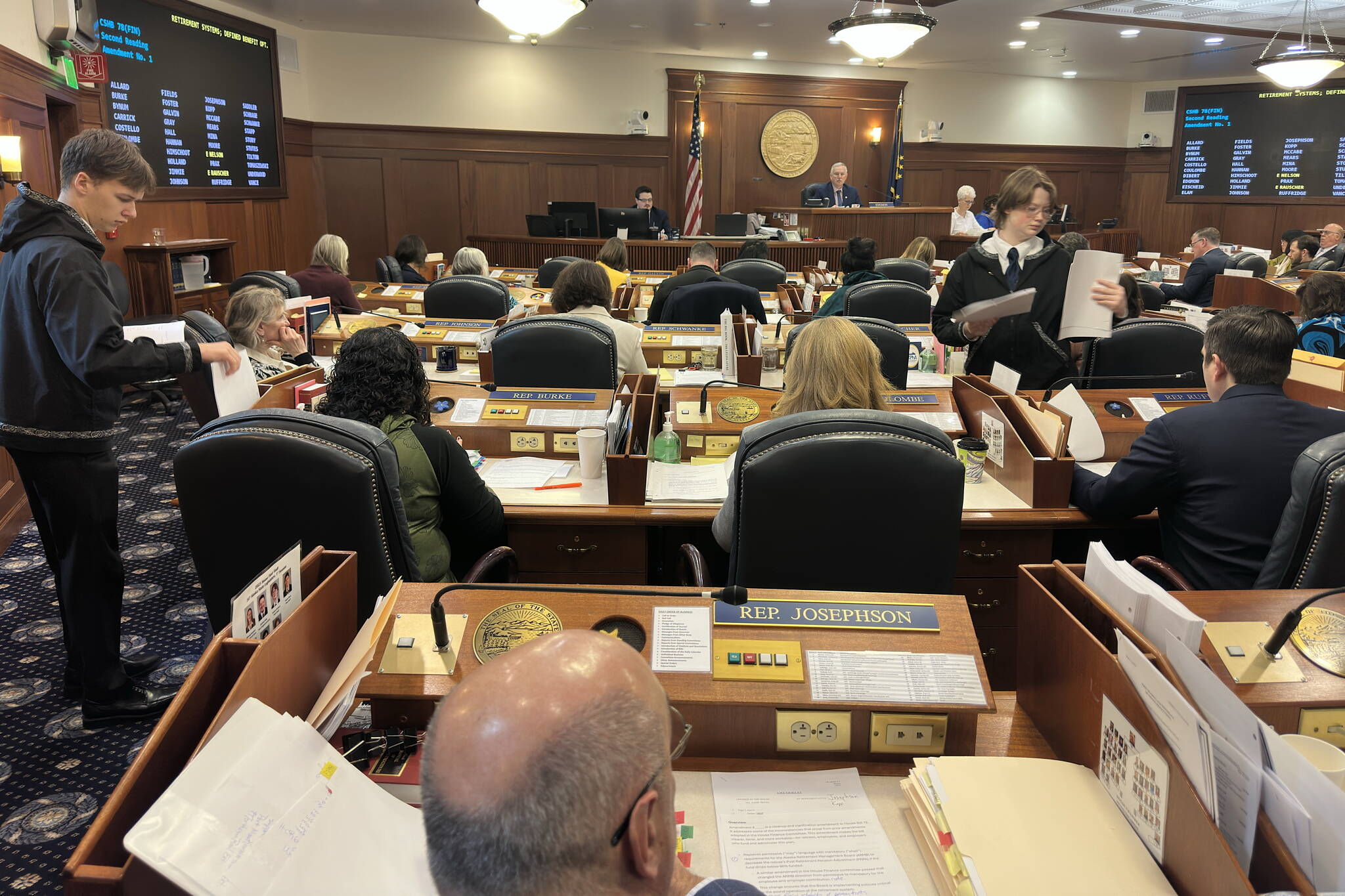
House pages distribute amendments to a bill reviving a traditional pension system for public employees during a floor session at the Alaska State Capitol on Saturday. (Mark Sabbatini / Juneau Empire)
Supporters of the bill also emphasized there are key differences compared to the previous pension system that resulted in the huge shortfall. Among them are adjusting employee and employer contributions upward if the plan becomes underfunded, and adjusting post-retirement cost-of-living payouts based on the fund’s investment performance if necessary.
A striking contrast between whether employees will see the pension system as helpful or handcuffs was also made by legislators arguing both sides of the bill.
Rep. Ky Holland (I-Anchorage) said reviving pensions has been a priority issue for public employees because “they need to know that they have the ability to work and eventually retire” in Alaska.
“We are a job market right now for short-term opportunities for employment training experience,” he said. “When we offer a defined benefits program we are saying that we want you to build your career here, we want you to build your lives here.”
Conversely, the pension system was described as “golden handcuffs” by Rep. Kevin McCabe (R-Big Lake).
“This bill handcuffs our state workers for a long period of time when they might want to leave, but they stay around for the retirement,” he said.
The Senate spent more than a year during the previous two-year session that ended last May passing a pension bill that died in the House when lawmakers adjourned. Supporters of HB 78 note this bill is a more cautious effort and Senate Majority Leader Cathy Giessel (R-Anchorage), who led the effort on the Senate bill, said it was a deliberate decision to let the House pass a bill before the Senate takes the issue up again.
Alaska’s state government has a 16% vacancy rate as of April 15, according to state Department of Administration. State union officials and sympathetic lawmakers cited a number of reasons including retirement benefits, salaries and other compensation, and lack of access to necessities such as affordable housing and child care.
One aspect of that was seemingly resolved earlier this month when a tentative agreement for an 11% pay hike and a significant boost in health care coverage was announced by the Alaska State Employees Association, the state’s largest public employees union representing more than 8,000 workers. The agreement must still be ratified by employees and approved by lawmakers.
However, some opponents of HB 78 emphasized the state is facing another crisis — a fiscal shortfall that is projected to get worse during at least the next year or two, primarily due to low oil prices that are a major source of the state’s revenue. Legislators are working on passing what they call a bare-bones budget that contains the smallest inflation adjusted Permanent Fund Dividend — $1,000 — in state history. Also, Gov. Mike Dunleavy on Friday imposed a freeze on hiring and state travel — with certain exemptions allowed — along with development of new regulations.
“There are many members in my community who asked for things like this — how can we make working in the state of Alaska a little more of an incentive?” Rep. Justin Ruffridge (R-Soldotna) said. “But I also think we have a responsibility to those people to say ‘How can we afford it?’ And we offered amendment after amendment after amendment to offer some leeway, some ways to say ‘Hey, maybe the foundation for this could be a little bit stronger. Maybe it shouldn’t cost us a bunch of money up front because we are in a fiscal constraint.’”
• Contact Mark Sabbatini at mark.sabbatini@juneauempire.com or (907) 957-2306.
