
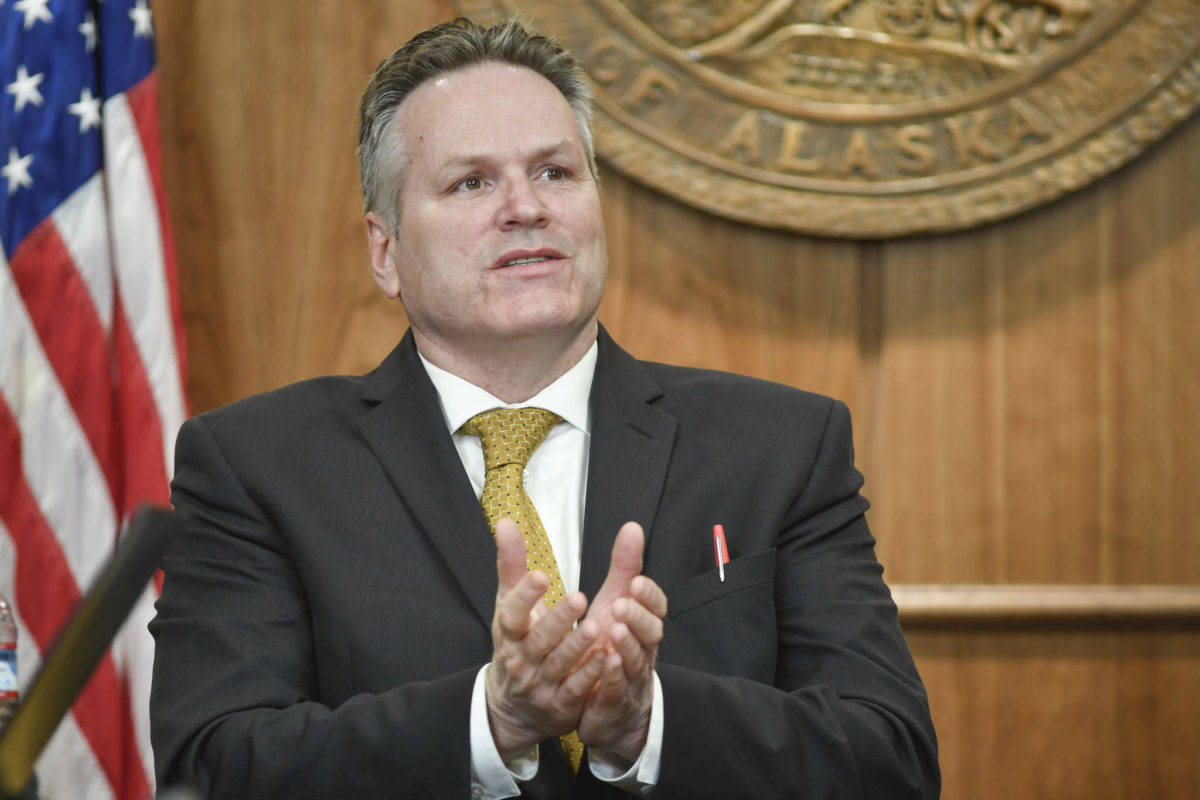
Gov. Mike Dunleavy repeated on Tuesday that he is not at this time considering reducing the state’s oil tax credits to help balance the state’s budget.
In a press conference with reporters, Dunleavy once again expressed his desire to resolve the state’s $1.6 billion deficit by reducing state spending rather than consider new sources of revenue.
“We’re going to do the best we can to get as close as possible to closing this gap,” he said during the conference in Anchorage. “My plan is to continue to work at reducing this deficit as much as we possibly can as soon as we possibly can.”
But more and more, the public has called the current oil tax system into question in the midst of the state’s budget turmoil, which on Monday saw $650 million in cuts to state programs, including $50 million to Medicaid and $70 million to the University of Alaska.
In July, protesters marched on the Governor’s Mansion in Juneau, many of them carrying signs reading, “it’s the oil tax credit,” as a solution to the states budget woes.
In the statehouse, some legislators have said that the state should look at oil taxes as a source of revenue. Sen. Bill Wielechowski, D-Anchorage, said on the floor of the Senate last month that choosing between a full PFD and state programs was a “false dichotomy,” and that oil taxes should be considered to bolster the state’s budget.
The state currently offers oil producers a per-barrel tax credit on a sliding scale maxing out at $8-per-barrel. When the price of oil drops below $80-per-barrel, the tax credit rises to $8 dollars, which is the current rate.
Sen. Tom Begich, D-Anchorage, said that in conversations with other legislators he has heard suggestions at lowering that number to anywhere from $3- to $5-per-barrel.
Dunleavy on Tuesday said if Alaska changes the way it allocates the credits, oil companies operating in the state would take their operations elsewhere.
But Begich disagrees.
Begich said during a press conference last month that oil industry leaders had expressed no desire to leave the state.
“Informally, industry leaders have not expressed a desire to leave the state and has also expressed difficulty with recruiting talent from within the state. I believe that the oil and gas industry is willing to work as a partner,” Begich said on July 29.
“They’re not going to leave,” Begich told the Empire by phone Tuesday. He reiterated the point that companies had expressed frustration at not being able to recruit employees from in the state.
“They’re not going to leave the state of Alaska because the contracts here are safer,” Begich said, pointing to civil strife that occurs in other oil-producing regions like the Middle East. Begich said that for the governor to suggest that companies would leave the state if taxes were increased was, “misguided.”
Begich said that altering the current tax credits the state gives the industry could be altered in such a way as to maintain profitability for producers while providing increased revenue for the state. The state reduces the amount of taxes companies pay per barrel based off market value of a barrel of oil.
In a July 31 report from Legislative Research Services, ConocoPhillips’ earnings per barrel in Alaska were more than double earning from production in the Lower 48 for 2019 so far.
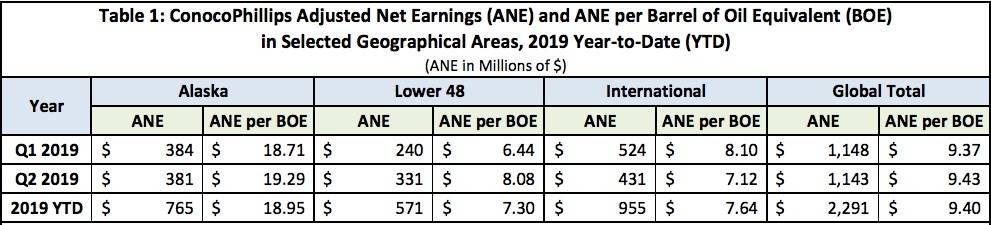
A screenshot from a July 31 report from Legislative Research Offices showing ConocoPhillips adjusted net earnings for year-to-date 2019. August 20, 2019.
Furthermore, Begich said, those companies have leases which provide a constitutional mandate to get maximum benefit from Alaska’s oil fields.
“If a company decided to slow roll,” Begich said meaning when a company decides to slow down its operations, “we could take them to court.” He added there was no threat from the industry that there were plans to draw down operations in Alaska.
Begich said that he believed that the oil industry was willing to work as a partner with the state, and that it would require compromises on all sides to reach a positive position.
“In the end we all have to work together,” Begich said. “Taking absolute positions is a mistake.”
• Contact reporter Peter Segall at 523-2228 or psegall@juneauempire.com.
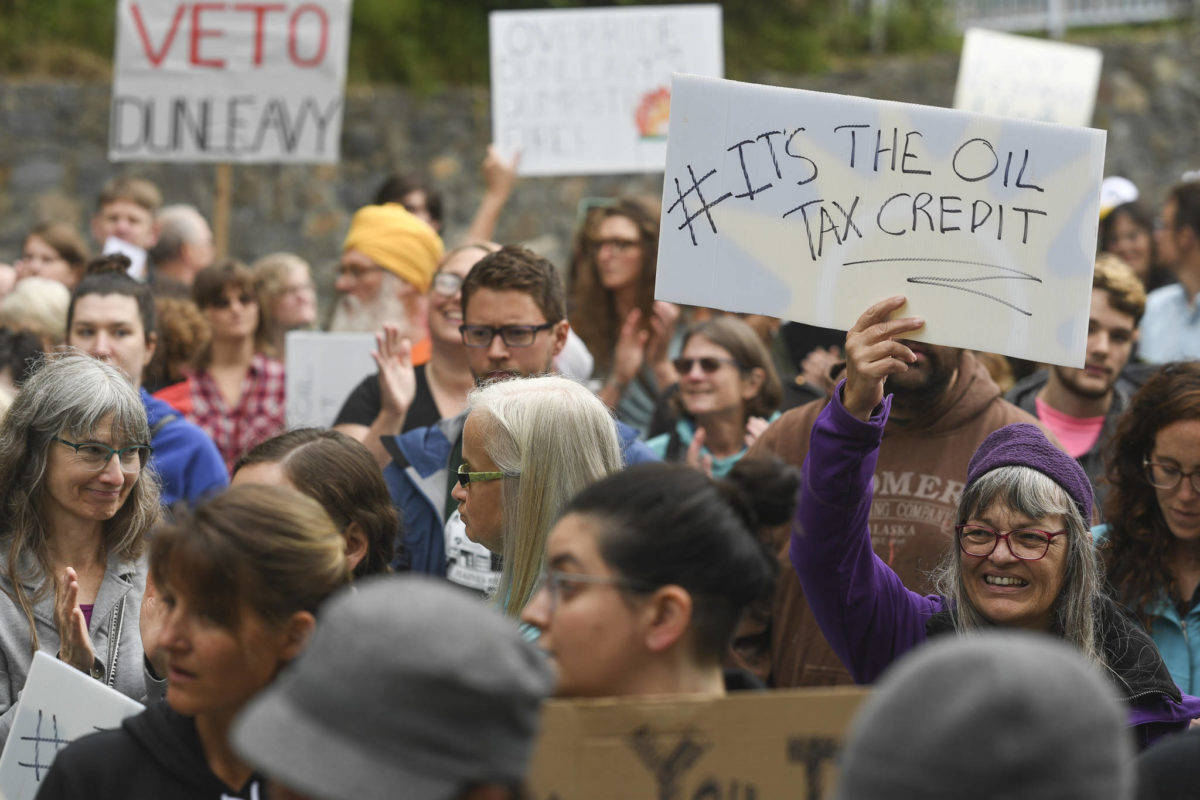
Over hundred people gather in front of the Governor’s Mansion to protest budget vetoes by Gov. Mike Dunleavy on Friday, July 12, 2019. (Michael Penn | Juneau Empire)
