
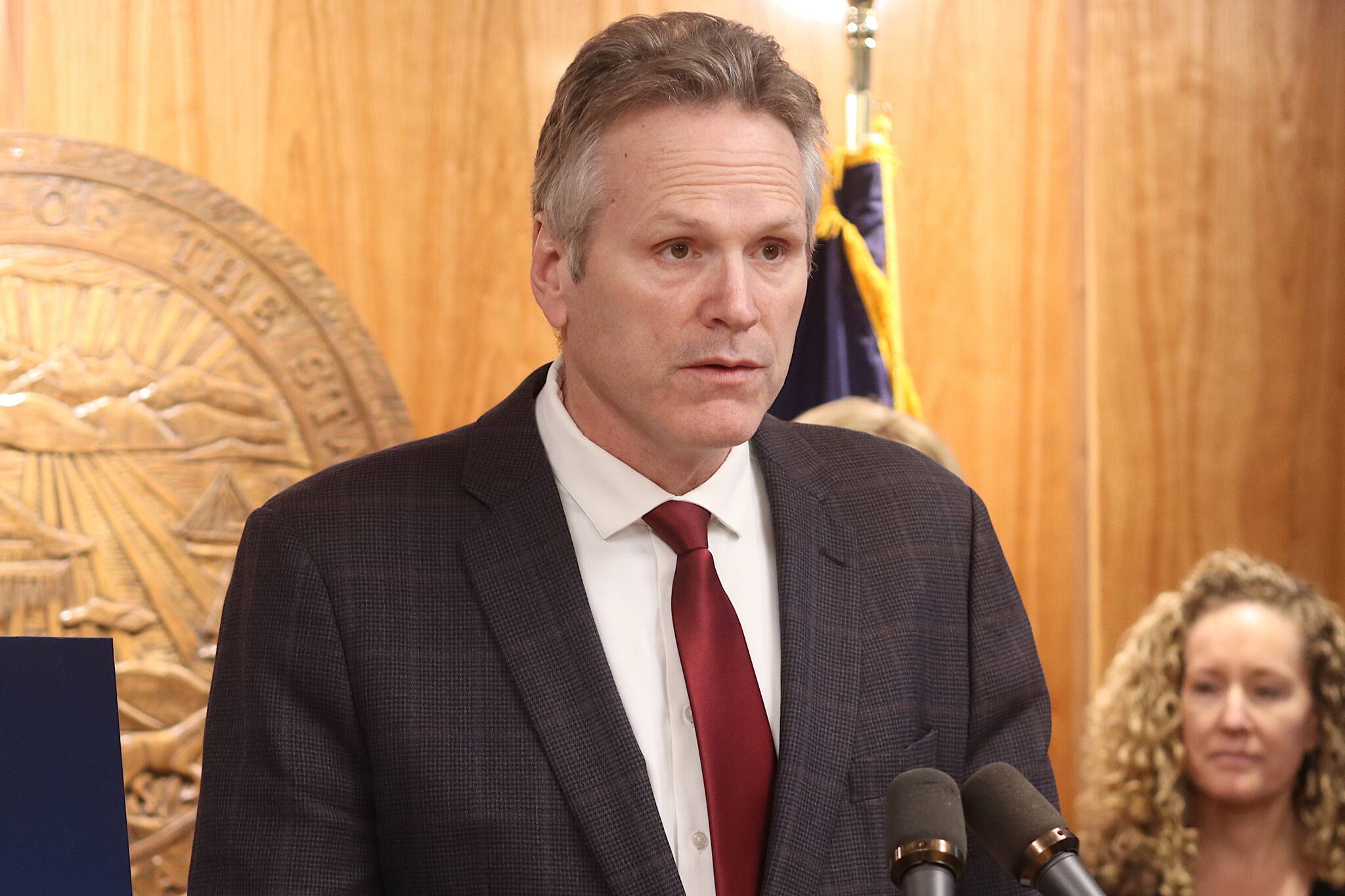
The next steps of Gov. Mike Dunleavy’s plan to stabilize the state’s finances by banking on carbon credits took shape Thursday as he outlined the provisions of bills he plans to introduce for the Alaska State Legislature to consider once the session begins Tuesday.
Dunleavy, who’s expressed skepticism about the scientific consensus on how humans are affecting climate change, is nonetheless proclaiming Alaska’s potential as a global leader in a market that essentially seeks to reap billions of dollars by not logging forests and taking other actions that reduce carbon emissions in the environment.
He also emphasized repeatedly during Thursday’s news conference in Anchorage that seeking such income is not intended to limit logging, mining, oil exploration and other resource activity that have long been foundational economic elements.
“This is not an either/or, this is an add,” he said. “In many respects it will complement those industries.”
Dunleavy’s plan comes as he’s proposing a budget for the coming year that has a deficit of $250 million and a 10-year plan that envisions the state drowning in debts of more than $1 billion a year starting in 2029 without carbon credit income. His long-term solution that projects $900 million a year in carbon income is based on the amount desired rather than hard commitments or evidence, and he has consistently rejected other remedies such as an income tax or reducing Permanent Fund dividends.
“We’re all learning about this,” he said. “It’s an emerging, fast-growing market. We’re just asking Alaskans to do their homework and ask questions and we’re asking legislators to do the same.”
The governor, as he did when first introducing the proposal in December, noted three Alaska Native corporations have earned hundreds of millions of dollars since 2016 by putting tracts of timber holdings into California’s carbon credits markets, which is paying the corporations to keep the lands unharvested for 100 years.
State legislative leaders and members of the local delegation have agreed since the proposal was introduced last month that there are too many questions and uncertainties to immediately bet the state’s financial future on carbon credits. State Sen. Cathy Giessel, an Anchorage Republican who will co-chair the Senate Resources Committee, expressed the same sentiment in an interview Wednesday with the Northern Journal newsletter.
“Are we locking up our land?” she said. “What if there’s a forest fire and those trees are destroyed? Do we have to reimburse the people who gave us the money? I don’t want to be a naysayer right out of the gate, but it sounds like it’s complicated. So, we need more information.”
Dunleavy’s plan relies on two ways of cashing in on carbon.
The first, carbon credits for leaving natural resources such as forests intact so they pull carbon out of the air naturally, would involve much of what the governor described as one-seventh of the world’s timber as well as natural elements such as kelp along Alaska’s vast shorelines.
The second is sequestration and storage where emissions are captured and then injected underground into storage sites, with Dunleavy citing Cook Inlet as a site where up to 50 gigatons of carbon could be stored.
“That’s equal to what Japan produces in carbon for the next 50 years,” he said.
The current market price for carbon credits is about $100 a ton, said Nick Fulford, senior director of energy transition for GaffneyCline, one of three consulting companies supporting Dunleavy’s proposal and a participant in the news conference.
“We’re looking at a market that growing by more than $10 billion per annum over the next decade,” he said. “It’s a very deep and growing market which can be accessed.”
Alaska’s strong tradition of oil and gas development means “in effect you’ve combined perhaps the most important industries in the state” by including carbon credits, Fulford said.
The legislation Dunleavy said will be introduced is largely authorization language and parameters for the state agencies involved. John Crowther, deputy commissioner of the Department of Natural Resources, said during the news conference “we’re not anticipating significant upfront costs as far as capital outlays” to enter carbon markets.
Dunleavy said income from carbon credits could be realized almost immediately.
“I would say what I’m hearing from experts is several months to a year-and-a-half,” he said. “You’re not going to go from zero to millions of acres at that point, but it’ll be ramping up.”
• Contact reporter Mark Sabbatini at mark.sabbatini@juneauempire.com
