
This article has been updated to clarify a time period.
Gov. Mike Dunleavy said with the state’s COVID-19 emergency declaration expired, it’s now time for Alaska to focus on recovery.
For nearly a year, a COVID-19 disaster declaration has been in place, but the Alaska House of Representatives was unable to organize in time for the Legislature to take action to extend the declaration. Dunleavy said he was unwilling to again extend the declaration, so it came to an end Sunday.
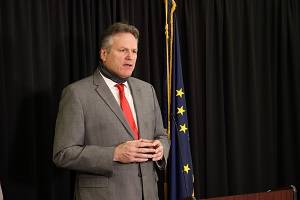
“This sun-setting of the declaration is no cause for alarm,” Dunleavy said in a rare Sunday news conference. “We believe that we have the protocols we need, the tools that we need to move forward. Where we see a hole that we may not have picked up over the last few weeks when we were planning for this inevitability, we will address that hole. If there is an issue that the declaration overlooked, we will address that as soon as possible. This is a new beginning for Alaska. This is a new day for Alaska.”
However, the end of the declaration, which helped the state manage administration of vaccinations and made it eligible for millions of federal dollars, raises questions that are still being worked out.
“We may not have all the answers right now, but we will get them,” Dunleavy said before taking questions from reporters. “This question-and-answer period is going to take at least the next week or two to get everything in place for the rest of the transition moving forward.”
Dunleavy issued a directive to all commissioners and state employees to continue following all policies regarding COVID-19 that were in place under the COVID-19 disaster declaration. He said in the coming weeks, regulations suspended during the pandemic will be reviewed and changes are likely.
“Over the next couple weeks, we’ll be meeting with our departments, we’ll be meeting with those entities, we’ll be clearly articulating to the people of Alaska what still remains in place,” Dunleavy said.
He said the most immediate and public-facing change will be at airports, where COVID-19 testing will no longer be required. However, Dunleavy said testing will be available to those who want to be tested at no cost to the traveler. Additionally, health advisories including recommendations for keeping Alaskans safe, in-state travel, out-of-state travel and critical infrastructure were issued.
In Juneau, city officials have advised travelers not to expect any changes in light of the lapsed declaration.
On Thursday, Feb. 11, City and Borough of Juneau Assembly voted to adopt a local emergency ordinance that mirrored the previous state mandates. Dunleavy said Sunday that the state’s first-class cities have that right, but he heavily encourages them to make data-driven decisions when putting restrictions in place.
Guidelines for travelers arriving in Juneau can be found online at https://juneau.org/covid-19/covid-19-travel.
State health officials, including Department of Health and Social Services Commissioner Adam Crum, Division of Public Health director Heidi Hedberg and Alaska’s chief medical officer Dr. Anne Zink said limiting spread of COVID-19 and ensuring availability of vaccines to Alaskans remain priorities.
Crum said the expired declaration raises questions about the state’s ability to distribute the vaccines, but in the near-term future, the state’s existing plan can continue to work.
“Our ability to get the vaccine from the federal government will not come into question,” Crum said. “We can still receive the vaccine. What we’re trying to work out with Department of Law is our ability to distribute it.”
He said state officials are confident they can continue to distribute vaccines through the month and will work with federal officials to determine what can be done.
Prior to the emergency declaration’s expiration, dozens of individual lawmakers and the state Senate asked Dunleavy to extend the declaration by another 30 days.
Dunleavy said in light of the state’s relatively favorable metrics, distribution of COVID-19 vaccines to about 24% of the state’s population and the Legislature being back in session, he did not feel it was necessary to extend the declaration.
However, he said if the state starts to see numbers go “out of whack,” action will need to be taken.
“We continue to be in this together, but we’re moving in a, I think, positive direction,” Dunleavy said.
• Contact Ben Hohenstatt at (907)308-4895 or bhohenstatt@juneauempire.com. Follow him on Twitter at @BenHohenstatt.
