
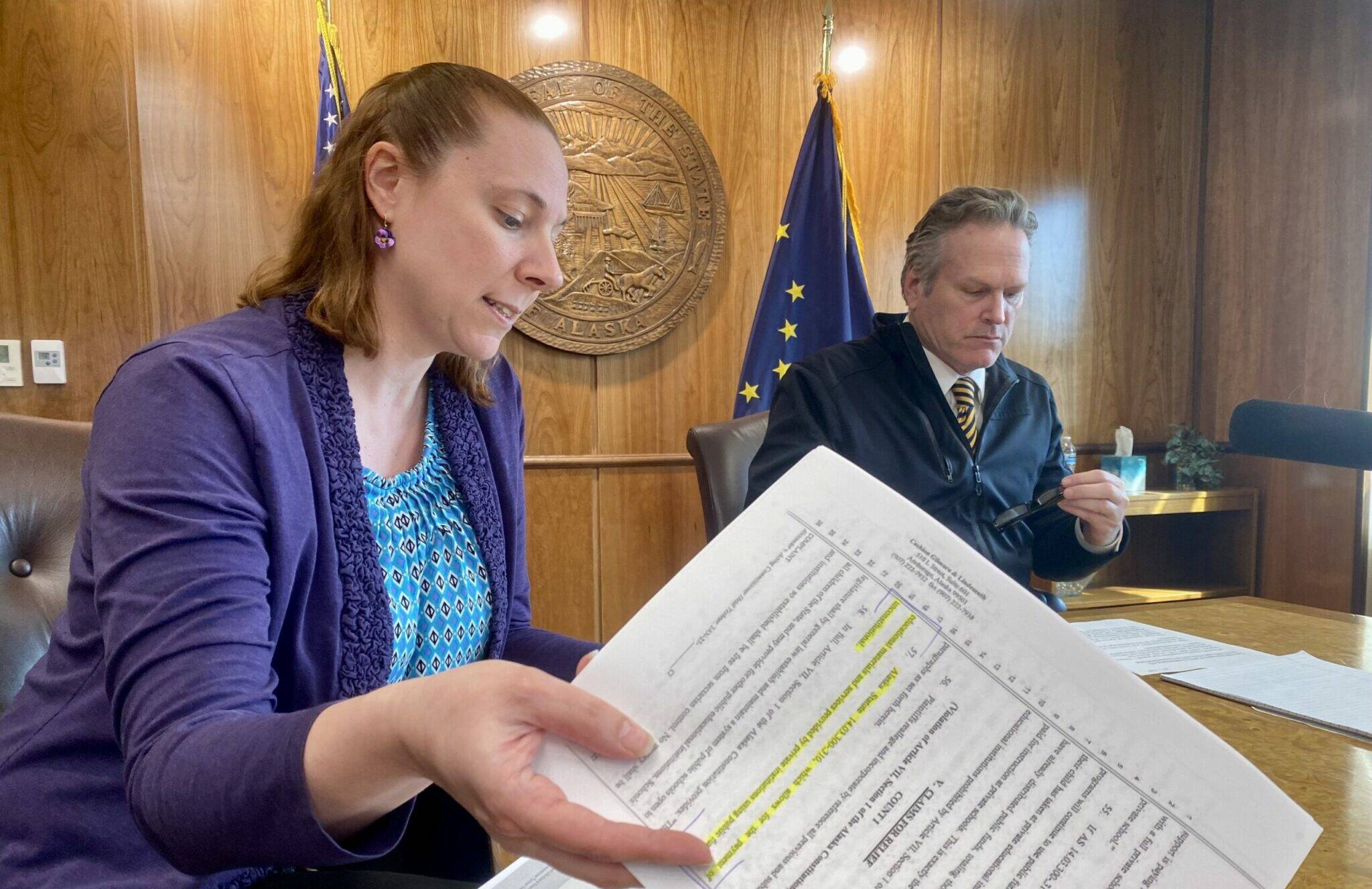
It may take a special session of the Alaska Legislature to clarify what’s available through the state’s correspondence school program. Gov. Mike Dunleavy suggested Wednesday that he would veto any related bills before the state Supreme Court weighs in on the program’s status.
Alaska families who use the correspondence school option have been waiting for state guidance since a judge struck down key components of the program in April. State legislators in both houses have proposed fixes to keep the programs running.
But Dunleavy said those proposals may not be valid once the state’s Supreme Court rules. He said that after the court rules, lawmakers would have to come back together quickly: “Something of this magnitude warrants a special session,” he said.
Anchorage Superior Court Judge Adolf Zeman decided that two sections of state law that allowed public funds, in the form of per student allotments, to be spent at private and religious organizations are unconstitutional.
Dunleavy and Deputy Attorney General Cori Mills interpreted his ruling to mean that all correspondence programs in the state are inoperable. “This is literally a disaster and, potentially, an emergency because of its magnitude,” Dunleavy said.
Lawyers for the Legislature have had a different interpretation. “Because the ruling only struck down student allotments, the correspondence study program continues to exist following the ruling,” wrote legislative counsel Marie Marx in an April memo.
The lawyer who brought the lawsuit that led to the decision, Scott Kendall, concurred: “Homeschooling remains,” Kendall said by phone on Wednesday. “The allotment program — the statute underlying that — has been wiped out.”
Zeman struck down the two provisions of law pertaining to specific features of the correspondence program and did not mention other laws that pertain to district spending.
Mills said that the language in Zeman’s ruling could be interpreted to ban all school spending on items from private organizations; Dunleavy supplied the example of district contracts with private bus companies for student transportation. Mills said their interpretation stems from Zeman’s use of the word “organization” to describe places where unconstitutional spending occurs, rather than “school” or “institution.”
Kendall said the administration’s read of the decision is “absurdly” overbroad. “What they say is, this is so broad that a school district can’t buy a mop,” he said.
He pointed out that when the judge struck down specific pieces of statute, he invited lawmakers to fix them.
“If the legislature believes these expenditures are necessary — then it is up to them to craft constitutional language to serve that purpose — that is not this Court’s role,” Zeman’s ruling said.
With only two weeks left in the legislative session, both the House and Senate have attempted to answer the ruling’s call and introduced bills aimed at providing certainty to correspondence school families through their respective education committees. Both bills are intended to allow correspondence programs to continue operating constitutionally and are scheduled for committee hearings this week.
House Bill 400 would direct the governor’s appointees on the state Board of Education and Early Development to develop new regulations that adhere to the state constitution. Committee co-chair Rep. Justin Ruffridge, R-Soldotna, said the language is such that the law would be relevant even if another proposal, to pass a constitutional amendment, were approved.
Senate Bill 266 would strike the language Zeman found to be unconstitutional and add restrictions on how families spend and report state education dollars. It would also require students to take statewide assessments.
Education committee Chair Sen. Löki Tobin, D-Anchorage, said the Senate majority would continue to pursue legislative solutions and has communicated that to the governor.
“President Stevens and I shared our emphatic belief that we need to act so we can ensure stability and predictability and certainty for our correspondence programs,” she said.
Both sides of the correspondence school court case asked the court to delay its ruling through a mechanism called a stay. Attorneys for the state requested the court stay its ruling until after a higher court hears its forthcoming appeal. Plaintiffs have asked that the court limit any stay to two months, and to allow rules that are more narrow than the provisions Zeman struck down to govern correspondence programs next school year. The judge is expected to decide as soon as this week.
Alaska Beacon reporter James Brooks contributed reporting to this article.
