
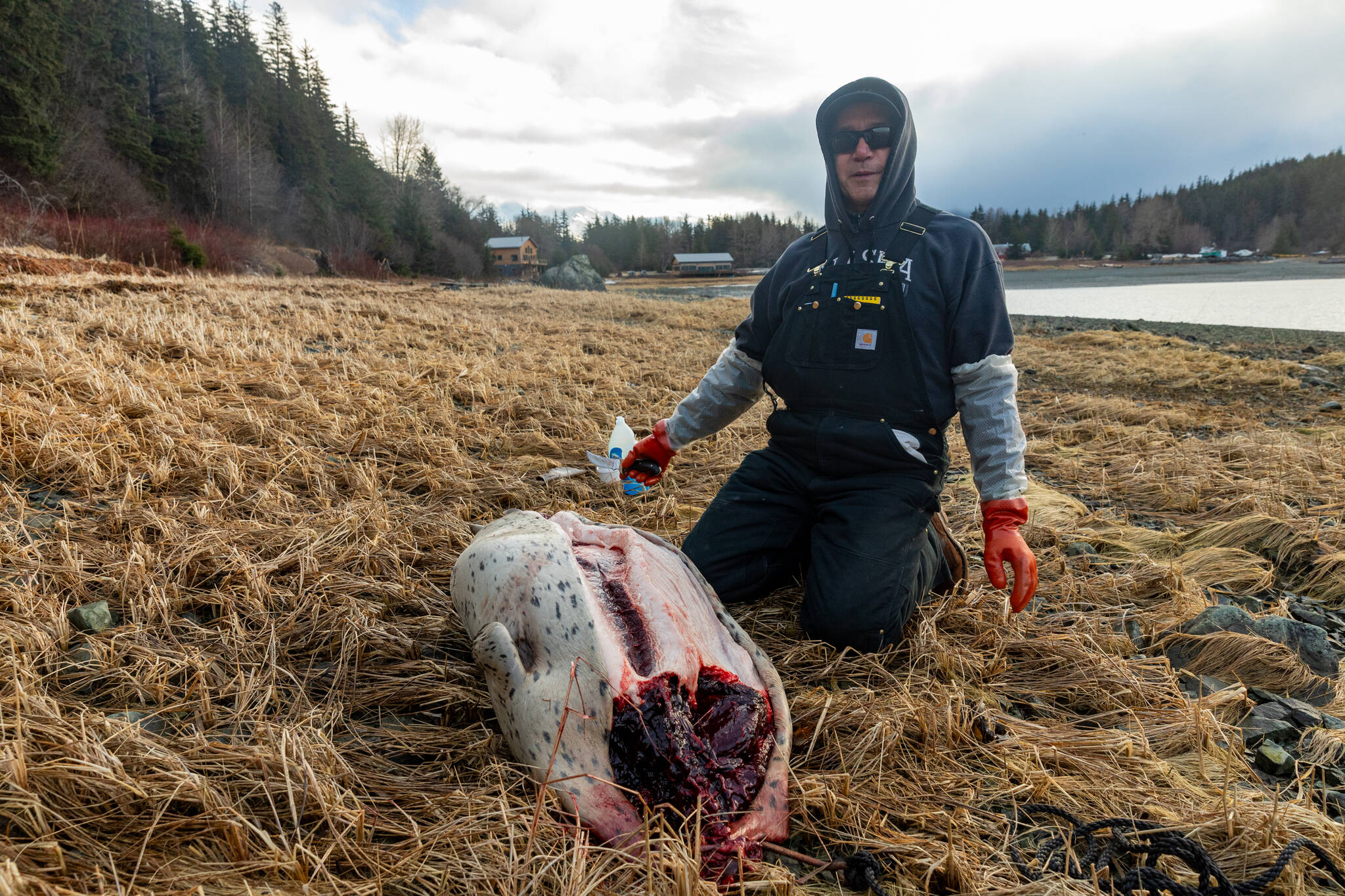
On a windswept beach near Haines, Tim Ackerman walks down a hill with a pair of gloves, a knife, and a bottle of Dawn dish soap to kneel beside the carcass of a harbor seal. The flesh of its head is conspicuously absent, though the bones are still visible.
It’s one of a handful that have washed ashore in Haines since late November, with at least three recovered at Letnikof Cove. This fall, the National Oceanic and Atmospheric Administration’s regional stranding coordinator said they’ve not figured out what’s killing the seals – or getting to them after they’ve died – but it’s not an uncommon scene for Ackerman, a Lingít hunter and maritime expert who has spent decades watching the drama of Alaska’s marine life unfold.
Today, he’s iterating through theories about what could have killed this particular seal and in particular, he’s thinking about orcas.
“This particular group, I call them the meat eaters,” Ackerman explains, gesturing to the decapitated seal. “They’ll come in and just eat the head only, or just the tongue. Killer whales prefer the tongue.”
Ackerman divides local killer whale pods into two distinct groups: the ones he calls “meat eaters” and those that hunt primarily for salmon. Transient killer whales, also known as Bigg’s killer whales, are known to roam in small groups and hunt marine mammals, while resident killer whales prey on salmon and other fish.
Ackerman remembers finding evidence of the Biggs’ visit years ago.
“I found, like a seven-foot shark on an island on the west side,” Ackerman said. “Just the front pectoral fin was bit off. They were on that side when the seal washed up on the beach, decapitated too, at the same time. Then, we watched them on the other side chasing a porpoise, and the porpoise was just swimming for all it could, it would come up take a breath, dive back down and go 100 yards and the killer whales weren’t moving fast, they just .. made it all tired and then it expired, then they ate it.”
Ackerman’s stories, backed by years of firsthand experience, reveal a world where killer whales, seals, sharks, and hunters are locked in a perpetual struggle for survival. In the case of this particular seal, Ackerman thinks something else is responsible for its death.
“There’s a bullet hole,” he said, pointing at the skull. “It looks like someone shot it.”
Marine mammal hunters
The Marine Mammal Protection Act allows Alaska Native people, like Ackerman, to hunt species like harbor seals, sea otters, certain kinds of whales for subsistence food and for crafting.
Ackerman said there’s only a handful of marine mammal hunters in the area, and speculates that this seal might have been killed by one who used to live here but is just coming in for a visit.
“The seal that was on the beach downtown, that was from him,” Ackerman said but he demurred when asked to identify the hunter.
But, he said the best time to hunt seals depends on what the seals are eating.
“You hunt them when they’re eating hooligan. You hunt them when they’re eating salmon,” he said. “They’re consuming the same thing we do, so you could imagine the taste difference. In our world it’s called the opportunistic moment.”
Ackerman, who was down on the shore in mid-January, said he had been going out for a few days looking for seals but the weather had not been cooperative.
“I work it with the tides,” he said. “I try to shoot them on the incoming tide. They drift up with the tide.”
It’s not uncommon for seals to sink when they’ve been shot during a hunt, he said.
“So my shot will be right here in the eye. It comes out the back of its skull and it blows air down the throat,” he said. “The other thing is, right before they dive, they’ll come up and you’ll see them tilt their head back. They’re inhaling.”
Too high of a shot, or a mis-timed one and the seal can sink because there’s no air in its lungs.
Ackerman, who said he has been hunting his whole life but more heavily on marine mammals in the last 10 years, said he generally starts hunting in October. But that presents its own set of problems.
“If I don’t process it on the beach, then I’m at my house skinning the seal out and it’s late in the evening and it’s dark and the bears are everywhere,” he said.
What’s left behind
Michelle Dutro, who helps monitor the marine mammal stranding hotline for NOAA, said in late January that her office had confirmed four dead stranded seals in the Haines area over a period of just under two weeks. Though they were in varying states of decay, each had that similar degloved look on the head but skin further down on the body, which she said is “interesting.”
State park ranger Jacques Turcotte found two at Letnikof Cove on the same day, including the one Ackerman was processing. Turcotte took samples from the seals which Dutro said will eventually make their way to the Southwest Fisheries Science Center, which is headquartered in La Jolla, California for testing.
Sometimes when Ackerman harvests a seal, he’ll wash it, skin it, quarter it, box it and ship it to the Alaska Native Tribal Health Consortium in Anchorage so that people who are convalescing can eat subsistence foods while away from home.
“I call it rip, strip and ship,” he said, laughing. “We’ve sent quite a few up there already.”
The meat is no longer edible once an animal has washed ashore, but Ackerman said he still gets calls from NOAA or the state troopers who sometimes ask him to take samples and get measurements while he’s processing the animal for its hide.
He keeps track of where the seals are, their overall condition and if he notices anything weird while he’s processing it.
“Just make sure there’s no abnormal growths on the liver and stuff,” he said.
In the case of this seal, he just plans to get the hide off – keeping whatever the local crafters tell him they want. And, he’ll check the stomach to find out what it’s eating, like hooligan or salmon.
He slides his knife methodically, separating the pelt from the seal. Ackerman said it takes him about an hour to process a seal when he doesn’t have a chatty reporter in his ear. He paused to pull a measuring tape out once he had uncovered the fat layer covering its stomach. It’s still pink, and almost three inches thick.
“So what this tells me is, this is an environmental thing, and they’re nice and fat and getting a lot to eat. There’s a lot of biomass out there for them to eat, yeah?” he said.
• This article was originally published by the Chilkat Valley News.
