
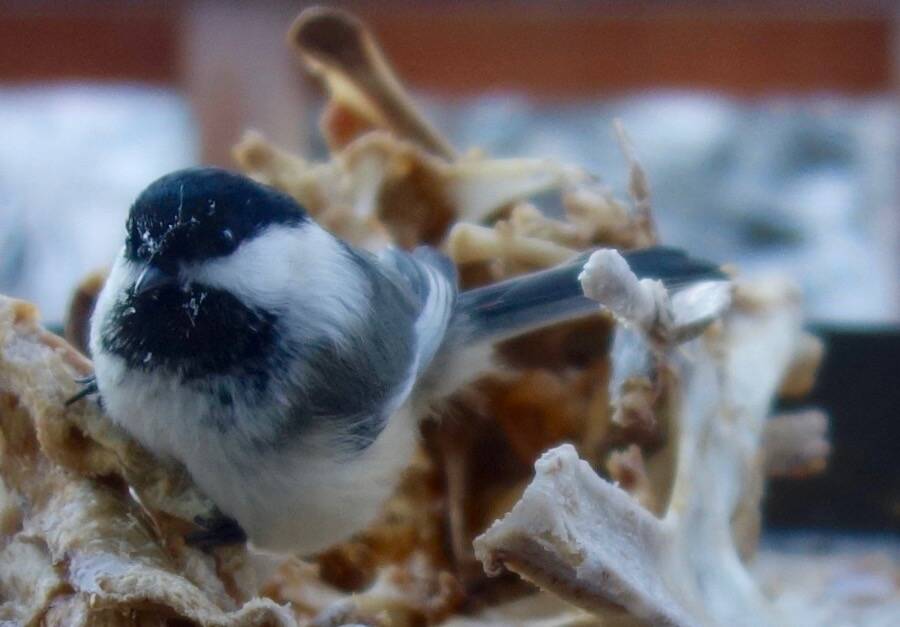
During the darkest days of Alaska’s winter, black-capped chickadees stuff themselves with enough seeds and frozen insects to survive 18-hour nights.
Where chickadees spent those long nights was a mystery until a University of Alaska Fairbanks biologist tracked them.
Susan Sharbaugh spent many winter nights trying to find out how a creature as light as a handful of paperclips endures nights of 40 below. Sharbaugh, now living in Arizona, worked for many years as a biologist in Alaska. She is a fan of the black-capped chickadee, one of the most unlikely residents of the north because of the difficulty of keeping a tiny body warm in a cold place.
In her studies on the northern chickadee, Sharbaugh found that black-capped chickadees gain an additional10 percent of their body weight each day by stuffing themselves; the birds then use that fat to shiver all night, which keeps them warm.
The human equivalent would be a 165-pound man who spent a frigid night outside and emerged 15 pounds lighter by morning.
Sharbaugh wondered where black-capped chickadees performed their amazing acts of nighttime survival until engineers in the 1990s developed a radio transmitter tiny enough to ride on a chickadee’s back.
Weighing .5 grams, the radio transmitter was about the size of an M&M, with a whip antenna about five inches long.
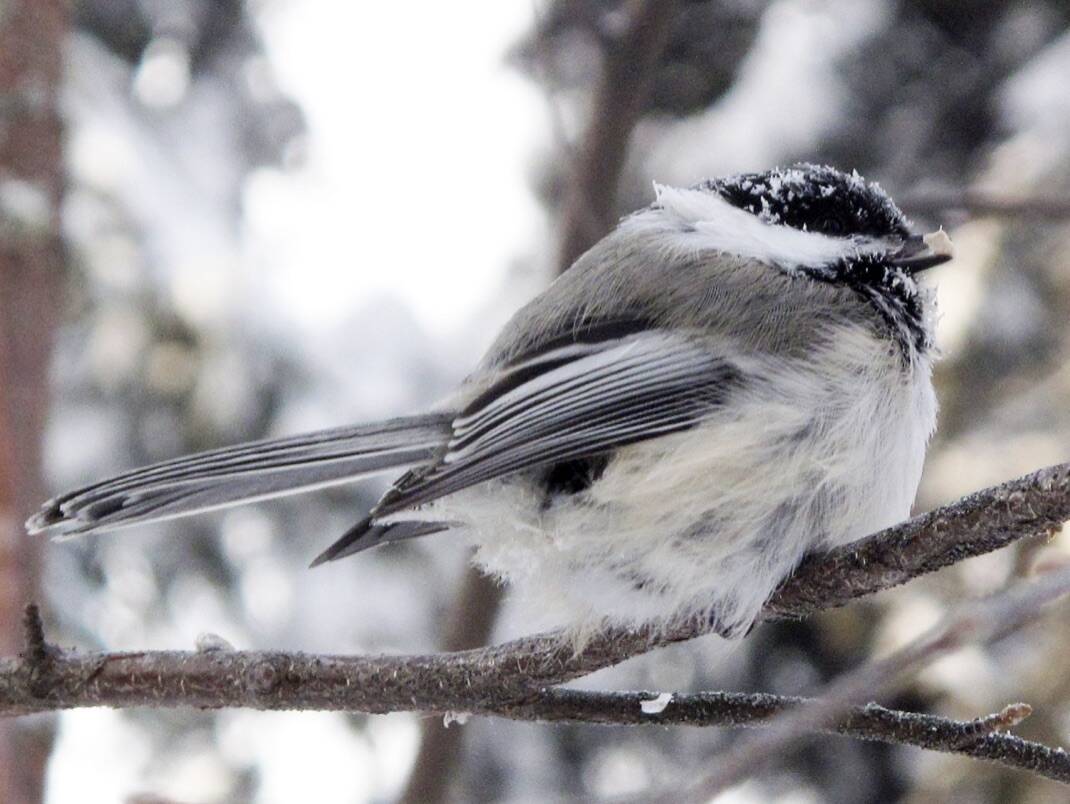
A black-capped chickadee holds a sunflower seed in its beak at minus 40. (Courtesy Photo / Ned Rozell)
Sharbaugh attached the transmitter to captured chickadees with two elastic loops that fit over a bird’s legs like a climbing harness.
“They ride really nicely,” Sharbaugh said. “You can’t even tell the transmitter’s there.”
After she first attached the device to a chickadee near the cross-country ski hut at the UAF campus in November 2000, Sharbaugh watched it disappear into the woods. Then she waited for darkness. She hoped the evening would provide an answer to a question she had pondered for years: Where do northern chickadees spend the night?
People had told her about chickadees flying under the eaves of their homes at dusk, and Sharbaugh had seen chickadees with bent tails at her feeder in the morning; this suggested they crammed their tiny bodies somewhere to escape the deep cold of the night.
When darkness fell on the night she attached the first transmitter, she ventured into the woods with former UAF biologist Tom Hahn. They carried a receiver in an insulated bag, and an antenna that resembled a green ping-pong paddle.
Sharbaugh and Hahn followed the beeping signal to a birch tree with a broken top. They returned at twilight the next afternoon to see the chickadee diving into hole on the tree bark the size of a quarter.
They had found a roost, a place where the chickadee wedged itself, puffed its feathers, turned its internal thermostat down 15 degrees Fahrenheit, and burned fat all night.
Sharbaugh said chickadees would not survive without finding such a sanctuary.
“Finding a roost is just as critical, if not more critical, than finding food,” she said. “You have to find a good, insulated place to spend the night when you’re that small.”
After she and Hahn found the first roost, they found the roosts of several other black-capped chickadees. Using diced peanuts as a lure, Sharbaugh recaptured the birds and removed their transmitters.
All the roosts Sharbaugh found were in birch trees; she never saw more than one chickadee enter a roost.
Other birds, such as bluebirds, survive the cold by huddling together, but that appears not to be the case for black-capped chickadees in the north. Roosting alone seems to fit their character, Sharbaugh said.
“They’re fairly aggressive towards each other,” she said. “It would be difficult for them to share a space.”
If chickadees around Fairbanks endure long winter nights in birch trees, the nighttime haunts of their relatives farther north — the Siberian willow tit of Russia’s Arctic and the gray-headed chickadee of Alaska’s Brooks Range —remain a mystery. Those tiny birds live in areas without large trees, and might roost in snow, Sharbaugh said.
• Since the late 1970s, the University of Alaska Fairbanks’ Geophysical Institute has provided this column free in cooperation with the UAF research community. Ned Rozell ned.rozell@alaska.edu is a science writer for the Geophysical Institute. A version of this story ran in 2003.
