
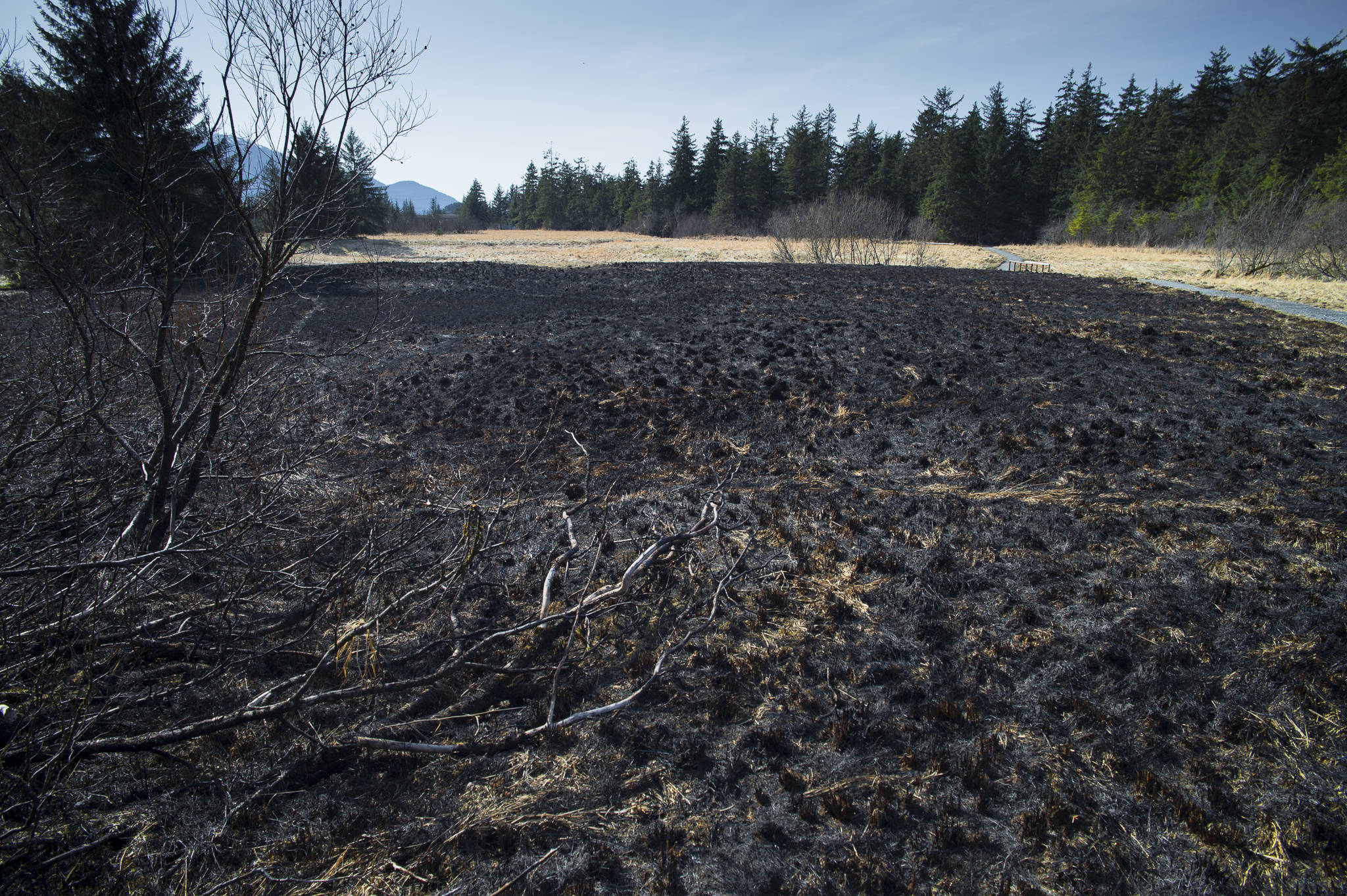
A 400-foot by 400-foot area of burned grass area next to the Davis Meadows Trail in Switzer Creek on Tuesday, April 2, 2019. The fire was reported on Sunday, March 31, and put out by Capitol City Fire/Rescue. (Michael Penn | Juneau Empire)

A 400-foot by 400-foot area of burned grass area next to the Davis Meadows Trail in Switzer Creek on Tuesday, April 2, 2019. The fire was reported on Sunday, March 31, and put out by Capitol City Fire/Rescue. (Michael Penn | Juneau Empire)

‘Eyebrow’-raising weather set records this summer

Hot and dry Alaska.

Burn bans and seemingly endless dry weather — the average temperature between June and September this summer were the highest on record in Juneau.

The season was hotter and drier than normal for much of the panhandle, from Yakutat, which recorded its warmest June and July ever, to Juneau and Sitka, each of which recorded their second warmest July on record. Starting in June and ending in August, the average air temperature at the Juneau International Airport was 56.9 degrees, the warmest on record.

“From just a public perspective, it was a beautiful summer,” National Weather Service meteorologist Rick Fritsch said. “It was reasonable warm, it was very dry. We had a record number of days where we got above 70 Fahrenheit which for this part of Alaska is a pretty big deal. The overarching message there is significantly drier than normal and that raised a lot of eyebrows.”

The number of 70-degree days in Juneau totaled 47, exceeding the previous record by five days. Fritsch said the normal count for 70-degree days is between 15 and 20.

The ongoing drought in the southern panhandle has been extreme — the two-year precipitation deficit is over 4 feet. Yakutat, the small coastal town of approximately 650 people, hasn’t received normal amounts of rain in over 10 years, according to Fritsch.

“The difference between Yakutat and the southern panhandle is that the societal impacts for the small town of Yakutat are not that great,” Fritsch said.

Yakutat’s Jack Endicott, owner of Icy Waves Surf Shop and former employee of the National Weather Service, expressed his ambivalence about the hotter, drier weather. On one hand, there was more business for his shop, but on the other hand, there was a general anxiety about the dry conditions.

“It was a boon for a surf shop because we had such nice, dry, beautiful weather that our business really increased because it was sunny everyday,” said Endicott, who served 30 years in the NWS.

But the Yakutat businessman said he was alarmed at the low levels of Situk River, a major salmon stream that also boasts the largest wild steelhead run in the state. The river was so low that some pink salmon didn’t reach their normal spawning grounds, Endicott said.

“Normally the rivers are wide and there’s plenty of area for everybody to spawn but this year, they were all jammed into one (spot),” he said. “It’s going to be really interesting to see how it all turns out.”

The capital city was warmest in July, when the average temperature rose to 61 degrees and 14 days were 70 degrees or higher. With just over 2 inches of rain, it was the second driest July on record, according to NWS records which date back to the 1930s. As a result of the dry conditions, the weather service issued a fire weather watch July 4-5 and several communities set up burn bans as scores of wildfires burned around the state.


• Contact sports reporter Nolin Ainsworth at 523-2272 or nainsworth@juneauempire.com.


More in News

The northern lights are seen from the North Douglas launch ramp late Monday, Jan. 19. A magnetic storm caused unusually bright northern lights Monday evening and into Tuesday morning. (Chloe Anderson/Juneau Empire)
Rare geomagnetic storm causes powerful aurora display in Juneau

The northern lights were on full display Monday evening.

teaser
Juneau activists ask Murkowski to take action against ICE

A small group of protesters attended a rally and discussion on Wednesday.

Herbert River and Herbert Glacier are pictured on Nov. 16, 2025. (Mari Kanagy / Juneau Empire)
Forest Service drops Herbert Glacier cabin plans, proposes trail reroute and scenic overlook instead

The Tongass National Forest has proposed shelving long-discussed plans to build a… Continue reading

A tsunami is not expected after a 4.4-magnitude earthquake northwest of Anchorage Wednesday, Feb. 4, 2026. (U.S. Geological Survey)
No tsunami expected after 4.4-magnitude earthquake in Alaska

U.S. Geological Survey says 179 people reported feeling the earthquake.

ORCA Adaptive Snowsports Program staff member Izzy Barnwell shows a man how to use the bi-ski. (SAIL courtesy photo)
Adaptive snow sports demo slides to Eaglecrest

Southeast Alaska Independent Living will be hosting Learn to Adapt Day on Feb. 21.

Cars drive aboard the Alaska Marine Highway System ferry Hubbard on June 25, 2023, in Haines. (Photo by James Brooks)
Alaska’s ferry system could run out of funding this summer due to ‘federal chaos problem’

A shift in state funding could help, but a big gap likely remains unless a key federal grant is issued.

Photo by James Brooks/Alaska Beacon
U.S. Sen. Dan Sullivan stands with acting Coast Guard Commandant Adm. Kevin Lunday during the after the commissioning ceremony for the Coast Guard icebreaker Storis on Sunday, Aug. 10, 2025, in Juneau, Alaska.
Coast Guard’s new Juneau base may not be complete until 2029, commandant says

Top Coast Guard officer says he is considering whether to base four new icebreakers in Alaska.

Students from the Tlingit Culture Language and Literacy program at Harborview Elementary School dance in front of elders during a program meeting in 2023. (Clarise Larson / Juneau Empire file photo)
Sealaska adds more free Tlingit language courses

The new course is one of many Tlingit language courses offered for free throughout the community.

teaser
New Juneau exhibition explores art as a function of cultural continuity

“Gestures of Our Rebel Bodies” will remain on display at Aan Hít through May.

Most Read