
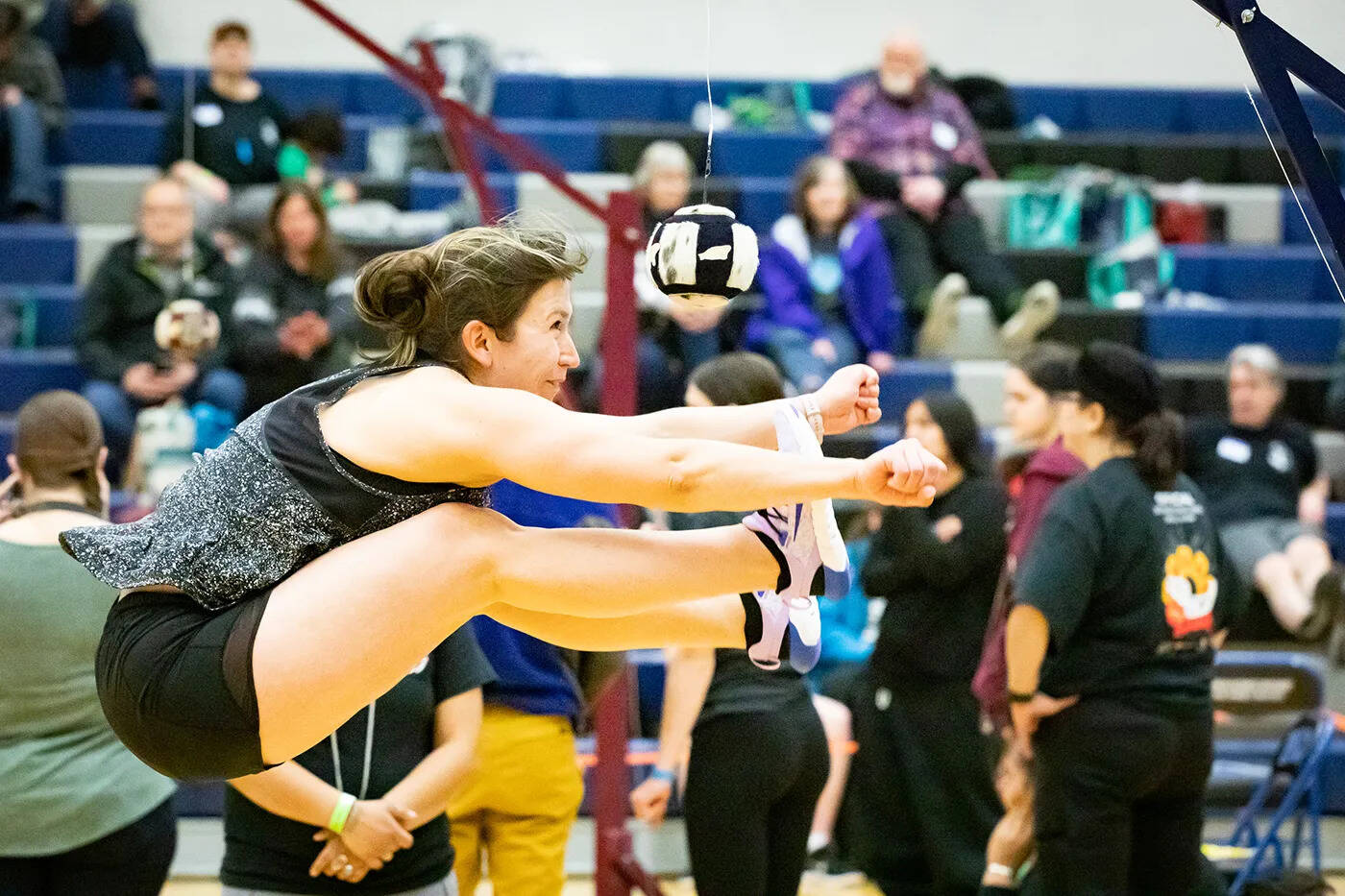
This article has been updated to correct a photo caption.
The eighth annual Traditional Games will be held this April at Juneau-Douglas High School: Yadaa.at Kalé, bringing teams from Alaska, Canada and the Lower 48 to Juneau.
Sealaska Heritage Institute hosts the event in partnership with the Central Council of the Tlingit and Haida Indian Tribes of Alaska, the Juneau School District and Zach Gordon Youth Services. Before that, the University of Alaska Southeast club Wooch.Een held the games on campus for college students and community members. They continue to take part in the event.
“The first year that we hosted this event, it was to bring back the Native Youth Olympics here in Juneau at the high school level and bring a team to state in Anchorage,” Juneau coach Kyle Kaayák’w Worl said. “And typically, you need to have a regional event or a qualifier before state to determine the team and who goes. So the original intent was to have a qualifier to go to state. And it’s expanded ever since.”
Worl said event coordinators have pushed to make the Traditional Games, also known as the Native Youth Olympics, a regionwide event for Southeast Alaska. New Southeast teams this year include Wrangell and Angoon.
“My goal is to eventually get a team from every single Southeast community represented at the Traditional Games,” he said. “We’ve had a team from the majority of Southeast communities, but not every team comes every single year.”
He said he’d like to see teams from small communities like Gustavus, Pelican and Tenakee Springs join in the future.
In recent years the event has expanded to include statewide and international teams. This year more than 270 middle school, high school, college and adult athletes from more than 20 communities will compete in 12 events, including teams from Canada, Colorado, Kansas, New Hampshire, New Mexico and Washington.
“I don’t think any other competition has a division that recruits college teams in the same way that we do, but we want to make sure that our youth, our younger youth that are still in high school, middle school, can see that they can pursue their sport in higher education,” Worl said. “So we really believe in supporting these college teams to attend and participate.”
The Traditional Games have an award system, providing colleges with training, equipment and travel scholarships.
“The students come together and train, and build up their own student club or team,” he said. “It’s something that we also did with UAF, UAA and UAS that has led to them continuing the program, even after our initial first year of helping sponsor them and providing these supports.”
Worl said he hopes the colleges from the Lower 48 will continue the program even after returning home.
“We already know some of our high schoolers plan to go to some of those colleges, and they know they already have a community there waiting for them, so that’s amazing,” he said.
The Traditional Games, which were played across the Arctic, were based on the ancient hunting and survival skills of the Iñupiaq people. Different interpretations of the games exist depending on which part of the Arctic, because the Iñupiaq culture spreads across Russia, Alaska, Canada and Greenland. Worl described just a couple of the different traditional sports.
“A lot of games incorporate important skills, and you have games like the scissor broad jump, which is based on ice hopping,” he said. “Ice hopping can sometimes be a life and death situation if you’re falling into the Arctic Ocean. We have the seal hop, which is based on mimicking the motion of hopping like a seal. And it’s actually based on a hunting technique that hunters used to sneak up to the seal, because simply walking up to the seal, they’re going to recognize a human pretty quickly on two legs. They would get down low, hop like the seal, and have their harpoon on their back.”
Worl said being in throwing range was necessary to strike a seal, requiring hunters to be close. Now the game is played in a physical endurance competition.
But the competition is different from most other sports. Athletes cheer each other on even while competing against one another in the same events, and coaches give helpful tips and guidance to athletes from opposing teams.
“It’s about personal records, self-improvement and community,” Worl said. “We’re all one community in NYO. It doesn’t matter what team you’re on, you can cheer each other on, support each other, give each other advice, even if that piece of advice allows your fellow athlete to excel beyond you. That’s not something you’re going to see in a lot of other sports, but it’s OK in our games, because we realize we’re all one community. We need to all support each other and lift each other up.”
Worl works with the Tlingit and Haida Youth Wellness Program. He said the Traditional Games are a healthy sport based on Indigenous values of coming together and supporting each other as a community. Although the games are from the Inuit culture, Tlingit youth resonate with them, and participating in NYO has encouraged athletes to learn the Tlingit language. Cheers in Tlingit, Haida and Tsimshian are available on the Traditional Games website.
“We’re also hunters here in Southeast Alaska and we hold very similar cultural values to these games,” he said. “These are areas where we celebrate culture. Everyone wants to be able to share who they are.”
Cheering on every team results in uncommon camaraderie and respect among athletes, who find a new network of supporters and friends through the games.
“Tlingit & Haida is proud to support the annual Traditional Games in Juneau, Alaska each spring,” Tlingit and Haida President Richard Chalyee Éesh Peterson said in a prepared statement. “This event features 12 different games that test strength, agility, balance, endurance and focus — skills rooted in the hunting and survival traditions of Indigenous peoples of Alaska and the North for hundreds of years.”
The games continue to grow in representation this spring and athletes can play with any level of experience.
“They were important to survival long ago and I think they’re important to our people today as a healthy way of living, and a healthy way of carrying on our culture and sharing our culture with everybody, because these games have now spread far beyond the Arctic and as far south as the Institute of American Indian Arts in Santa Fe and the East Coast in Dartmouth,” Worl said.
The event is free to attend at Juneau-Douglas High School: Yadaa.at Kalé. The first events will take place on Friday starting at 5:30 p.m. and ending at 8:45 p.m.
The traditional games will be held on Saturday and Sunday from 9 a.m. to 6:30 p.m. Middle school and high school events begin at 9 a.m. Saturday, with the official opening ceremony at 12:30 p.m. An awards and closing ceremony will be held Sunday at 5:30 p.m. Worl said there are 70 volunteers helping with the Traditional Games.
The games will be livestreamed from noon to 6 p.m. Saturday and Sunday on SHI’s YouTube channel, which will be accessible through the Traditional Games website. An online schedule is also available.
SHI President Rosita Ḵaaháni Worl said the games provide a platform for Native athletes to discuss common experiences, while non-Native athletes learn about Alaska Native cultures.
“The Native Youth Olympics and Traditional Games play a significant role in influencing young people, encouraging them to improve academic performance, strengthen their health and wellbeing, and embrace tribal values such as leadership and respect, which are key elements in building strong communities and shaping tomorrow’s leaders,” she wrote in a prepared statement.
• Contact Jasz Garrett at jasz.garrett@juneauempire.com or (907) 723-9356.
