
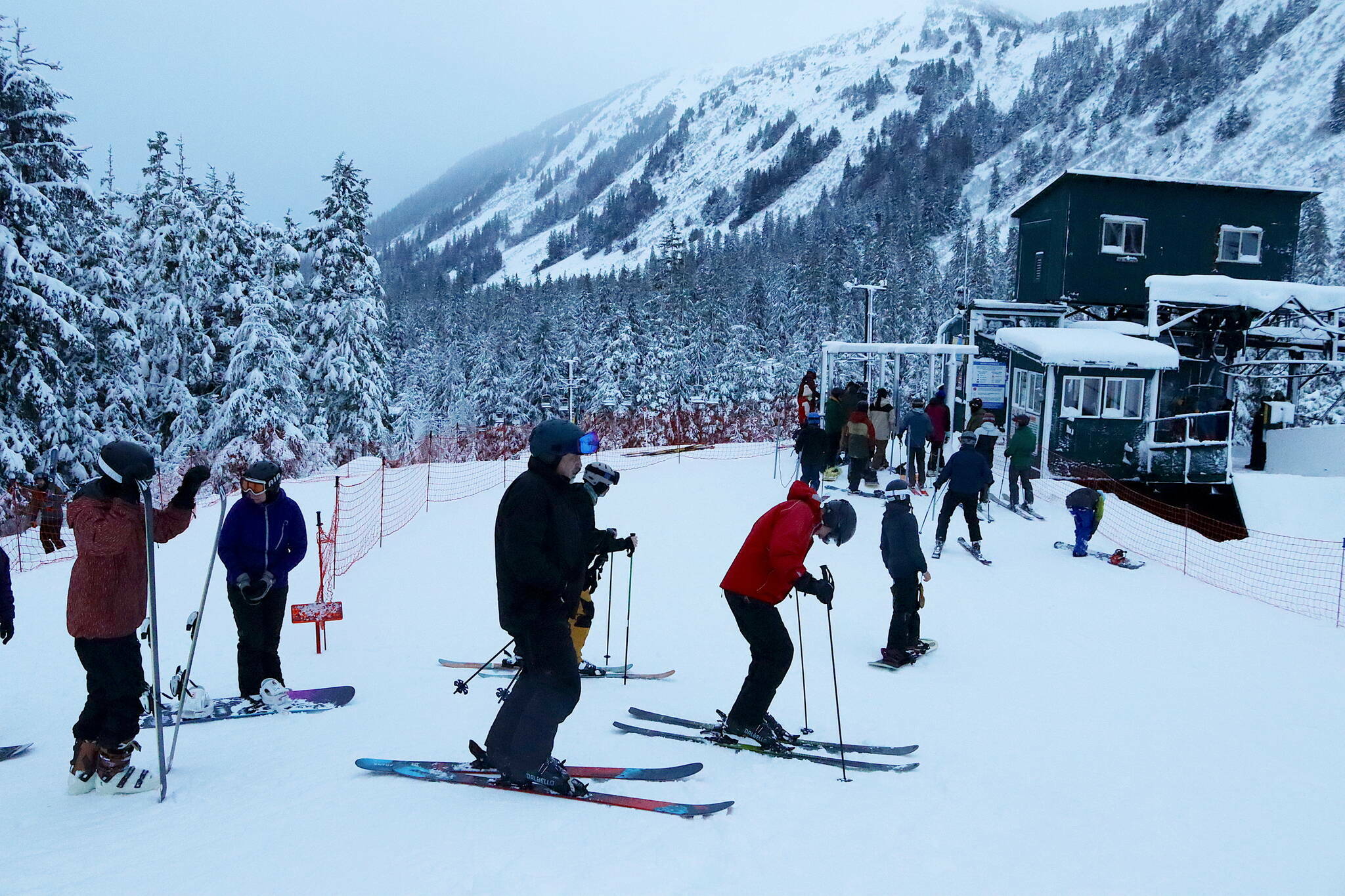
Eaglecrest Ski Area has poorly maintained facilities operated by an underpaid staff who are managed by mostly new leadership under the direction of board members lacking industry knowledge, according to an assessment by a former general manager of the resort hired as a consultant earlier this year.
That bleak assessment is the first draft of a presentation intended for Juneau Assembly members next month as part of Eaglecrest leaders’ efforts to develop a future business plan in anticipation of a major transition at the city-owned resort during the next few years. Primarily that involves a switch to year-round operations with the installation of a gondola some officials hope will “save” Eaglecrest through lucrative summer activity that will more than offset potential ongoing winter losses.
[See also: Eaglecrest Ski Area’s dilemma: Aging equipment needing repair while planning an ambitious new future]
A summary of the report was presented to Eaglecrest’s board of directors on Thursday night by Kirk Duncan, the resort’s general manager for seven years beginning in 2004, who was brought in this summer to offer his expertise after former General Manager Dave Scanlan was forced out by the board in June.
Some board members and other participants at the meeting called the summary troubling in its tone. Duncan said the board will get to weigh in on the full report before he presents it to the Assembly.
”You don’t need to agree with it, but you need to at least say, ‘Yeah, I’ve seen it,’” he said.
Eaglecrest is scheduled to begin its season Saturday with the opening of the Porcupine lift that services the beginner hill at the base of the resort, with an opening date for the rest of the mountain uncertain due to rainy weather forecast to last at least into next week. Once the full mountain does open only one of two chairlifts to the top will be operating, since the Black Bear lift has been closed for the season due to mechanical problems.
Board members and administrative leaders have acknowledged the Black Bear lift is just one of many installations on the mountain needing maintenance and/or repairs. Duncan’s summary notes the problem involves staffing as well as financial shortfalls.
“Eaglecrest has not maintained its lifts to industry standards (which are somewhat subjective) and at present does not have adequately trained lift mechanics,” he wrote. “While the new management intends to develop necessary training programs, until such time that staff is fully trained, additional funds over current levels will likely be required for contracted services. Insufficient maintenance and lack of ongoing training over the past several years have resulted in the Black Bear chair not operating this winter and added to the cost of maintenance on the other chairlifts in the years to come.”
Other current issues Duncan highlights in his draft summary include:
• “Eaglecrest has not kept up with paying competitive wages to its employees and lacks a coherent pricing structure. Eaglecrest, in anticipation of the gondola operation has increased year-round staffing, which needs to be reexamined as the gondola is not coming online until July of 2027 at the earliest.” Furthermore, the resort has “many unfunded positions within the current budget.”
• “Many of the issues facing the ski area can be traced back to the Eaglecrest Board of Directors. While board members are very dedicated to the ski area and its success, they lack the industry knowledge needed to provide supervisory overview of the area. As a city department, some of the past and current issues at the ski area would not have been allowed to grow to the point that the board had to take drastic action. Whether Eaglecrest remains as an empowered board or a city department with an advisory board (ala the Parks and Recreation Advisory Committee) will be a much needed conversation within the community.”
• “Three of the five senior management positions are held by newly hired individuals who are qualified to do the job but face steep learning curves. Eaglecrest is a complicated ski area compared to many areas in that it has extensive avalanche mitigation which increases costs. In addition, its relatively low elevation and maritime climate make a consistent opening date and operations a challenge.”
Looking ahead, Duncan’s summary asserts there are concerns during the next year or two about funding maintenance and/or employee raises if the board wants those. Assembly members have stated city funds will be scarce due to a need to pay for other priorities including flood protection after hundreds of Mendenhall Valley homes have suffered such damage the past two years.
Eaglecrest may need an extra $1 million during the current fiscal year (FY25, which ends next June 30) to cover maintenance and staffing costs not already budgeted, according to Duncan.
“In FY 2026, if the decision is made to increase Eaglecrest salaries/wages to a competitive level, the increased costs will range between $600,000 and $800,000,” he added. Lift maintenance and related personnel costs could add another $1.5 million to the budget.
“There may be some limited opportunity to offset increase costs with increased user fees, though development of a rationalized pricing model and strategy would first be required,” Duncan wrote.
Looking longer-term, a key issue for people hoping the gondola will be Eaglecrest’s financial savior is “due diligence has never been done for the gondola” for crucial factors such as the likely number of riders and how much people will be willing to pay, according to the summary.
However, the board has adopted some target numbers and if those pan out Eaglecrest’s future could indeed be as lucrative as hoped, Duncan stated.
“In FY 2028, if the gondola realizes its projected ridership and revenue targets (40,000 riders with revenue of $85 per rider as specified by the Eaglecrest Board) and expected expenses are correct, the summer operation would have net income of about $1 million,” he wrote. “With projected ridership increasing to 125,000 and revenue per rider increasing to $125, the gondola would generate net income of $10 million annually by 2043. Eaglecrest would over time be able to invest $19 million back into the mountain, have a positive fund balance of $43 million by 2043 and stop receiving general fund support in 2031.”
Duncan, during a meeting of the board’s finance committee Tuesday, said “the gondola could be a savior, but it could take a bridge loan to get there.” But he also noted the financial projections are highly uncertain — and dependent on a used gondola purchased from an Austrian resort that already is costing far more than expected for extra parts and taking longer to install than originally planned.
Discussion during Thursday’s meeting about Duncan’s report among board members, staff and members of the public (most former Eaglecrest officials themselves) focused largely on near-term possibilities. Among those were making less-expansive repairs to the Black Bear lift rather than a much costlier overhaul to keep it going until the gondola is functioning — at which point a further assessment can be made if the resort still needs two chairlifts to the top of the mountain.
“If we’re looking at a future of Eaglecrest where money’s coming down the road later with the summer use the cheaper solution to get the system back up and running,” said Charlie Herrington, a former marketing manager for the ski area. “And if it becomes obsolete in 2030 when the gondola is online (then) it’s obsolete, but it’s a good investment, and it shows faith and the passholders that you guys are doing a lot to run the mountain.”
Kevin Krein, appointed to Eaglecrest’s board last year, said the concern about lack of industry experience expressed by Duncan hasn’t been an issue in discussions with city leaders who have concerns.
“They had more to do with the fact that there was tension, I think, between the way Eaglecrest was being run, and maybe the way other departments and CBJ are,” Krein said, adding if qualifications are deemed a notable issue that could become part of the requirement for applicants seeking a board position.
• Contact Mark Sabbatini at mark.sabbatini@juneauempire.com or (907) 957-2306.
