
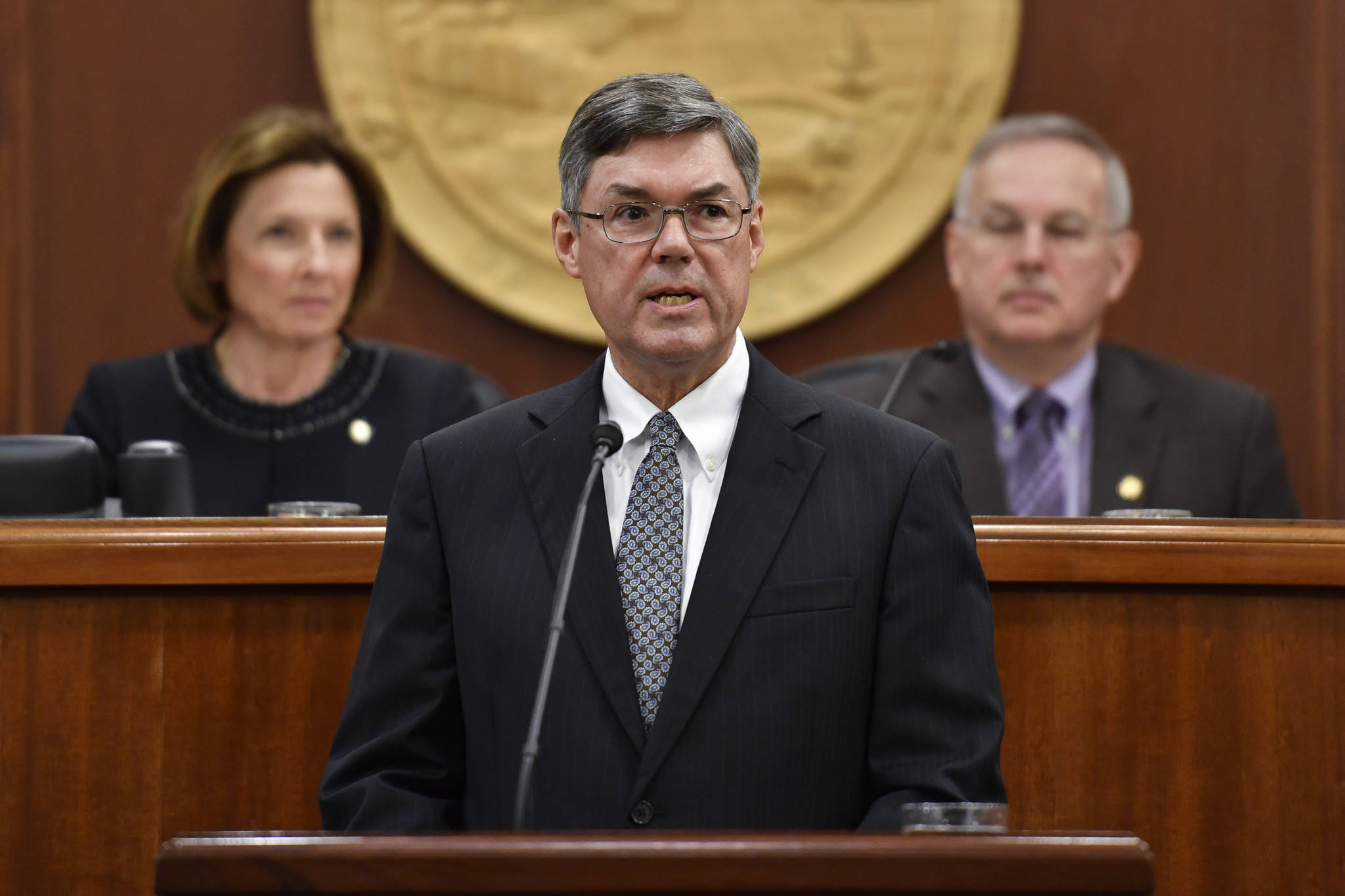
Gov. Mike Dunleavy planned to meet Tuesday with the chief justice of the Alaska Supreme Court in a dispute over judicial nominations.
Dunleavy last week filled one Palmer Superior Court seat but refused to fill a second. In a letter to members of the Alaska Judicial Council, which sent him three finalists for the two seats, Dunleavy said he would “not be selecting a second candidate from this truncated list.”
Chief Justice Joel Bolger has countered that founders of the state’s constitution intended for a governor to appoint for judgeships candidates nominated by the council and defended the council’s process for vetting and nominating candidates.
“We concur that we have to pick from the list. The question is, Is there a way to broaden that list, especially going into the future because there are a lot of qualified applicants for these positions?” Dunleavy told Alaska Public Media’s Talk of Alaska Tuesday. “We just want to have a discussion as to how narrow that list is going to be and how broad it can be.”
The call-in program, which also was carried live on a public affairs TV channel, comes as Dunleavy participates in meetings around the state pitching his approach to addressing a projected $1.6 billion deficit. Five of the meetings scheduled this week, including one in Anchorage on Tuesday evening, are being hosted by the conservative group Americans for Prosperity-Alaska, prompting questions about how open the forums would be. The events, when first advertised by the group, laid out terms by which participants were to abide.
Ryan McKee, state director of Americans for Prosperity-Alaska, has said the group is renting the space and has the right to remove anyone who is disruptive and ensure the venues aren’t over capacity. He said the events are open on a first-come, first-served basis.
Dunleavy said the administration is partnering with “any and all” organizations, some of which have rules, as it outlines its fiscal policy approach. He said he’s trying to save the state money and doesn’t see a problem with it.
Democratic Sen. Donny Olson offered to pay for the venue where Americans for Prosperity-Alaska plan to host an event in Nome provided the group was not involved. In a Facebook post, he said the rental space would cost $173.25. He accused Dunleavy of wanting “a crowd controlled by stipulations that allow for no public input.”
Other Senate Democrats who cited concerns with the Americans for Prosperity-Alaska-hosted events offered to pay for venues in several cities, including Juneau, which is not on Dunleavy’s posted schedule for policy events, to “promote stronger public involvement and the people’s faith in government transparency.” Dunleavy’s office hasn’t responded, said Noah Hanson, a spokesman for the caucus.
Dunleavy’s budget proposal includes deep cuts to areas like education, health and social service programs and the state ferry system; shifts in the collection of petroleum property and certain fisheries-related taxes that would benefit the state but hurt some communities; no new statewide taxes; and a full payout of the annual check residents receive from the state’s oil-wealth fund, the Alaska Permanent Fund, following three years of reduced checks.
He also is proposing constitutional amendments to limit spending and give voters a say on new or higher taxes passed by the Legislature and changes to the dividend program.
Hundreds of people have testified in opposition to certain cuts, like those proposed for the ferry system, with some expressing an openness to being taxed or accepting a lower dividend.
Dunleavy, a Republican, has often said the dividend isn’t the problem, and he said Tuesday the state can’t tax or spend its way out of the situation. He said there many details to work out with a tax, including rates, exemptions and how long it would be in effect.
“It’s easy to throw out, ‘Just tax us.’ But when you get down in the details it becomes a lot more complicated,” he said. “I don’t think taking more money out of the private sector until we have made the government more efficient and have decided what we want for outcomes … is the answer.”
Dunleavy said he would work with the House and Senate on a budget “that works for everybody.”
“But if question is, in the end, will I exercise my constitutional authority to get the budget in line with expenditures? The answer is yes,” he said.
• This is an Associated Press report by Becky Bohrer.
