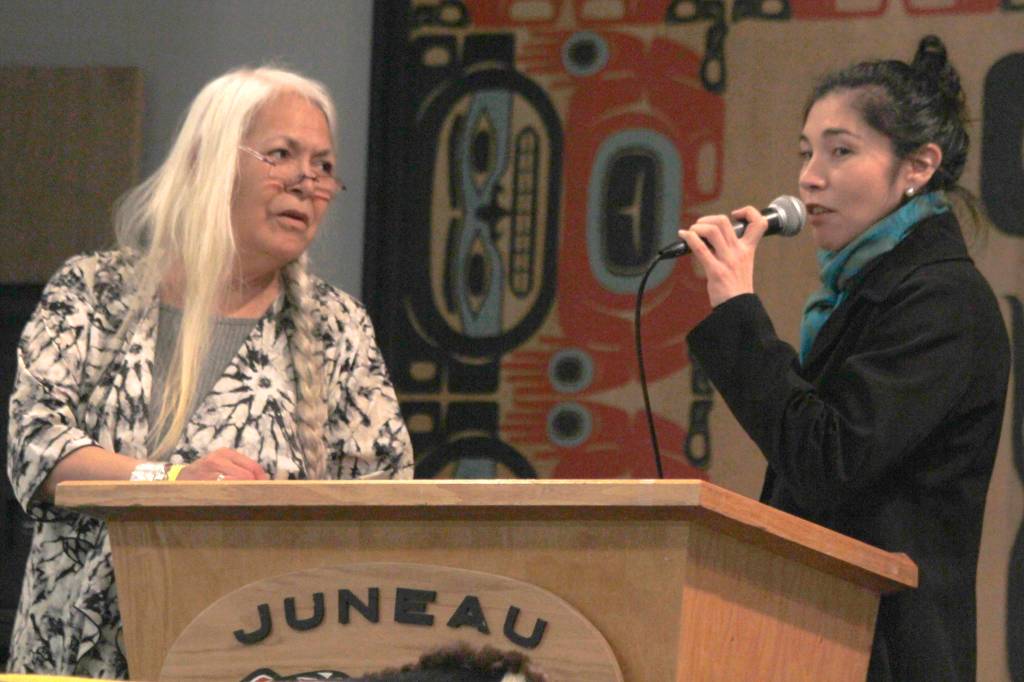
KathyHope Erickson, chair of the Sitka Tribe of Alaska Tribal Council, left, listens as Elizabeth Saagulik Hensley, attorney for Landye Bennett Blumstein LLP, gives an update on the litigation between the tribe and the State of Alaska. (Alex McCarthy | Juneau Empire)

KathyHope Erickson, chair of the Sitka Tribe of Alaska Tribal Council, left, listens as Elizabeth Saagulik Hensley, attorney for Landye Bennett Blumstein LLP, gives an update on the litigation between the tribe and the State of Alaska. (Alex McCarthy | Juneau Empire)

Sitka Tribe gears up for legal battle

Goal is to protect herring population in Sitka Sound

Correction: An earlier version of this article stated Sealaska Heritage Institute gave money to this effort. Sealaska Corporation gave money, not Sealaska Heritage Institute. The article has been changed to reflect that.

KathyHope Erickson believes what she’s doing now is the most important thing she’ll ever do with the Sitka Tribe of Alaska.

Erickson, the chair of the tribe’s tribal council, looked out over a room of about 60 people Friday and spoke about the importance of preserving the herring fishery around Sitka. In December, the tribe filed a civil case against the Alaska Department of Fish and Game, looking to get the department to take better care of the herring fishery in Sitka Sound.

The tribe has held meetings in Sitka and Juneau thanking people for their support and raising money for their legal costs. The Juneau meeting happened Friday afternoon, with Erickson leading the event.

“I firmly believe that it’s not just a battle for subsistence,” Erickson said in an interview Friday. “It’s a battle for the ecology of the Pacific Northwest.”

The herring population has declined in recent years, and the tribe has pushed for changes to the way the fishery is managed. In 2018, Fish and Game calculated the harvest for Sitka Sound to yield more than 11,000 tons of sac roe herring, but the actual harvest failed to even produce 3,000 tons, according to a fish and game report cited in court records.

Prior to that fishing season, in Jan. 2018, the tribe brought multiple proposals to the Board of Fisheries, including one (Proposal 99) to reduce the percentage of herring that commercial fishermen could harvest in Sitka Sound.

[Fish and Game appointee looks for more state, not federal, control over fisheries]

The tribe wrote in its proposals that overfishing in the commercial fishing industry was impeding the ability of subsistence fishermen who rely on herring roe, according to court records. The Board of Fisheries voted down Proposal 99 by a 5-2 vote, and multiple board members stated they believed the board’s regulations already provided “a reasonable opportunity for subsistence uses,” a phrase that is key to both the state’s and the tribe’s arguments.

Now, members of the tribe are looking to settle the issue in court. Seth Beausang, the lawyer representing the Department of Fish and Game, has told the Empire and has written in court documents that the tribe hasn’t been specific in its legal requests.

Elizabeth Saagulik Hensley, an attorney for Landye Bennett Blumstein LLP representing the tribe, said during Friday’s event that the tribe is hoping to get a court hearing, and has appealed to the Alaska Supreme Court to try and get a hearing. The Supreme Court has not issued a decision, Hensley said.

The tribe has allocated $40,000 for its legal costs, according to a GoFundMe page raising money for the legal effort. The GoFundMe, titled “Sitka Tribe of Alaska’s fight to save the herring,” sets a goal of $50,000 and had raised $3,720 as of Friday evening. Erickson said Sealaska Corporation and Central Council Tlingit and Haida Indian Tribes of Alaska have already pledged their help.

Mike Miller, a member of the Sitka Tribe of Alaska’s Tribal Council, agreed with Erickson that this situation goes beyond just herring eggs.

“We’re seeing some of these cultural ways of practicing being picked at, little bit by little bit by little bit, and it’s really quite concerning,” Miller said. “If we keep letting that go, it’s just going to be wrong, and it’ll be another thing that’s lost forever where people remember how it used to be.”


• Contact reporter Alex McCarthy at amccarthy@juneauempire.com. Follow him on Twitter at @akmccarthy.


More in News

Members of Juneau Education Association and supporters of the union dress in green at the Board of Education Meeting on Oct. 28, 2025. (Mari Kanagy/Juneau Empire)
Teacher’s union speaks on lapsed contract as board members shuffle

Juneau Educators Association’s contract expired at the end of July.

“Tide Pools” is part of the “Landscapes of Southeast Alaska” exhibit by Johanna Griggs, presented by Juneau Arts & Humanities Council. The exhibit will open at the Juneau Arts and Culture Center on Friday, Nov. 7 2025. (courtesy Juneau Arts and Humanities Council)
November’s First Friday: Here’s what to see

Juneau Arts & Humanities Council announces community events at attend Nov. 7.

One of the houses on Telephone Hill stands vacant on Wednesday, Nov. 5. A lawsuit filed against the city Friday seeks to reverse the eviction of residents and halt demolition of homes on the hill. (Mari Kanagy/Juneau Empire)
Telephone Hill residents file lawsuit against city to stop evictions and demolition

The city says legal action is “without factual or legal support.”

“Hair ice” grows from the forest floor in Fairbanks, Alaska. Photo courtesy of Ned Rozell
‘Hair ice’ enlivens an extended fall in Interior Alaska

Just when you thought you’d seen everything in the boreal forest, a… Continue reading

Goldbelt Inc. illustrates a potential cruise ship port and development along the coast of west Douglas Island. (Port of Tomorrow MG image)
Assembly approves one step in Douglas cruise port plan, but pauses next move

Goldbelt’s “new cultural cruise destination” in west Douglas is still years out.

Kelsey Ciugun Wallace, president of the Alaska Native Heritage Center, looks over a collection of frozen sockeye salmon on Oct. 30, 2025. The salmon was donated from the Copper River basin and is part of the collection of traditional Native foods donated for the Yukon-Kuskokwim residents displaced by Typhoon Halong. The salmon and other foods have been stored in a large freezer trailer at the heritage center, pending distribution to families and organizations.
Alaska typhoon victims’ losses of traditional foods go beyond dollar values

A statewide effort to replace lost subsistence harvests is part of the system of aid that organizations are trying to tailor to the needs of Indigenous rural Alaskans

Gov. Mike Dunleavy discusses his new proposed omnibus education legislation at a news conference on Jan. 31, 2025. (Photo by Corinne Smith/Alaska Beacon)
Alaska declares disaster over federal food aid failure, diverts $10 million for temporary help

Following a request by state legislators and similar action by other states,… Continue reading

Yuxgitisiy George Holly and Lorrie Gax.áan.sán Heagy (center left and right) stand alongside Lieutenant Governor Nancy Dahlstrom (left) and other honorees at the Governor’s Arts and Humanities Award ceremony in Anchorage on Oct. 28, 2025. Holly won the Margaret Nick Cooke Award for Alaska Native Arts and Languages, and Heagy won the award for Individual Artist. (photo courtesy of Yuxgitisiy George Holly)
Two Juneau educators win Governor’s arts awards

Holly and Heagy turn music and dance into Lingít language learning, earning statewide arts awards.

Most Read