
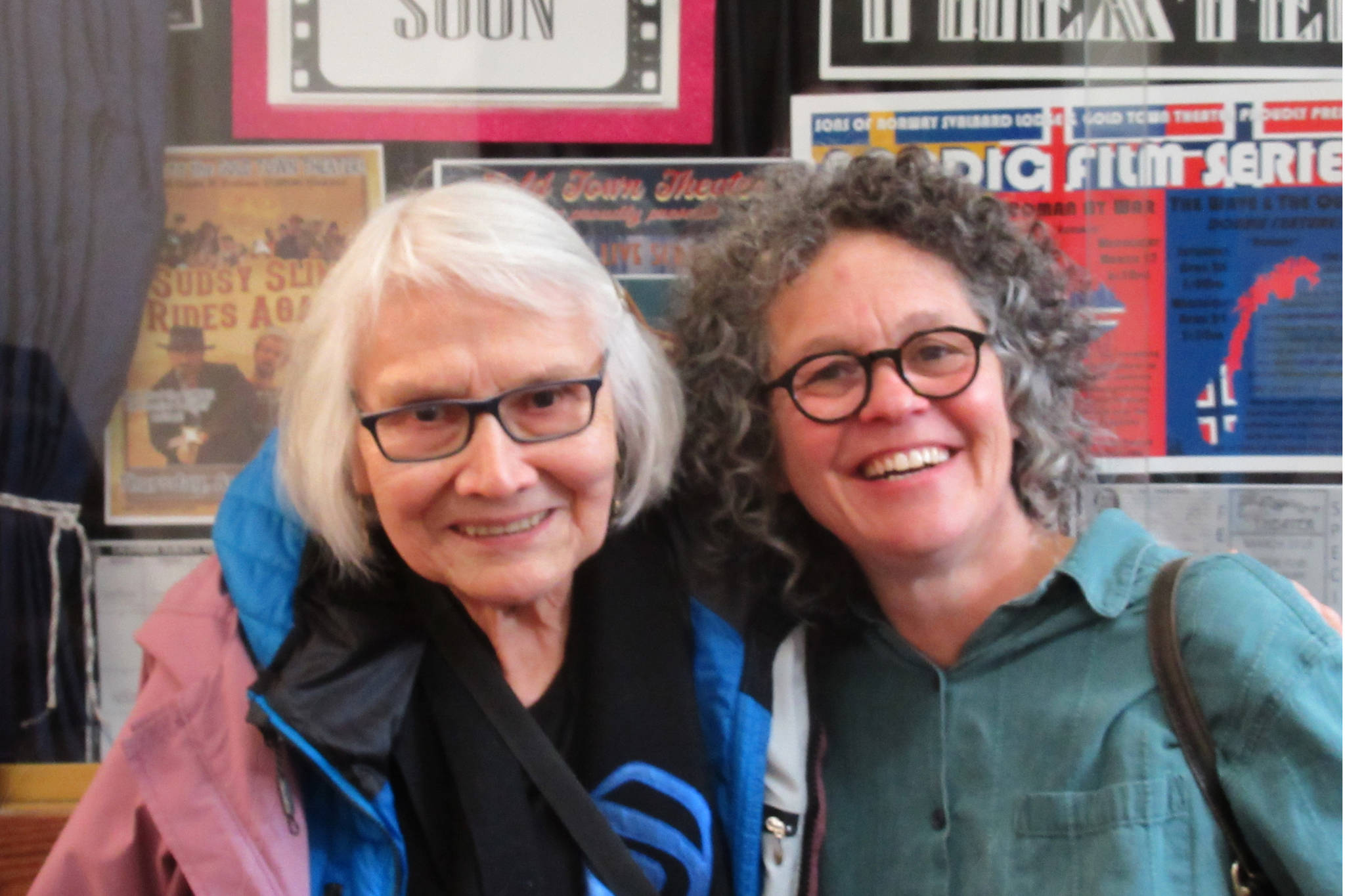
Weaver Delores Churchill and filmmaker Ellen Frankenstein smile outside the Gold Town Theater after a screening of “Tracing Roots,” Sunday, March 31, 2019. (Ben Hohenstatt | Capital City Weekly)

Weaver Delores Churchill and filmmaker Ellen Frankenstein smile outside the Gold Town Theater after a screening of “Tracing Roots,” Sunday, March 31, 2019. (Ben Hohenstatt | Capital City Weekly)

Dream Weaver: Haida elder talks learning and becoming a master weaver

She’s a dream weaver.

Luck played a role in Delores Churchill becoming both a renowned weaver and a generous repository of weaving knowledge.

After a Sunday screening of “Tracing Roots,” a film about the master Haida weaver and her quest to learn more about a centuries-old hat, Churchill spoke about the circumstances that led to her decades-long infatuation with weaving and effort to perpetuate the endangered Alaska Native art form.

“There are many things that happened in my life right at the right time to make sure weaving could continue be taught,” Churchill said during a 40-minute discussion after a movie screening Sunday at the Gold Town Theater.

While Churchill’s mother, Selina Peratrovich, was an acclaimed weaver and weaving teacher, Churchill didn’t grow up seeing basketry in her future.

“When I went to school in Canada, they told me because I was academically inclined … they told me, ‘You would never be an artist.’ They said, ‘people who are academically inclined will not be artists.’ So, I never really thought about art, and in fact, I’d walk by my mother when she was weaving.”

That indifference meant that when Churchill eventually showed up in a community college classroom for a weaving class taught by her mother, she was initially told by her mother to go home.

However, every student was needed for enrollment, which worked out in Churchill’s favor.

“The head of the art department, he said to her, ‘We need her registration,’ so I really got to stay,” Churchill said.

Later, a random encounter at a speaking event lead Churchill to a discovery that increased the number of people she could teach.

“There was a white woman there, and I was telling her when my mother died, I probably wouldn’t teach basketry anymore because it took so long to prepare the material. I said, ‘It takes us all summer to prepare the material for two classes in the winter because we have to split it by hand, and it just takes a lot of time.’”

The woman suggested using a leather stripper to help make preparing materials easier.

“It really did change the art of basketry,” Churchill said. “I don’t think people would have learned as fast as you could using that (leather) stripper, which strips the weavers and warp to the right size, so you can use it for weaving.”

Thanks to those events, Churchill is a veritable Rosetta Stone of indigenous weaving and knows the styles of Tsimshian, Tlingit and Haida weavers among others.

Those insights were at the center of the film made by Ellen Frankenstein showed at the Gold Town Theater. “Tracing Roots” tells the story of Churchill’s attempts to see the hat found with the body of Kwäday Dän Ts’ìnchi, also known as the Long Ago Man or Canadian Ice Man.

Churchill was interested in determining if the man’s heritage could be discerned from the characteristics of the hat.

Ultimately, she was able to see the hat and photograph it, but it could only be shown in the movie in the form of sketches.

Churchill found stylistic indications that left the cultural identity of the man, who died about 300 years ago, uncertain.

In a few centuries, Churchill said there probably won’t be similar questions on the lips of whoever might happen upon her work.

“I think everything I’ve done is so well documented, I don’t think anyone will have a problem,” Churchill said.
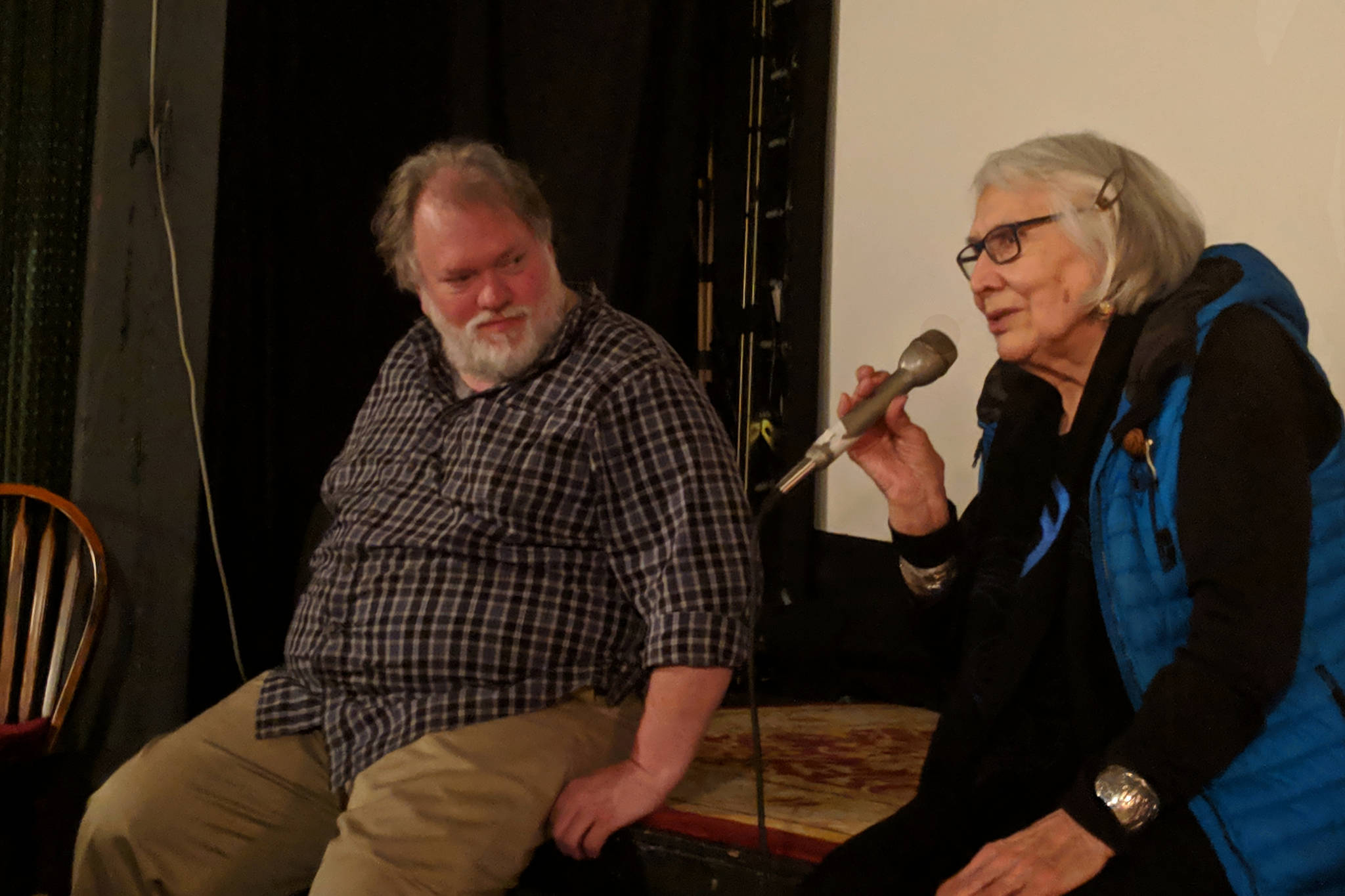
Curator of collections for Alaska State Museums Steve Henrikson and weaver Delores Churchill talk after a screening of “Tracing Roots,” Sunday, March 31, 2019. (Ben Hohenstatt | Capital City Weekly)

Curator of collections for Alaska State Museums Steve Henrikson and weaver Delores Churchill talk after a screening of “Tracing Roots,” Sunday, March 31, 2019. (Ben Hohenstatt | Capital City Weekly)

More in News

A residence stands on Tuesday, Dec. 23 after a fatal house fire burned on Saturday, Dec. 20. (Mari Kanagy / Juneau Empire)
2 house fires burn in 3 days at Switzer Village

Causes of the fires are still under investigation.

A house on Telephone Hill stands on Dec. 22, 2025. (Mari Kanagy / Juneau Empire)
Court sets eviction date for Telephone Hill residents as demolition plans move forward

A lawsuit against the city seeks to reverse evictions and halt demolition is still pending.

Juneauites warm their hands and toast marshmallows around the fire at the “Light the Night" event on winter solstice, on Dec. 21, 2025. (Mari Kanagy / Juneau Empire)
A mile of lights marked Juneau’s darkest day

Two ski teams hosted a luminous winter solstice celebration at Mendenhall Loop.

A Capital City Fire/Rescue truck drives in the Mendenhall Valley in 2023. (Clarise Larson / Juneau Empire file photo)
Juneau man found dead following residential fire

The cause of the fire is still under investigation.

CBJ sign reads “Woodstove burn ban in effect.” (City and Borough of Juneau photo)
Update: CBJ cancels air quality emergency in Mendenhall Valley Sunday morning

The poor air quality was caused by an air inversion, trapping pollutants at lower elevations.

A dusting of snow covers the Ptarmigan chairlift at Eaglecrest Ski Area in December 2024. (Eaglecrest Ski Area photo)
Update: Waterline break forces closure at Eaglecrest Friday, Saturday

The break is the latest hurdle in a challenging opening for Juneau’s city-run ski area this season.

Patrick Sullivan stands by an acid seep on July 15,2023. Sullivan is part of a team of scientists who tested water quality in Kobuk Valley National Park’s Salmon River and its tributaries, where permafrost thaw has caused acid rock drainage. The process is releasing metals that have turned the waters a rusty color. A chapter in the 2025 Arctic Report Card described “rusting rivers” phenomenon. (Photo by Roman Dial/Alaska Pacific University)
Ecosystem shifts, glacial flooding and ‘rusting rivers’ among Alaska impacts in Arctic report

NOAA’s 2025 report comes despite Trump administration cuts to climate science research and projects

The U.S. Capitol in Washington, D.C., on Oct. 1, 2025. (Photo by Jennifer Shutt/States Newsroom)
Moderate US House Republicans join Dems to force vote on extension of health care subsidies

WASHINGTON — Republican leaders in the U.S. House will face a floor… Continue reading

The National Weather Service Juneau issues a high wind warning forDowntown Juneau, Southern Douglas Island and Thane due to increased confidence for Taku Winds this afternoon. (National Weather Service screenshot)
Taku winds and dangerous chills forecast for Juneau

Gusts up to 60 mph and wind chills near minus 15 expected through the weekend.

Most Read