
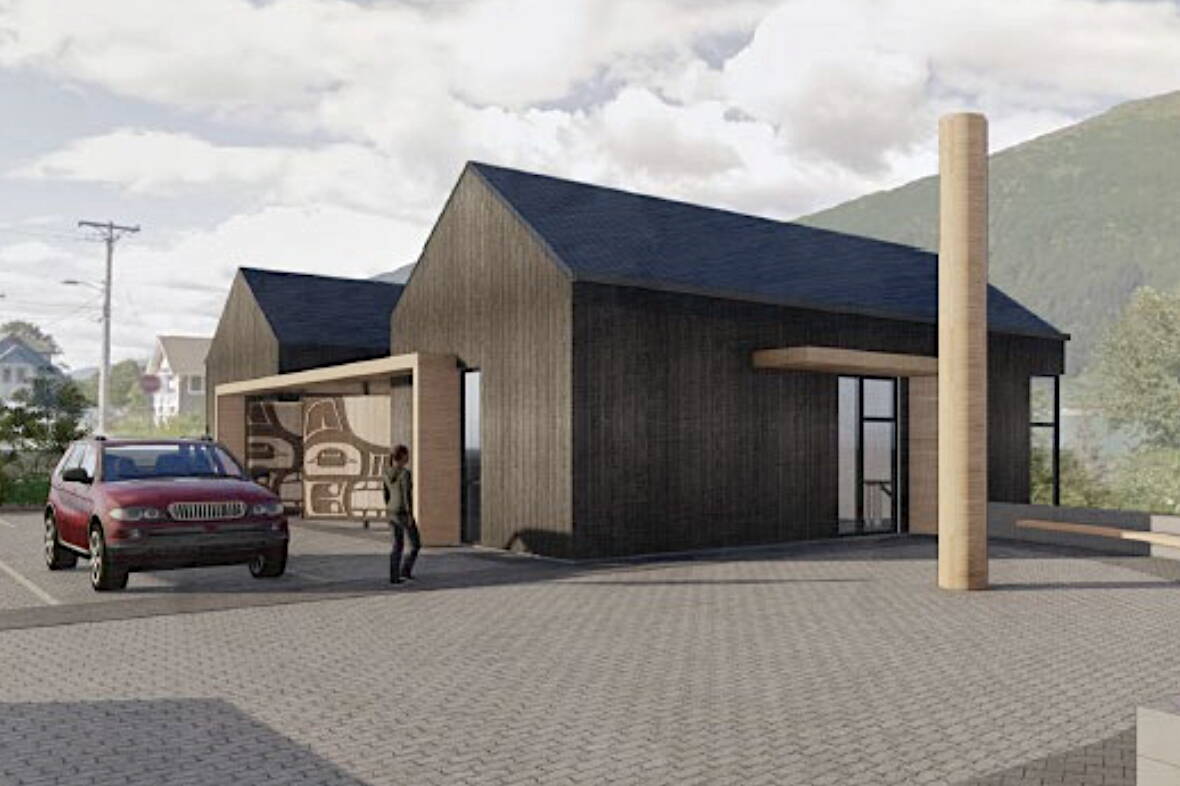
A conditional use permit for a cultural learning center operated by the Douglas Indian Association at the end of St. Ann’s Avenue near the Treadwell Mine Historic Trail was approved by the Juneau Planning Commission in a 5-3 vote on Tuesday, after weighing testimony from several residents in the neighborhood concerned about traffic, noise and other potential impacts.
The proposed project includes a 4,000-square-foot building for activities such as language and traditional food learning, with an outdoor covered area of up to 1,000 square feet, according to a report submitted to the commission. The center on a 13,500-square-foot lot overlooks traditional Tlingit lands where T’aaku Kwáan homes were burned in 1962.
“It’s a very small facility that we’re proposing, which is a learning facility with a focus on preservation of language, conservation of language through a computer archive, and an educational kitchen which is geared towards conservation and communication of traditional foods in our DIA tribal community — and of course sharing that with other community members who are participating in the education program there,” said Sean Boily, principal architect and partner at NorthWind Architects, in a presentation to the commission of the project his company designed.
The center will include a teaching kitchen, computer lab, and offices and studios for visiting educators and artists, according to the project description.
While little opposition was expressed to the concept of the center, several residents in the area testifying during the meeting, along with some members of the commission, expressed concerns about the impacts and level of activity that might occur at that location.
“We are concerned cultural learning center activities might detract from our ability to enjoy our home, yard and neighborhood,” said Richard Pratt, a nearby resident. “We are daily users of the Treadwell trail. We’re concerned center activities might negatively affect our enjoyment of these trails. Will center activities generate noise that’s audible at our house located approximately one block away? Will the center activities negatively affect our use of the trails? We believe the questions we have presented above need to be considered and addressed before the project is allowed to proceed.”
Concerns about lack of parking, access on the narrow street that can be hazardous during winter and disruptions during construction — which could take up to three years under a grant DIA received for the project — were also voiced by some residents.
“I have spoken with most of my neighbors, and I know this project would have overwhelming support from everyone if it were located closer to Savikko Park where safety, construction, parking and zoning are not issues,” said Erica Simpson, telling commission members she lives “about one parcel over” from the proposed center and has been in the area for about 40 years.
A couple of residents expressed support for the project, including Rachael Juzeler, who said she lives directly across from the proposed project.
“I think it is a fantastic opportunity for DIA, who owns the property,” she said. “I think the building that they’re doing is very small, low profile and very respectful of all the neighbors. And it’s also very aesthetically pleasing, which would actually very much improve what ends up happening at the end of the road in the summer where we have lots of people just hanging out in a dirty parking lot area.”
An impassioned pitch in favor of the project was made by Dionne Cadiente-Laiti, DIA’s grants management specialist and acting education director, who co-authored the grant request for the project. She said the goal of the project is to “have a sense of belonging within the community that we do not currently have.”
“When we wrote the grant with the vision for a learning center it was with the notion that the learning center would be a hub for education within the community as a whole, and thinking about the historical significance of the traditional village that was in this area and the subsequent burning of that village in 1962,” she said. “We had envisioned that the center would be a site that would actually share the history of this area which does not currently exist anywhere. And that it would also enable language, preservation and that sharing of knowledge.”
“We believe we would become a very nice part of this neighborhood, and round out the education that does need to be shared and the preservation of history.”
A report to the commission detailing the background of the location notes “T’aaku Kwáan families inhabited the tidewaters to the Northwest of the proposed project from the 1880s. By the 1940s, members of the Douglas Indian Village (the Village), a federally protected enclave, wintered in approximately 20 structures on pilings.”
“In 1946, the Alaska Native Service petitioned the City of Douglas and the Army Corps of Engineers (the Corps) for aid in the construction of a small boat harbor adjoining the Village” the report notes.” The Corps committed to dredge the harbor, backfill the tidelands where the Village was situated, and rebuild the Village. In 1962, the Village was destroyed via controlled burn, and a boat harbor was constructed. Tlingit tribal members became dispersed.”
AJT Mining Industries transferred the lot where the proposed center is located into private hands in the 1990s and the DIA purchased the property in 2021, the report notes. Other traditional lands cited are currently held by the City and Borough of Juneau, and the U.S. Department of Interior, with uses including a sports center and Coast Guard operations.
A significant permitting concern raised at Tuesday’s meeting, in addition to the center itself, is parking. Due to the building’s size a total of six spaces would likely be required by the city, but DIA submitted variance requests seeking either nine “off-street back-out parking spaces” or allowing only five spaces at the center itself due to space limitations.
Commission members rejected the nine-space proposal by a 4-4 vote, with dissenting members expressing safety and other concerns about such spaces. The five-space request was also unanimously rejected after Boily said it appears the on-site lot can be designed to accommodate six vehicles.
The debate by commission members about the permit for the center itself came down to the same issues heard during public testimony.
“I like the facility and everything about it,” said Erik Pedersen, the commission’s assistant clerk. “But I do think the public safety aspect of it is going to compel me to vote no.”
Commission member Adam Brown voiced agreement, adding “I just don’t think it’s the right property to put it on.”
Making a strong counterargument in favor was Mathew Bell.
“In listening to my fellow commissioners it’s difficult to sit here and listen to what all is being said when we see the value of this project,” he said. “The neighborhood? Yes, it’s a very congested difficult area, but this is the Douglas Indian Association’s land. This was where their village was burnt. A hard pill to swallow. I am in favor.”
Travis Arndt, presiding over the meeting due to the absence of commission Chair Michael LeVine, spoke last and cast what would turn out to be the decisive vote in favor of the center.
“It is not a huge building out of character with the neighborhood,” he said, adding he believes the activities there will be relatively quiet. “I think it’s going to fit in with the neighborhood.”
Boily told the commission preliminary construction at the site can begin “as soon as next week” once the conditional use permit is approved.
• Contact Mark Sabbatini at mark.sabbatini@juneauempire.com or (907) 957-2306.
