
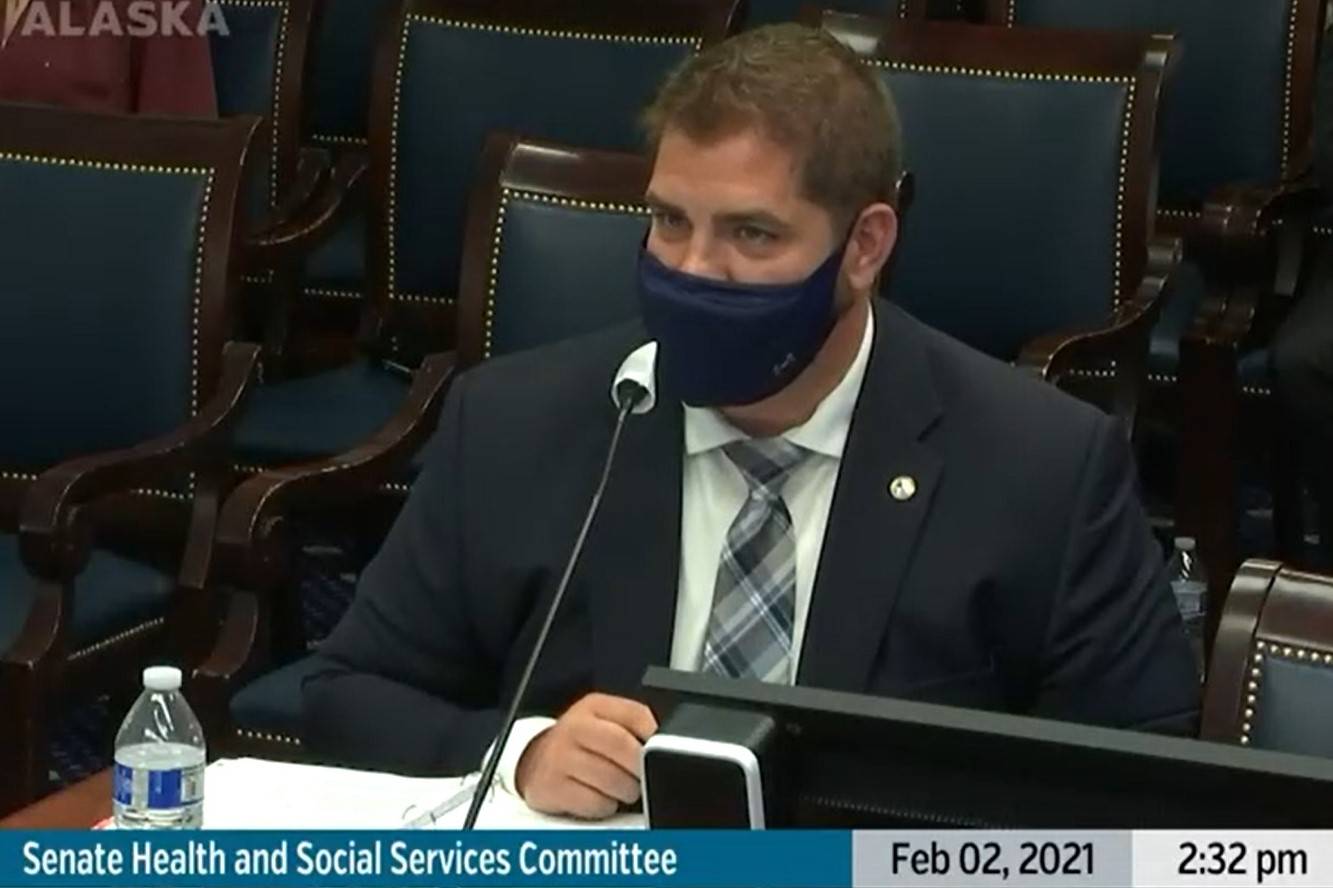
Department of Health and Social Services officials on Tuesday defended Gov. Mike Dunleavy’s use of emergency declarations during the coronavirus pandemic in a Senate committee hearing at the Capitol.
Members of the Senate Health and Social Services Committee put so many questions to DHSS Commissioner Adam Crum he was only able to get through a portion of his presentation, and he will come before the committee again on Thursday.
Crum was there to discuss the need for extending the disaster declaration in place since last year in order to continue effectively managing the pandemic. The initial emergency declaration was granted when the Legislature was still in session last year, but that ended Nov. 15, 2020. Dunleavy has since extended the declaration multiple times. However, now that the Legislature is back in session Crum said the governor wants to submit the declaration for lawmakers’ approval.
Some lawmakers criticized the governor for not calling a special session in order to have the Legislature pass a second, extended emergency declaration bill.
House remains deadlocked. Here’s what that means for future legislation
Crum told committee members the waivers allowed under an emergency declaration allow the administration to effectively combat the pandemic. Vaccine procurement and distribution as well as ongoing testing were two key areas made easier by waivers in the declaration, Crum said, pointing to Alaska’s status as first in the nation for vaccine distribution per capita, according to the Centers for Disease Control and Prevention.
“The typical government procurement process takes about three months,” Crum said at the hearing, but provisions in an emergency declaration allowed the state to bypass those rules and act faster.
But committee members, four Republicans and one Democrat, were concerned with how the Dunleavy administration has repeatedly extended the declaration without consulting the Legislature. Sens. Lora Reinbold, R-Eagle River, and Shelley Hughes, R-Palmer, questioned whether it was necessary to continue the declaration. Reinbold also questioned whether the initial disaster declaration was legal.
Reinbold repeatedly asked Crum to define the terms of a disaster and said the initial modeling on which the declaration had been based, specifically in regards to the state’s hospital capacity being exceeded.
Crum said that some initial modeling had been “fatally flawed,” but said the decision was made based on information and context available at the time. A New York Times article from March 2020 predicted between 160 and 214 million Americans infected with 200,000 to 1.7 million deaths. According to the Centers for Disease Control and Prevention there have been more than 26 million cases in the U.S. and more than 440,000 deaths.
Hughes questioned why the requests in the emergency declaration couldn’t simply be put into legislation, even for a limited time to ensure the changes weren’t permanent. That was possible, Crum said, but the declaration was the quickest way the administration had for obtaining those waivers.
Sen. Mia Costello, R-Anchorage, questioned why the governor could not simply continue to extend the declaration in 30-day increments and said she was not prepared to approve an extension until Sept. 30, as currently written in the bill. Costello said she was willing to work with DHSS and the administration to come to something “more palatable.”
[Emergency extended as governor asks for diligence]
The committee’s lone Democrat, Sen. Tom Begich of Anchorage said he supported the governor’s efforts to combat the pandemic but called the extension of the declaration unconstitutional, a statement he made for his entire caucus, he said.
Committee members, Reinbold in particular, asked so many questions of Crum committee chair Sen. David Wilson, R-Wasilla, at times had to limit the scope of the discussion to the current bill to extend the declaration, not any past declarations or decisions. Wilson reminded his colleagues several times the answers to their questions were contained in Crum’s presentation if he was given the time to speak.
“We’re still working through that, we still need to get through the presentation in order to do that,” Wilson said in response to a question directed at Crum.
Crum will return before the committee Thursday and on Wednesday the Senate Judiciary Committee, chaired by Reinbold, is scheduled to review the legality of the governor’s past administrative orders.
House still deadlocked
The Alaska House of Representatives remained deadlocked after a brief session Tuesday morning. Rep. Laddie Shaw, R-Anchorage, was nominated as speaker pro tem for a second day, but his confirmation vote again ended in a 20-20 split. House members remain evenly split between 20 Republicans and a coalition of 16 Democrats, three independents and one Republican.
• Contact reporter Peter Segall at psegall@juneauempire.com. Follow him on Twitter at @SegallJnuEmpire.
