
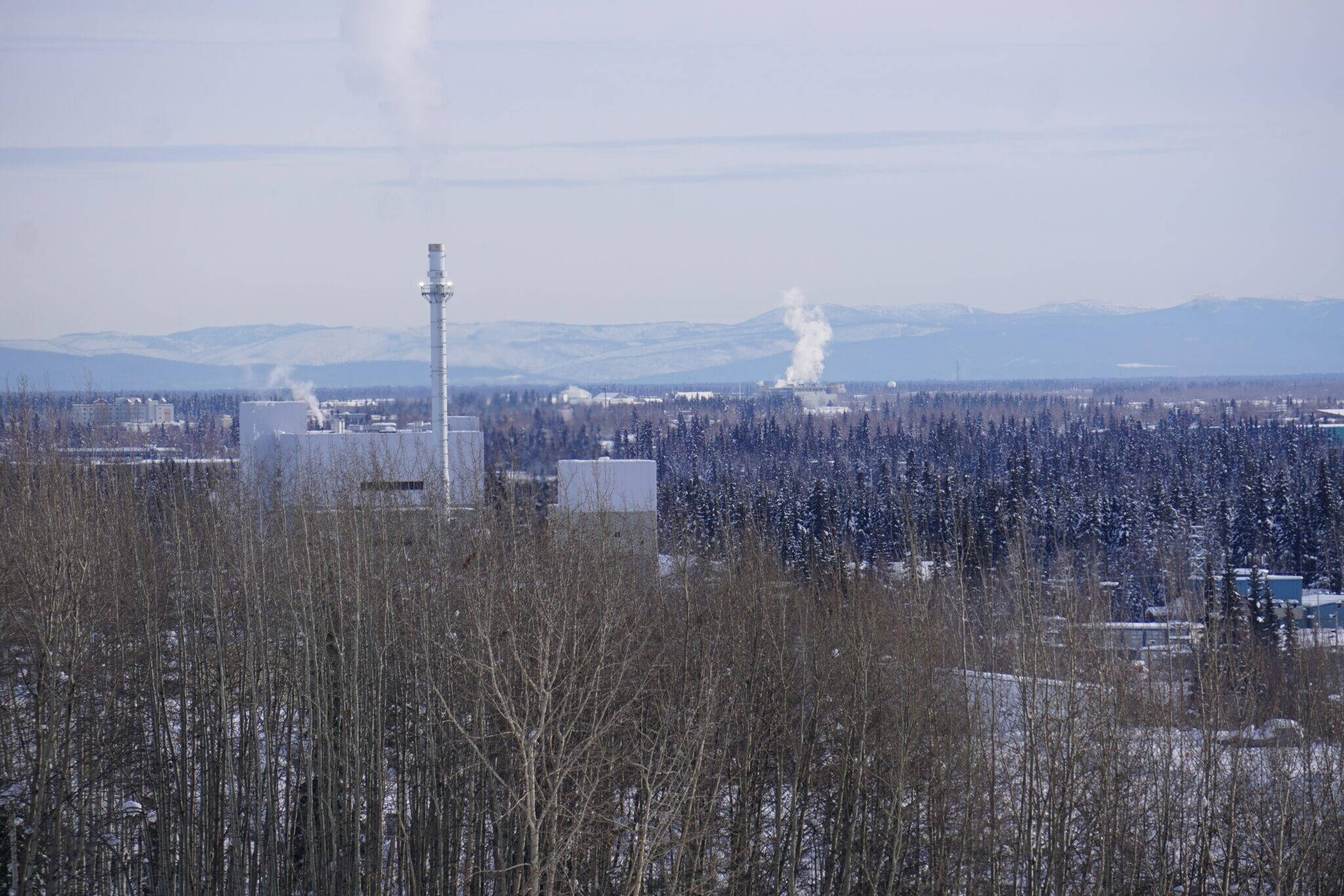
The Biden administration has announced a $9 million grant to Alaska researchers to study a project that could capture carbon emissions from a big new coal-fired power plant and inject them in a depleted natural gas field not far from Anchorage.
The University of Alaska Fairbanks would lead the research into what’s known as carbon capture and storage, or CCS.
That’s a still-emerging field that boosters say could help fight global warming while reorienting the petroleum industry to profit from less environmentally harmful projects — even as research shows that CCS is expensive and still hindered by technical challenges. Critics say it’s largely a distraction from the need to shift to proven renewable energy sources like wind and solar.
The new CCS grant is one of 16, and $444 million in total, announced by the U.S. Department of Energy last month. The department aims to expand carbon dioxide storage infrastructure “to significantly and responsibly reduce CO2 emissions from industrial operations and power plants,” it said in its announcement.
The Alaska grant would help examine the viability of a major carbon “storage complex” in Southcentral Alaska, likely at the mostly depleted Beluga River gas field west of Anchorage, according to the university’s application.
A 60-mile pipeline would carry carbon emissions to Beluga from a new 400-megawatt coal-fired power plant, which a Canadian company, Flatlands Energy, proposes to build in the Susitna River valley. As an alternative, researchers would also examine if the carbon could be injected into aquifers closer to the plant, which would save money on pipeline construction.
The overall project would be the first of its kind in Alaska, and it coincides with an increasing focus from state and federal policymakers on the development of the CCS industry.
The 2021 federal infrastructure legislation included $8.2 billion for the technology, largely to advance demonstration and large-scale pilot projects. A year later, lawmakers boosted a tax credit for carbon storage by 70%, and today, companies can collect an $85 credit for each ton that’s locked away.
Alaska Republican Gov. Mike Dunleavy, meanwhile, has advanced his own policies in an effort to generate profits for the state from the management of carbon emissions.
Earlier this year, Dunleavy signed legislation aimed at generating carbon credits by leaving harvestable timber standing on state land.
A separate, still-pending bill he sponsored — the Carbon Capture, Utilization and Storage Act — would add provisions for CO2 injection and storage to Alaska’s existing framework of oil and gas laws. Dunleavy’s administration envisions companies paying the state at least $2.50 for each ton of carbon injected into public land.
The new Biden administration grant would help the Alaska researchers develop a better understanding of what’s known as pore space — the empty areas between grains of sand or within a rock that could be filled with oil, gas, or injected CO2 — said Brent Sheets, head of the Fairbanks university’s Petroleum Development Laboratory and one of the study’s leaders.
“The state wants to start monetizing its pore value for CO2 — that’s what this is all about,” Sheets said in an interview. “If the state’s going to start monetizing it, they’re going to have to define it.”
For the project to move forward, the Alaska Legislature will have to approve a $2.2 million state budget request from the university and advanced by Dunleavy that would partially match the $8.8 million federal grant.
A group of nine legislators recently traveled to North Dakota for a tour of an active CCS project and briefings on the industry, which included a presentation by researchers working on the new Alaska study, according to Anchorage Democratic Sen. Bill Wielechowski, who attended.
Given his new understanding of CCS technology and the federal government’s support for it, Wielechowski said he’s open to the state budget request, though he probably wouldn’t have been before the trip.
“I don’t think the Biden administration would be providing a grant for dirty coal,” Wielechowski said in an interview. “Let’s have the hearings and let’s see if they genuinely can do this cleaner than some of the alternatives.”
One potential stumbling block for the Alaska project is its proximity to and potential synergies with a controversial proposed road project under development by Dunleavy’s administration, West Susitna Access.
Anders Gustafson, who leads an organization opposing the road called the Alaska Range Alliance, said his group would be closely watching the request for state money as the budget process plays out.
“We’re going to be all over it,” he said.
The study, Sheets said, focuses on a proposed coal plant because no existing source in urban Alaska currently emits enough carbon — and could earn enough tax credits by capturing it — to make a CCS project pay off.
Natural gas plants, which currently generate the vast majority of the region’s electricity, emit a much more diluted stream of carbon, Sheets said.
The university’s grant proposal says it will examine the storage of more than 50 million metric tons of carbon — most of it from the coal plant, with additional contributions from two natural gas plants in the Anchorage area.
At 400 megawatts, the proposed coal plant could generate electricity equivalent to roughly half of urban Alaska’s entire peak demand. But some 25% of that would go toward running the carbon capture infrastructure, Sheets said.
“It’s a pretty big tax on the plant to capture that and separate out that CO2,” he said. “But the technology is well-proven and well-understood.”
Earlier this year, there was just one commercial carbon capture facility operating at a power plant anywhere in North America.
CCS skeptics point to mechanical problems that have left the coal-fired facility, in the Canadian province of Saskatchewan, capturing substantially less emissions than its official target.
The cost of CCS has also proven to be a major obstacle. The only operating commercial-scale carbon capture project at a U.S. power plant, at a coal-fired facility in Texas, shut down for three years amid what its operator described as challenging economic conditions. It reopened in September.
“The extent to which carbon capture and storage will be used in the future is highly uncertain,” the nonpartisan Congressional Budget Office wrote in a report this month. “Its prospects depend on a variety of factors, including changes in the cost to capture CO2, the availability of pipeline networks and storage capacity for transporting and storing CO2, federal and state regulatory decisions, and the development of clean energy technologies that could affect the demand for CCS.”
• Nathaniel Herz welcomes tips at natherz@gmail.com or (907) 793-0312. This article was originally published in Northern Journal, a newsletter from Herz. Alaska Beacon, an affiliate of States Newsroom, is an independent, nonpartisan news organization focused on connecting Alaskans to their state government.
