
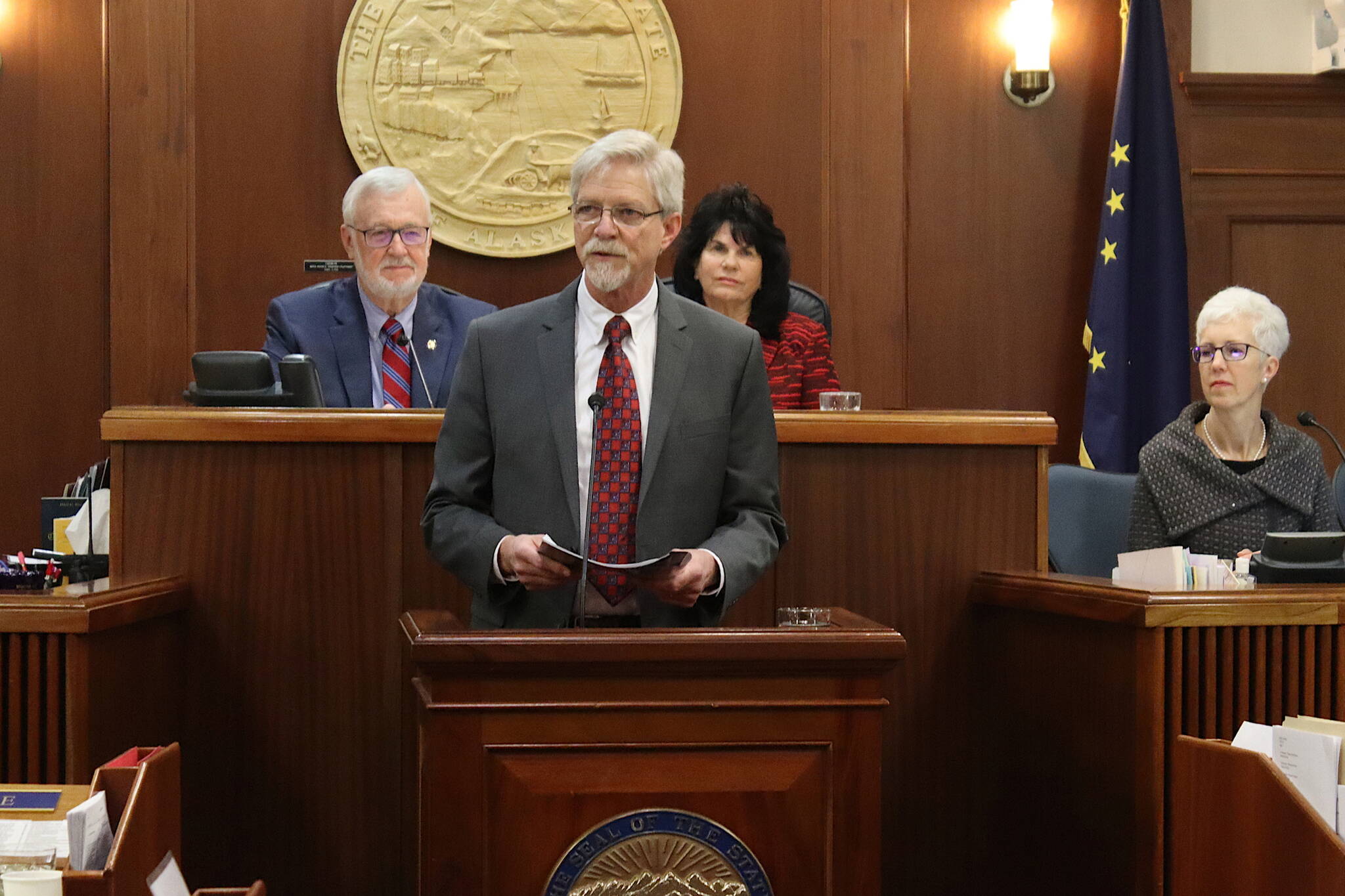
A look at the lasting changes to Alaska’s court system resulting from the COVID-19 pandemic, including more reliance on remote hearings and technology, plus efforts to cope with challenges such as a backlog in cases were the focus of the annual State of the Judiciary address delivered for the first time by Chief Justice Peter J. Maassen on Wednesday to a joint session of the Alaska Legislature.
Maassen, whose term as chief justice began exactly one year before his inaugural address, offered a low-key overview of the judiciary compared to the final speech last year by his predecessor Daniel Winfree, who delivered a bluntly worded warning about mixing of politics and courts by the legislative and executive branches.
Some state lawmakers and Gov. Mike Dunleavy in particular, are continuing to aggressively pursue legal action against other branches of government, especially at the federal level. But Maassen, in a brief interview following his speech, said he didn’t think the topic needed to be revisited during his speech.
“I thought the Legislature didn’t need a fiery address every year,” he said. “I felt the message was well-received last year.”
During the opening of his speech, Maassen noted the judiciary branch represents only 2% of the state’s budget, and high-profile cases involving other branches of state government such as challenges involving ballot access and privacy rights “are a very, very small part of what we see.”
Instead, the focus of much of his speech was what he deemed successes in judicial efficiency and accessibility resulting from changes implemented during COVID-19 restrictions that are still in place.
“I sincerely hope that this is the last State of the Judiciary address where the chief justice utters the word ‘pandemic,’” he said. But “the pandemic did result in changes in our procedures that are positive that were just normalized over the past year.”
Among those changes are remote proceedings that help remedy the large distances between many communities and shortage of legal staff such as public defenders who are associated with cases, Maassen said.
“During the pandemic most of our judges and in-court clerks became very adept at Zoom,” he said. “In November we as a Supreme Court implemented an order that attempts to both encourage more regular use of remote proceedings and identify which types of court proceedings should be presumptively remote as opposed to presumptively in person.”
Part of the effort includes working with the state Department of Corrections to ensure all jail facilities have video equipment suitable for remote proceedings, Maassen said.
Also, the system is improving efficiency with jurors because “our trial courts called fewer jurors at a time and ended up using them more efficiently,” he said. That reduced the risk of large groups of people clustered in jury assembly rooms, and less costs and waiting for jurors.
A key remaining challenge is the backlog of criminal cases, Maassen said. He said the backlog is due in part to a lack of attorneys, translators and other staff during the pandemic. Also, while jury trials are rare for cases, the possibility of them is a frequent motivator in resolving cases, and the lack of such incentive during pandemic restrictions “really slowed down” the process.
Among the remedies underway are “trailing calendars” where schedules allow other cases to be heard if one foremost on the docket is postponed or otherwise consumes little time, and “limiting the number of allowable continuances and ensuring that every pretrial hearing is actually meaningful,” he said.
Efforts to improve efficiencies that aren’t pandemic-related include increasing working with tribal courts on cases involving familiar matters and “restorative justice,” Maassen said.
“This is a rule that allows the judge in a criminal case to refer the matter to a restorative justice program in a criminal case as long as the victim, the defendant and the prosecutor agree,” he said. “Restorative justice may include circle sentencing or another culturally based practice that incorporates input not just from the victim, but from the community at large. And it may result in recommendations for what a sentence should be. It’s another way to help Alaskans see the court system as a part of the community reflecting its values and not apart from it.”
Maassen also referred to other system improvements including upgrades to handle digital evidence, such as items stored by witnesses on phones, without putting court computer systems at risk. He also said an update is being made to the code of judicial ethics, a topic that has gained national attention during the past year with the sense some justices and other court officials are exempt.
“In Alaska the judicial code of conduct does bond every court officer, top to bottom, and we take it very seriously,” he said.
• Contact Mark Sabbatini at mark.sabbatini@juneauempire.com or (907) 957-2306.
