
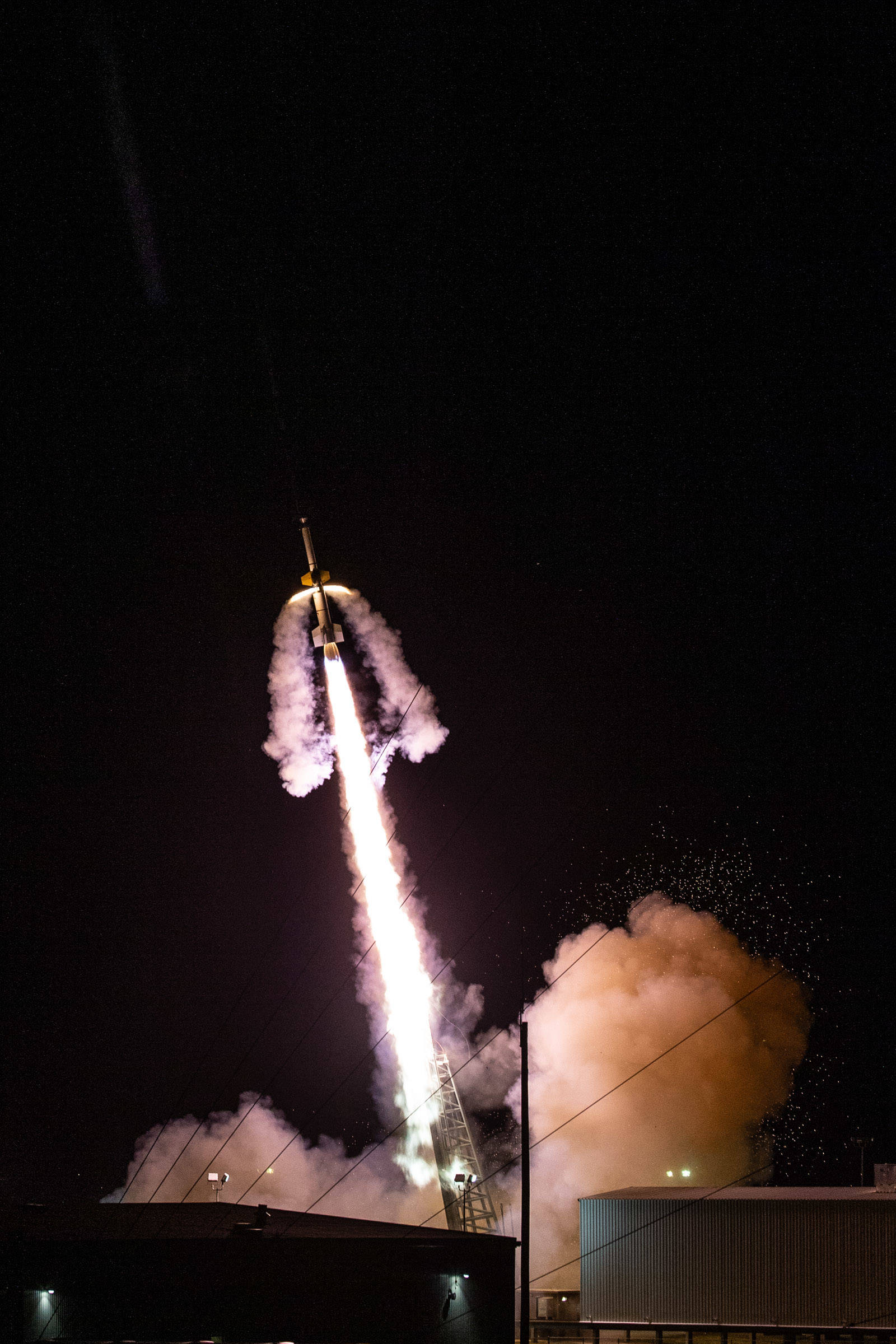
Virginia isn’t typically a place one thinks about studying the aurora.
But a University of Alaska Fairbanks Geophysical Institute team did just that, firing a rocket 400 kilometers (just shy of 250 miles) up from the NASA Wallops Flight Facility, located on the Eastern Shore, into the atmosphere to simulate an active plasma situation, related to aurora research.
“We needed a big rocket to do that,” said principal investigator Peter Delamere. “If we did this from Poker (Flat Research Range) we would have been way up over the Arctic Ocean. We didn’t want any space weather competing with the mission.”
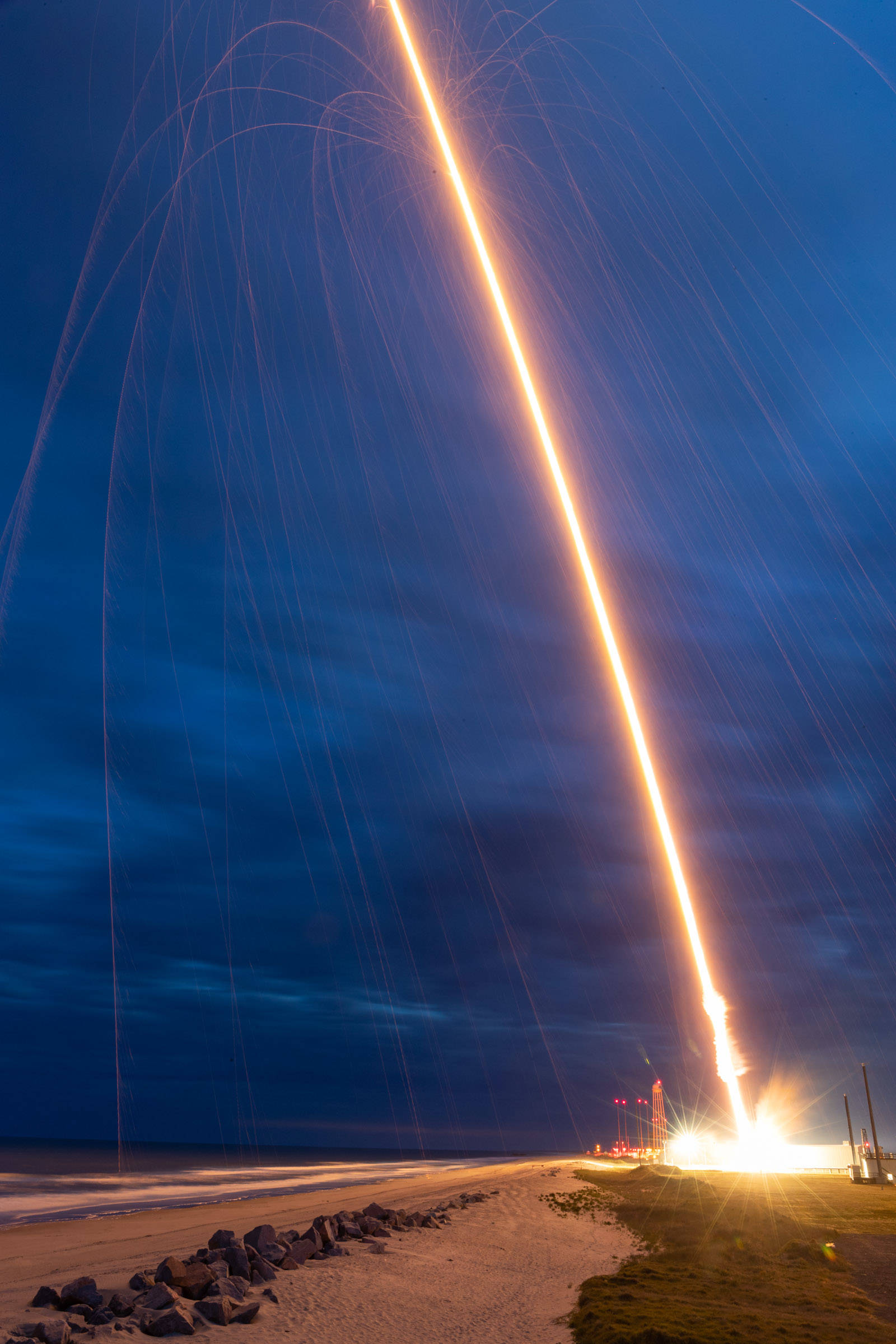
The NASA Black Brant XII rocket lifts off with the KiNET-X experiment at Wallops Flight Facility in Virginia on May 16, 2021. (Allison Stancil / NASA)
The rocket, a Black Brant 12 sounding rocket, carried a payload of barium thermite aloft, detonating them at 400 kilometers and 350 kilometers (roughly 217.5 miles), which generated their own electromagnetic fields and waves as they interacted with the plasma of the ionosphere.
“This mission generated the green and purple vapors at high altitude. It was visible from Bermuda and from the aircraft,” Delamere said. “We’ve been doing this since the ‘70s. There’s many other universities and programs that use that method.”
[6 arrested and indicted in drug ring bust]
The launch nearly didn’t happen in the 10-day window, Delamere said. Inclement weather, first on the East Coast and then over the observatory in Bermuda, nearly scrubbed the mission. High winds at the altitudes the observer aircraft was doing loops also interfered with the launch.
“It would get rescheduled,” Delamere said. “NASA’s not in the business of throwing payloads away.”
However, a reschedule could go next month or next year, Delamere said. NASA’s launch schedules and the availability of the observer aircraft are congested by pandemic conditions. It came down to the wire, only going on the last possible day before the cycle of the moon would have degraded the results.
“I said, ’Let’s not sacrifice science.’ There’s too much that went into this. Let’s come away with a comprehensive success,” Delamere said. “We put too much effort to waste a payload. We pulled it off in a pandemic situation.”

The NASA Black Brant XII rocket lifts off with the KiNET-X experiment at Wallops Flight Facility in Virginia on May 16, 2021. (Terry Zaperach / NASA)
A pocket in the clouds over Bermuda allowed the mission to go forward.
“It all came down to the last two nights. The window is what it is because we can’t have the moon up. We want dark black skies,” Delamere said. “We knew that this pocket was viable. We knew we could make observations with these conditions.”
The launch nearly didn’t happen, but the conditions aligned for long enough for the team to get their shot off, Delamere said.
“We were constantly bottom of the ninth with two outs,” Delamere said.
With stars aligning for just long enough, they were able to launch the sounding rocket and achieve total success, Delamere said. More than 100,000 viewers tuned in for the live feed of a launch, an unusually high number, and the rocket could be seen from as far as New Jersey, several states away.
“I was very, very happy with the outcome,” Delamere said. “We’re gonna take a look at the data, write some papers, and in all likelihood, ask more science questions.”
• Contact reporter Michael S. Lockett at 757-621-1197 or mlockett@juneauempire.com.
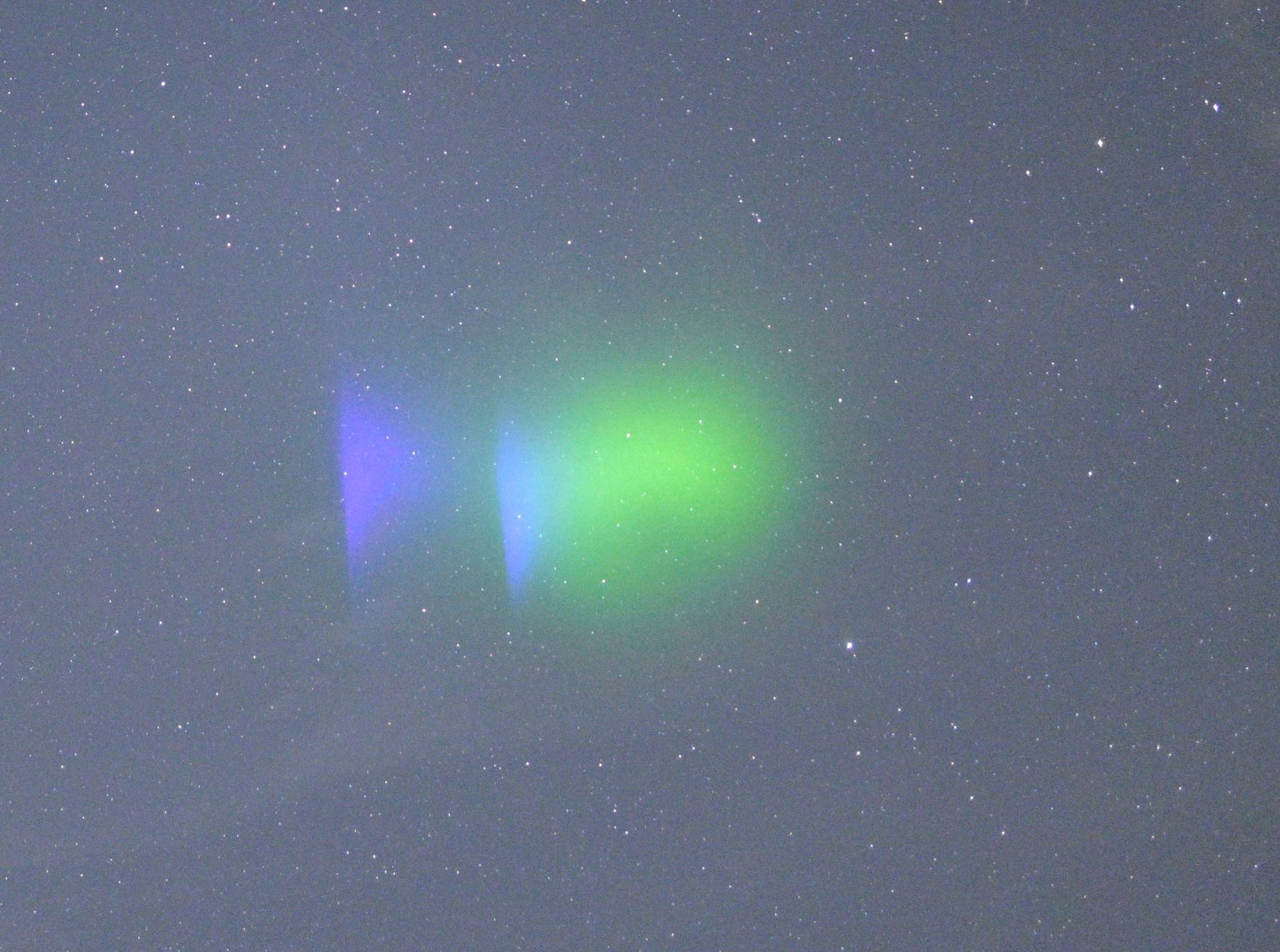
Glowing clouds created by the release of barium into the ionosphere. (Don Hampton / Geophysical Institute)
